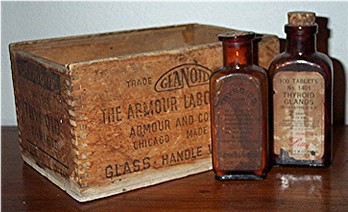
Natural desiccated thyroid, usually porcine, goes way back to the 1890’s. Except for some sad and frustrating glitches in the last decade, it always worked before, giving you all five thyroid hormones, not forcing you to live for conversion like T4-only does.
TIMELINE HISTORY of DESICCATED THYROID, also called NDT:
1891
Natural desiccated thyroid is a treatment that had its first medically documented use in 1891, and successfully. The details of this first and subsequent uses are mentioning in Chapter 2 of the updated revision Stop the Thyroid Madness book. It rose in popularity and was determined quickly to be a great treatment for hypothyroidism. “Armour” was one of several brands.
1906
The beginning of the FDA’s current regulations with the passage of the Pure Food and Drugs Act. This act was created to prevent the commerce of “adulterated and misbranded food and drugs”.
1938
The establishment of the Food, Drug and Cosmetic Act which gave the FDA authority to oversee the safety of all three of the latter. Many medications already in use, like Armour and Naturethroid, were “grandfathered in”…but as you look down, you’ll see that seems to have been forgotten or reversed by 2006.
Early 1960s
Comes the Drug Efficacy Study Implementation (DESI) by the FDA which was meant to classify drugs introduced between 1938 and 1962 as either effective, ineffective, or needing further study. That study was completed in 1969.
2006
A new Compliance Policy Guide (CPG, updated June 20th of 2006) which targets the remaining unapproved drugs like natural desiccated thyroid and which ultimately requires the pharmaceuticals which make these drugs to “prove” their effectiveness and safety (i.e. 110 years of millions of safe and effective use of desiccated thyroid by patients is not enough for the FDA, it appears). The proof will come in an NDA (New Drug Application) and rigorous clinical trials, which are quite expensive.
An important sentence in the CPG is found in Section II A: We want to achieve these goals without adversely affecting public health, imposing undue burdens on consumers, or unnecessarily disrupting the market. In other words, all thyroid patients who know the superiority of desiccated thyroid will be keeping the FDA to task for this. (As of 2013, NDT has never gone through any known clinical trials)
2009
Thyroid patients in horror saw the FDA act upon the compliance by informing two generic makers to cease production, since they started long after. Time Caps Labs was warned in April (scroll down about 3/4th to the heading Unapproved New Prescription Drugs). There is no FDA-listed warning for Major Pharmaceuticals, the other generic maker, but they ceased as well.
Also, Forest Labs reformulated the long popular and effective Armour desiccated thyroid by doing a flip-flop–raising the cellulose and lowering the sucrose. Patients were no longer able to do Armour sublingually–a huge disappointment–and they reported a return of hypothyroid symptoms and new strange ones. Many made a sad exodus from the use of Armour to other brands. We later figured out that we had to chew up the tablets to release the thyroid from the excess cellulose, but patients were not pleased. (In late 2008, one gal reported that her 3 or 4 grain Armour tablet was like taking nothing–was that the beginning of this ridiculous change?)
Also in 2009, a shortage of US-made desiccated powder occurred, first coming from the only North American manufacturer of the powder: American Labs. The stated cause was demand being greater than supply–an actual possibility since websites like STTM and patients groups were espousing how well it works to patients. The loss of the generics made this shortage from the manufacturer a critical situation for thyroid patients.
By Fall of 2009, The FDA approved that thyroid patients could send their prescriptions to Canadian Pharmacies for Erfa’s “Thyroid”. Compounding desiccated thyroid also found more business in the US.
2010
RLC Labs, the makers of Naturethroid, beginning to send out supplies of their product to pharmacies in January. The same started to be true with the newly formulated Armour by February (but most patients yawned about that, since the Armour now sucked for many.)
By February 2010, it became clear that Naturethroid had also been somehow changed, say patient reports, even if differently. RLC stated that they changed the cellulose from methyl to micro as an improvement, and they removed potassium from the tablet. Information is confusing as to what really changed, since RLC became more private in their communications with patients—an attorney mandate.
In 2010–chewing the tablets: chewing the Armour tablets before swallowing, and perhaps Naturethroid, was first announced by STTM as a way to break down the hard cellulose-compacted tablets and achieve better symptom relief.
In late 2010, Acella’s NDT appears. There are more questions than answers as to why this appeared. The FDA is more secretive than their so-called “open policy” reveals and greatly disappoints thyroid patients whose lives and health depend on desiccated thyroid. Patients like NP thyroid by Acella.
2012
Reports of Armour is back to being soft. STTM mentions this here. This is mainly with the smaller amounts. Many patients report they refuse to go back to Armour even still, not liking the pharmaceutical Abbott Labs for the way they treat patients.
And this year, we see Medicare moving Armour away from its pharmaceutical formulary of approved medications.
2013
A new Westhroid-P desiccated thyroid by RLC Labs called WP Thyroid, having less fillers. STTM first mentions this in the blog here.
Early 2014
Patients seeing their symptoms returning on Erfa in a bad way. Erfa’s NDT is being made in a new facility, making some of the tablets harder. See the following STTM blog post: https://stopthethyroidmadness.com/2014/05/08/dear-erfa-canada-stop-nonsense-change-desiccated-thyroid-back/ This continues into 2016, sadly, for some.
2015
Patients reporting their symptoms coming back on Armour, besides tripling in price. Patients are angry! This all occurred after Allergan, then bought out by Activas, then changing the name back to Allergan…buys out Forest. You can read about it here.
2017
Cigna removing Armour as a covered medication, January 1st. Other insurance companies may follow in all their ignorance.
Patients this year continued to see most other brands of NDT cheaper than Armour.
RLC Labs, the makers of Naturethroid and Westhroid, said they were “updating their machines”. And suddenly, both brands became VERY hard to find in pharmacies in the Fall of 2017, angering or frustrating hypothyroid patients who used their product. Here’s a blog post about this issue.
This is also the year that the UK National Health Service, which has already made it hard to get NDT, also has made it horribly hard for UK patients to even get synthetic T3! A hell of a year for patients whose lives have changed thanks to NDT or T3.
2018
Naturethroid by RLC came back into production. But sadly, a certain body of patients are reporting a return of their hypothyroid symptoms in various and bad ways as time went by. And STTM paid attention and thus began reporting what patients were reporting. Granted, there are a very small body who feel they continue to do well, but it’s also noted that their feel goods may be either the effect of excess adrenaline (which a body will release out of alarm), or rising cortisol, or they somehow managed to get a former stock and don’t realize it. We don’t know. But it’s the very large body who reported a return of hypo that has been extremely concerning. Most seem to move to NP Thyroid; some to Armour, etc. RLC doesn’t address this problem.
For what it’s worth, it does appear that the FDA “regulates” NDT, but it’s not FDA-approved. We saw that regulation when it inspected a Chinese facility that makes NDT powder. The FDA then declared that good practices are not going on in this facility. It’s the same facility that Westminster was using to make a newer version of NDT. So they had to stop making it.
2019
This was a nightmare of a year. Because the last remaining, “non-changed and consistently excellent” desiccated thyroid has been reported as changed in a negative way by a body of patients in various groups. It was NP Thyroid by Acella. Starting in the summer of 2019, the frequency of patients reporting a return of hypothyroid symptoms was growing. Also, they noted that the tablet was now thicker (probably a new tablet press machine doing that?) and smelled so bad now that some were saying they wanted to gag, or describing the smell as if it’s “cat pee”, or “cat litter” or “poison”. They also reported the taste was far, far worse. And finally, the return of symptoms with these different and changed tablets. See here: https://stopthethyroidmadness.com/2019/08/22/uh-oh-np-thyroid/
This is also the year that AbbVie/Abbott, the pharmaceutical which makes Synthroid, bought out Allergan. So the maker of Synthroid now owns Armour. {{shudder}} https://www.usatoday.com/story/money/2019/06/25/abbvie-allergan-acquisition-merger/1556361001/
2020
Oh boy. This is the year that THREE desiccated thyroid products were recalled.
First came the recall of NP Thyroid by Acella Pharmaceuticals in May, stated to be super potent. Then came the August recall of Naturethroid and WP Thyroid by RLC Labs, stated to be under potent. And reported experiences and observations by patients about problems they were now experiencing, before these recalls, fit.
2021
Unfortunately, after Acella claimed they had returned NP Thyroid back to what it used to be (while some patients still smelled the cat piss smell, which is definitely not what used to be there), another recall occurs in April of 2021 due to sub-potency.
There is also opposite experiences with Armour in 2021. Some are seeing changed labs after once being optimal. Others show continued optimal free T4 and free T3. Answers are being sought.
From Janie: this is not the way desiccated thyroid used to be at all. Brands would go years and years and decades without a problem. We are guessing it’s due to losing the US source of porcine powder a few years ago. That has causes pharmaceuticals to use porcine powder outside of the US.
*********************************
Read the Options for Thyroid Treatment to see all your possibilities.
Go here to read the FDA position on unapproved drugs, which seems a bit overkill when it comes to desiccated thyroid–a treatment used successfully for over 100 years.
Go here to read the FDA’s explanation of all the above dates.
Want more information about the history of natural desiccated thyroid? Chapter 2 in the updated revision STTM book (also called STTM I) has it!
Important notes: All the information on this website is copyrighted. STTM is an information-only site based on what many patients worldwide have reported in their treatment and wisdom over the years. This is not to be taken as personal medical advice, nor to replace a relationship with your doctor. By reading this information-only website, you take full responsibility for what you choose to do with the information on STTM or its outcomes. See the Disclaimer and Terms of Use.