As hypothyroid patients no matter the cause, it was discovered that lab results really are, in fact, important! They help explain what’s going on, because symptoms don’t always do the same. Check out this information below. ~Janie, hypothyroid, late onset Hashi’s patient and site creator
**********************************************
Lab work is important — because if you just go by “how you feel” you may end up with a problem. For example, we can “feel good” when our free T3 is midrange. But it backfires by stressing the adrenals–the individuality is when. You can also see a return of hypo symptoms. What we need to do is get an optimal free T3 to prevent that backfire, which is NOT midrange. Read this: “optimal“.
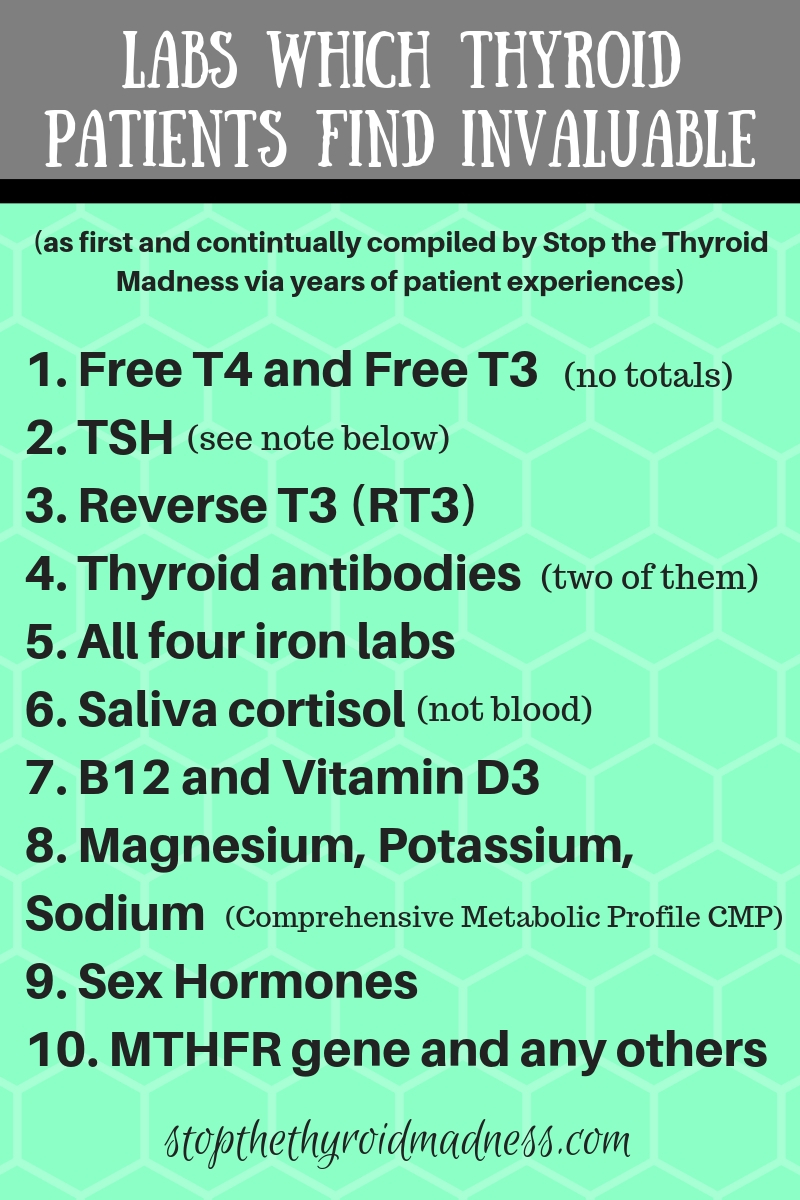
1) Free in front of T4 / T3 measure what’s available for use; totals do NOT 2) TSH along with low free T3 (not on meds) to discern hypopituitary 3) Reverse T3 (goes up due to low iron, high cortisol, inflammation) 4) Anti-TPO and TgAB, not just one 5) FOUR iron labs (Ferritin, % Saturation, serum iron & TIBC) 6) 24-hour Saliva cortisol (not blood) 7) B12 and Vit. D tend to fall with thyroid issues 8) CMP Minerals like Magnesium, Potassium, Sodium important–RBC versions give better info!! 9) Sex Hormones can go south in some with thyroid problems 10) MTHFR and other genes: Many use 23andme.com, then upload to livewello.com
PLACES TO ORDER YOUR OWN TESTS

Need to test your cortisol levels? It’s NOT about blood testing as doctors fail to understand. CLICK on the rectangle to the left or here. It’s one of the best saliva cortisol tests out there, with four results and a range per result. None of the silly “less than” goals. You can choose from one with DHEA, one without.
BELOW IS A GREAT LAB FACILITY WHERE YOU CAN ORDER YOUR OWN THYROID, IRON, B12 and MORE TESTS

A great variety of STTM RECOMMENDED tests! CLICK HERE. P.S. Use the above saliva test, though….Ulta has one with the ridiculous “Less than” goals, which you do NOT want. All the other tests you’ll see on the linked page are great. You can even go beyond that page to order any tests you do not see! NOTE: we want to add a UK facility, plus from other countries where you can order your OWN tests. Use the Contact form to let Janie know about one.
- Receive 10% off Stop the Thyroid Madness Preferred Lab Tests everyday with Promo Code: ULTA41012. https://www.ultalabtests.com/sttm/Shop/Promotion/6262
- 30 popular tests for only $12.95 each with Promotion Code: ULTA0615 https://www.ultalabtests.com/sttm/Shop/Promotion/6030 (NOTE: these 30 discounted tests include TOTAL T3 and TOTAL T4–you need the Free’s NOT the totals. Use STTM-recommended thyroid labs above instead with the red code.)
OTHER LABWORK TO CONSIDER
11. RBC zinc, copper and ceuroplasm: We have noticed a certain body of us with too high levels of copper, and the latter is toxic to your liver, brain, mito, etc. See this page and learn!)
12. Inflammation labs This is extremely important and probably should be listed above. For most, the ferritin will show inflammation first. But to be sure, there’s also CRP and ESR inflammation labs. See this page.
12. Lyme testing (recommended if you just never seem to get well–IgeneX or DNA Connexions does a good job.)
13. Epstein Barr Virus (EBV) (stress can raise this! Ask for the activated test, not whether you had past exposure)
14. Candida overgrowth (from antibiotic use, impaired immune system, etc)
15. Thyroglobulin (not the anti-thyroglobulin) is used by doctors if thyroid cancer is suspected.
Direct Labs below has testing for Neurotransmitters, as well as hair testing for metals.
WHEN TO TEST THYROID LABS:
We just take our thyroid meds as usual one day (and probably bring a night dose up to the afternoon), then do labs first thing the next morning before taking our meds for that day. i.e. we do not do labs after taking meds, as we’ll just be measuring the rise in our blood.
ABOUT LABS ACCORDING TO PATIENT OBSERVATIONS:

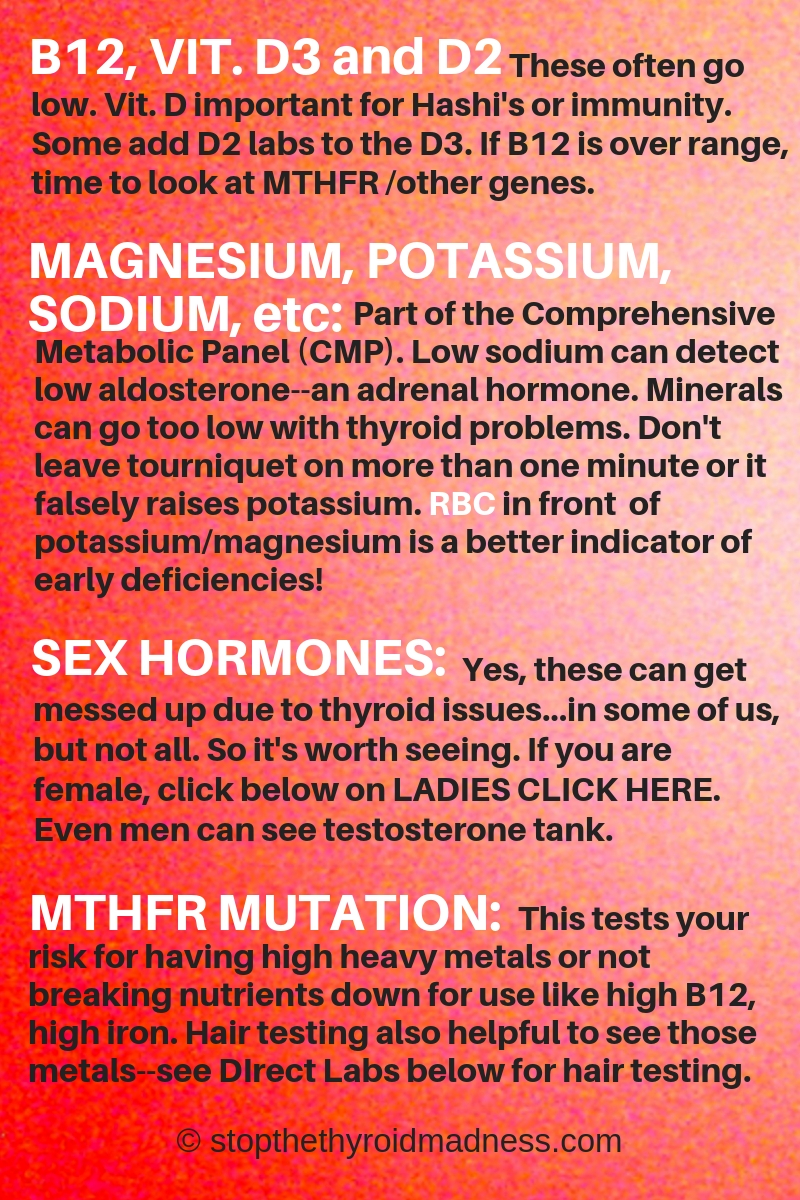
Summary: TSH (with a low free T3) is more about hypopituitary; “Free” in front of T3 and T4 is measuring what is available for use unlike the the “total”; both anti-TPO and anti-thyroglobulin are needed, not just one; all four iron labs are needed because ferritin can be low due to high heavy metals, not just low iron; blood cortisol might discern Addison’s or Cushings, not the cortisol problems we tend to get, thus saliva is needed; b12 can go low if undiagnosed or poorly treated hypo; Magnesium, other minerals, plus D3 and D2 can go low with hypo; Remember to have them remove tourniquet when doing a blood draw for potassium; sex hormones like estrogen & progesterone tested seven days after ovulation i.e. days 10 – 20 / FSH & LH tested days 2-4 of cycle with day 3 being ideal / Testosterone, DHEA any time; MTHFR mutation plus hair testing for high heavy metals. See Direct Labs link below for hair testing.
LADIES! CLICK HERE to read about sex hormones!
INTERPRETATION OF LAB RESULTS:
*Click HERE to see OPTIMAL LAB VALUES…i.e. what your lab results mean and where you want to be. Also see ADDENDUM C in the updated revision STTM book. Your doctor may use other lab facilities.
OTHER INFORMATION:
- The ZRT saliva test has proven repeatedly to be top notch. And they still have ranges, instead of those silly “less than or equal to” goals.
- Self testing is often not allowed in these US states NY, NJ, RI, MA or MD, though Ulta has worked it out with Massachusetts, and ZRT only mentions they can’t send to New York and Maryland, and California can only be sent with a doctor’s approval.
- INFO ON OTHER SALIVA TESTS FROM PATIENTS, BUT YOU CAN DECIDE as there have been issues with these over the years: 1) Cell Science–-some patients have reported results that didn’t fit their symptoms, but other patients were ok with it . 2) Quest–-you will have at least one “less than” goal instead of a range; 3) Dutch testing— we don’t know exactly why, but some report it gives results that don’t fit their symptoms or what saliva shows 4) Genova— again, some “less than” goals instead of ranges. 5) LabCorp--two of their ranges have the less than symbol before them as the goal instead of a range.
- IMPORTANT: use of any of these facilities it between you and the facility. If there are any problems, please reach out to the facility and repeatedly if necessary. Stop the Thyroid Madness LLC cannot do that for you, nor be responsible for any facility, and you agree to that.
**Have any suspicion of having thyroid cancer? The thyroglobulin test is a tumor marker (not the antibodies test–just the thyroglobulin.) But take heart…there can be other reasons, including continued hypo, which can raise thyroglobulin, too.
***********************************************************************
INTERNATIONAL
AUSTRALIA: http://nutripath.com.au–they will send you the tests and patients find this facility the most reliable!
CANADA: 1) ZRT will ship to Canada!! https://saliva-cortisol.squarespace.com/ ZRT is tops for accuracy of the results in fitting symptoms. 2) We used to recommend getting the saliva kit at pharmacies from Rocky Mountain Labs. Update: Canada’s Rocky Mountain Labs (a division of Lifelabs, basically the only private lab company in BC, Canada) no longer offers the saliva cortisol test. I just called them. It was from a company called Genova, which they no longer work with. 3) TrueHealthLabs.com can ship saliva cortisol test kits to Canadians
FINLAND: 1) http://www.mdd.fi/ Test kits from Genova diagnostics via MDD Terveyspalvelut, which are problematic 2) TrueHealthLabs.com: Europe Category
GERMANY: 1) www.medivere.de Saliva testing and helpful facility 2) http://www.medivere.de/shop/
NETHERLANDS: 1) http://www.prohealth.nl/ (need to state if you want a midnight sample otherwise they do 3 morning samples plus noon and 6pm samples) 2) http://www.yours-healthcare.nl 3) TrueHealthLabs.com: Europe Category
SWEDEN: 1) http://hormonharmoni.se/bestall-hormontest/kortisol-test/2) TrueHealthLabs.com: Europe Category
SWITZERLAND: 1) http://www.orthoanalytic.ch/be
UNITED KINGDOM: These three have either a Genova Saliva test (no range for bedtime, which is sad) or one that gives odd results–regeneuslabs, which is often not recommended. https://purehealthshop.ecwid.com; http://www.smartnutrition.co.uk/; http://www.regeneruslabs.com/shop TrueHealthLabs.com: Europe Category
Important notes: All the information on this website is copyrighted. STTM is an information-only site based on what many patients worldwide have reported in their treatment and wisdom over the years. This is not to be taken as personal medical advice, nor to replace a relationship with your doctor. By reading this information-only website, you take full responsibility for what you choose to do with the information on STTM or its outcomes. See the Disclaimer and Terms of Use.