Find out more here!
Hide me

* You are viewing Posts Tagged ‘t3’

Reverse T3–do you have this problem in excess? Let’s talk!

RT3 CloggedYes, we’ve all heard about T4 (the thyroid storage hormone) and T3 (the active thyroid hormone which rids us of hypothyroid symptoms). We’ve learned that the body not only converts T4 to T3, it also provides some of  T3 directly. The latter fact is why patients have found natural desiccated thyroid like Naturethroid, Erfa’s Thyroid, etc. to be a far better treatment for hypothyroidism, besides the T2, T1 and calcitonin you’ll also find in desiccated thyroid–just like your own thyroid would be making.

But in every individual, a thyroid also converts T4 to the inactive RT3 (reverse T3) as a way to clear out excess T4 that the body doesn’t need.  It’s natural and necessary. It will especially happen if you go through surgery or a diet.

Unfortunately, many thyroid patients make far too much RT3, and patients have been making cutting edge discoveries about this fact and how to treat it with their doctors.  High levels of RT3 can be found if you have high cortisol, low cortisol, low ferritin, low B12 and other undiscovered and untreated underlying issues that can go hand-in-hand with being hypothyroid.

Why is a high level of RT3 is problem? That excess RT3 is making itself lazily comfortable on your cell receptors, preventing T3 from gaining access to your body.  It becomes like a clogged up drain to your body. So you stay hypo and symptomatic, in spite of seemingly normal labwork.

This coming THURSDAY, NOVEMBER 19th (tomorrow as I write this) on the TALKSHOE THYROID PATIENT COMMUNITY CALL, we’re going to talk about the Reverse T3 problem with thyroid patient advocate Valerie Taylor. She not only owns the NTH Adrenals group (and is considered the most knowledgeable patient on adrenal fatigue in the world), she also created the RT3/T3  group on Yahoo, which you will find on the Talk To Others page.

We’ll talk about excess RT3, symptoms that can go along with it, how to do labwork to determine if you have this problem, how to treat it with T3-only, and more. There’s a Chat Box you can participate in while the show is going on. Audio will come directly out of your computer, and you can call in and ask Valerie or Janie a question. Times are 6 pm Pacific, 7 pm Mountain, 8 pm Central and 9 pm Eastern.

Want to read more? Thyroid patient Nick Foot, who also moderates the RT3/T3 group, has created an excellent Question and Answer RT3 website. This will make you even more informed before this Talkshoe event. Note that the website is still work-in-progress, so expect to see more as he works on it.

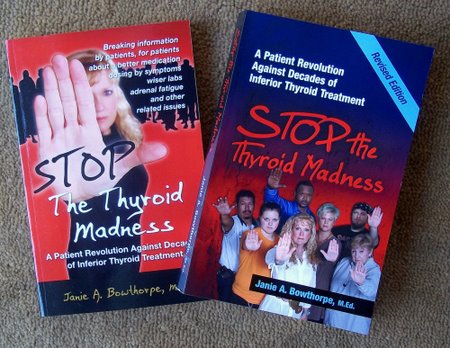
For those with the Stop the Thyroid Madness book, there is also more good detail in Chapter 12 called T3 is the Star of the Show, page 155. This is all good information to take into your doctor’s office.

Update: cellulose in our desiccated thyroid meds may be much more of a problem than we ever imagined. See my blog post below.

*HO HO HO! Have a STTM book sent to someone  you care about as a CHRISTMAS or HOLIDAY present. All the work is done for you!


  • Hip hip!! STTM has new products to help spread the word, here. Great BUMPER STICKERS, too, here. Spread the word--YOU may make a difference in someone’s life.
  • Check out the NEW REVISED patient-to-patient book with even more detail (and which doctors seem to respect more than websites).
  • Need to understand all your best options for thy­roid treat­ment? Go here.
  • Want to keep track of these "fringe website" blog posts? ;-) Curious what’s on Janie’s mind? Use the Blog Notification on the lower left of the links. or use an RSS Feed.

Is Cellulose the real problem in desiccated thyroid meds for many?

celluloseWhen Forest Labs reformulated Armour earlier this year, they stated they increased the filler Microcrystalline Cellulose, and decreased the Sucrose (sugar). The tablets became impossible to do sublingually, and you have to wonder why they would change a quality that patients praised so heavily.  Positive opinion among patients for Forest Labs slipped several notches.

But the real cuckoo’s nest for many thyroid patients, who knew firsthand the life-changing benefits of natural desiccated thyroid, was a maddening return of serious hypo symptoms on the new Armour and subsequent new stress on their adrenals, sooner…or later! You can read several horror stories in the comments of the post below, or go here.

So patients turned to other alternatives: Naturethroid and Westhroid by RLC Labs…then when the desiccated thyroid shortages hit in the Fall of 2009, Erfa’s Thyroid, Compounded desiccated thyroid, and others. And there have been problems for some patients on most everything they switched to.  The LEAST problematic has been Erfa’s Thyroid, and the most problematic was Compounded.

So what has been the common thread in the most problematic desiccated thyroid products? CELLULOSE, a plant fiber, and more commonly known by the trade name Avicel. And what does fiber do in your stomach? Inhibits absorption. Armour’s cellulose was raised, and bamm…problems.  Compounded desiccated thyroid, with cellulose as a filler, has been problematic for many patients with a return of hypo symptoms,  especially if  it was Methyl Cellulose, a larger particle size product. But some have even had problems with compounded containing Microcrystalline Cellulose, the smaller cellular product. And a certain body of patients even had problems with Naturethroid before it became scarce. And Naturethroid uses cellulose as a filler.

Is this problem true with T3-only products? Yup. Patients have noted that generic T3 is far less effective than the brand name Cytomel (both Liothyronine Sodium)  And what filler it up to 70% in the generic T3?  CELLULOSE.  See the percentages here for Paddock’s generic T3.

Why have less problems been reported with Erfa’s Thyroid? Perhaps because it has no cellulose as a filler! See this list of ingredients, which STTM has been working on lovingly for a few years.

What does literature say about the use of Cellulose as a filler in medications? Plenty. Cellulose is from wood. Wood is fiber. And fiber in your gut affects absorption. From http://www.umm.edu/altmed/articles/fiber-000303.htm we get this:

* Dietary fiber has been reported to lower the blood levels and effectiveness of tricyclic antidepressant medications…Reduced dietary fiber intake increased the blood levels and improved symptoms in these patients.

* While fiber supplements may help to regulate blood sugar levels, they may also interfere with the absorption of anti-diabetic medications….Therefore, fiber supplements should not be taken at the same time as these medications.

* Taking soluble fiber such as psyllium with carbamazepine (Tegretol), a medication used to treat seizure disorders, may decrease the absorption and effectiveness of carbamazepine.

* Fiber in the form of pectin (from fruit) and oat bran reportedly reduces the body’s ability to absorb cholesterol-lowering medications known as “statins,”… and could lead to decreased effectiveness of these medications.

* Fiber supplements may reduce the body’s ability to absorb digoxin (Lanoxin), a medication used to regulate heart function.

* Clinical reports suggest that psyllium or other soluble fibers may lower lithium levels in the blood, reducing the effectiveness of this medication.

* In one clinical study, the fiber supplement guar gum reduced blood levels of penicillin.

Cellulose can clearly be a problem, especially when it’s ratio is too high as compared to the desiccated thyroid. So what can you do?

If you are using a compounded medication, strongly request powdered acidophiles, also spelled acidophilus, as your filler.  One gal states her compounding pharmacy uses powdered Ginger (but beware of too much Ginger if you have Mitral Valve Prolapse. It can cause palps if you take too much–my experience).  See what other fillers your compounder can offer.

Another possibility is Cellulase, an enzyme which helps the splitting and breakdown of cellulose, and which was proposed to me by Naturopathic student Stephanie Buist. Google “cellulase” and find supplements that contain it.  If it looks promising to you, I’ll be curious to read your experience with swallowing a cellulase supplement, then swallowing your problematic desiccated thyroid.

And leaning towards Erfa’s Thyroid can be a plus.

Have other ideas or comments about Cellulose in our desiccated thyroid? Use the COMMENT function below and let’s talk!


  • Hip hip!! STTM has new products to help spread the word, here. Great BUMPER STICKERS, too, here. Spread the word--YOU may make a difference in someone’s life.
  • Check out the NEW REVISED patient-to-patient book with even more detail (and which doctors seem to respect more than websites).
  • Need to understand all your best options for thy­roid treat­ment? Go here.
  • Want to keep track of these "fringe website" blog posts? ;-) Curious what’s on Janie’s mind? Use the Blog Notification on the lower left of the links. or use an RSS Feed.

FDA’s Safe Use Initiative–think they will listen to our cries about T4-only meds?

EarplugsAs a thyroid patient who was profoundly harmed by the use of Synthroid and Levoxyl in the treatment of my hypothyroidism, and as an activist who sees this same harmful truth with potentially millions of other patients, I find this recent news interesting.

But you gotta wonder if they will be wearing noise reduction headsets and ear plugs…or not…when it comes to the scandal of synthetic T4-only medications.  Will they?

Just today, the U.S. Department of Health and Human Services and the Food and Drug Administration (FDA) announced the Safe Use Initiative, “a program aimed at reducing the likelihood of preventable harm from medication use”.

Statements I gleaned from this initiative include:

1. Today, tens of millions of people in the United States depend on prescription and over‐the‐counter (OTC) medications to sustain their health—as many as 3 billion prescriptions are written annually. Too many people, however, suffer unnecessary injuries, even death, as a result of preventable medication errors or misuse.

2. Although FDA and many other stakeholders have been working to improve how the healthcare system manages medication risks in the United States, it is widely recognized that more needs to be done to protect the public from preventable harm from medication use.

3. Medications offer great benefit, but they come with risks. Whenever medications are not used optimally, risks of harm can increase significantly.

4. FDA proposes to identify, using a transparent and collaborative process, specific candidate cases (e.g., drugs, drug classes, and/or therapeutic situations) that are associated with significant amounts of preventable harm.

This initiative is actually far broader than what I gleaned above, and also involves self-abuse, exposure of dangerous medications to children, dire side effects, and more. Five areas are also specifically targeted:  Consumer medication information (CMI), Medication dosing devices, Acetaminophen toxicity, Alcohol-based surgical preps, and Medications in vials. You can read more in the fact sheet.

But if the FDA is going to do their job with this initiative, or do their job overall, you have to wonder if they will listen to and include the problems associated with being treated with a T4-only medication as experienced by millions of patients worldwide. Continuing symptoms of hypothyroidism while on this inadequate treatment is widespread and damaging for many, causing hands reaching deep in pockets to pay for numerous doctors appointments, besides antidepressants, anti-anxiety meds, blood pressure meds, statins, cortisol meds for adrenal fatigue, and other medications which we would have never needed, and would have been preventable, if we had been on natural desiccated thyroid like Naturethroid or Westhroid in the first place.

Many patients on thyroxine, T4-only medications will also report actual hospital visits due to the side effects of a poor treatment.

In other words, thyroxine aka levothyroxine aka T4 treatment has been an unsafe and harmful treatment, causing millions to suffer unnecessary injuries and side effects for over 50 years of its useless and popular use.  It fits the Safe Use Initiative. Or at the very least, it calls for the FDA to listen to patient experience with this lousy choice to treat hypothyroidism.

Listen to us, FDA. Listen and be wise.

P.S. See the blog post below about a genetic reason why so many do lousy on T4.


  • Hip hip!! STTM has new products to help spread the word, here. Great BUMPER STICKERS, too, here. Spread the word--YOU may make a difference in someone’s life.
  • Check out the NEW REVISED patient-to-patient book with even more detail (and which doctors seem to respect more than websites).
  • Need to understand all your best options for thy­roid treat­ment? Go here.
  • Want to keep track of these "fringe website" blog posts? ;-) Curious what’s on Janie’s mind? Use the Blog Notification on the lower left of the links. or use an RSS Feed.

Is there a genetic reason many of us do lousy on T4?

deiodinase2Last May, a very interesting article appeared in the May 2009 issue of the Journal of Clinical Endocrinology and Metabolism, titled For Some, L-Thyroxine Replacement Might Not Be Enough: A Genetic Rationale and presented by Endocrinologists in Bristol in the UK. It’s accompanied with an editorial by Endocrinologists Brian W. Kim and Antonio C. Bianco.

This is the same article referred to by Endocrinologist Dr. Gary Pepper on the last Thyroid Patient Community Call on Talkshoe.

Basically, the article states that a genetic variation in the enzyme that converts T4 to T3, deiodinase D2 (also called Type 2 Deiodinase, or 5′-Deiodinase), may be responsible for why so many thyroid patients don’t do well on Synthroid, Levoxyl, levothyroxine, etc, and in turn, do so much better on natural desiccated thyroid like Naturethroid, Erfa’s Thyroid, or the combined synthetic T4 and synthetic T3 (Cytomel).

In other words, where some may have a strongly functioning deiodinase D2 enzyme which converts T4 to the active T3 well, others may have a modified deiodinase D2 enzyme, causing less optimal conversion.

In the Editorial, the two Endos Kim and Bianco explain the reality of “polymorphism”–a condition in nature in which changes or variations occur, and in one patient from another, a change in the DNA.  As related to conversion of T4 to T3,  some thyroid patients have a less effective deiodinase D2 enzyme in the conversion of T4 to T3.  Specifically, there is a common variant of the gene, threonine (Thr) 92 alanine (Ala), and it results in decreased D2 enzymatic activity.

The study proposes that this alteration from polymorphism occurs in 16% of those studied, and concludes that the majority don’t have this problem, and thus, “most do fine on T4-only medications”. But 16% do have this problem and need the combined therapy of T4 with T3.

Bristol was also mentioning this reality in 2004 here, even if they thought it was as low as 5%.

As Dr. Pepper hinted, this study could do wonders to open the eyes of Endocrinologists about the use of desiccated thyroid, or at the very least, about combined hypothyroid treatment with synthetic T3 added to synthetic T4.  And I’m glad for that when so many patients have found Endocrinologists to be narrow-mindedly stuck on Synthroid or other T4-only thyroxine products.

Of course, informed thyroid patients know this is only a baby step in the right direction, even if a good one! So we’ll rejoice for this study, and watch for more progress from the medical community and Endocrinology in general. For example, saying that “most do fine on T4″ simply because they have may a non-variation might be proven wrong as physicians take the time to really look at those “fine” patients, especially as they age and symptoms of an inferior treatment do pop up. And though the combination of synthetic T3 with synthetic T4 definitely gives better results, thyroid patients who then moved to desiccated thyroid with it’s T4, T3, T2, T1 and calcitonin report even better results and clinical presentation!  We’ve also learned that the TSH lab test absolutely sucks when it comes to diagnosis and treatment.  Read TSH Why It’s Useless, or see even more detail in Chapter Four of the STTM book, titled Thyroid Stimulating Hooey.

And finally: do thyroid patients really believe that problems with T4-only treatment is simply due to a genetic abnormality or variation? Maybe. But isn’t it funny that a healthy human thyroid does NOT depend solely on conversion, but also gives direct T3. hmmmmmm

P.S.  Patients also know that the use of the supplement Selenium helps with conversion, by the way, but has never stopped our first-hand knowledge that desiccated thyroid rocks!


  • Hip hip!! STTM has new products to help spread the word, here. Great BUMPER STICKERS, too, here. Spread the word--YOU may make a difference in someone’s life.
  • Check out the NEW REVISED patient-to-patient book with even more detail (and which doctors seem to respect more than websites).
  • Need to understand all your best options for thy­roid treat­ment? Go here.
  • Want to keep track of these "fringe website" blog posts? ;-) Curious what’s on Janie’s mind? Use the Blog Notification on the lower left of the links. or use an RSS Feed.

Two topics: Let’s talk iodine, plus a UK lab will analyze Armour, says Sheila of TPA-UK!

iodine_atomI confess that I hated my Chemistry class in high school, even if Mr. Bowen tried to make it interesting and favored the girls over the boys in class.  But lo and behold, one of those elements on the Periodic Table ended up having a significant role in all or our lives as thyroid patients: iodine.

Iodine can be found in every inch your body, but is especially prevalent in your thyroid, which makes it an interesting element for those of us with thyroid disease.  The active thyroid hormone T3 (triiodothyronine) is made up of three iodine molecules, and the storage hormone T4 (thyroxine) has four iodine molecules. In fact, without proper amounts of iodine, your thyroid wouldn’t even function well.

An optimal amount of iodine has also been shown to improve breast health, provide cancer protection, remove toxins like Bromide, fluoride, mercury etc…and in some cases, has helped thyroid patients either lower their dose, or even get off thyroid treatment. Thyroid patient Diana tells of getting off thyroid treatment due to iodine on the Stories of Others page.

***This Thursday evening on the Thyroid Patient Community Call on TalkShoe, we’ll have guest Stephanie Buist, owner of the Yahoo group Iodine and a 9-year thyroid cancer survivor who strongly feels iodine has been a huge factor.   We’ll explore how much iodine a person needs, the loading loading test, the best sources of iodine supplementation, whether you need iodine, as well as controversies with iodine use, including Hashimotos disease or bad reactions.  Times for the call are 6 pm Pacific, 7 pm Mountain, 8 pm Central and 9 pm Eastern. You can listen right on your computer, or call to talk directly to Stephanie and Janie. Join us!

*******************

ArmourtabletsUGH-1Sheila Turner of TPA-UK  (Thyroid Patient Advocacy-UK www.tpa-uk.org.uk) is starting the ball rolling on something very interesting:  they have contacted a lab in the UK who will do a qualitative analysis of the old Armour vs. the new reformulated Armour to get a breakdown of the ingredients, and potentially give us an idea WHAT is causing thyroid patients to have a return of their hypothyroid symptoms since Forest reformulated Armour in 2009.

However, says Sheila, this will cost in the region of £600 to £700 (approximately $1100).  Says Sheila, “If there are enough patients who are willing and able to help raise the funding required by giving whatever we can afford, we could finally get the answer as to which changes have been made in the new formula and whether this includes changes in the active (as some have suggested) and the inactive ingredients and put this baby to rest once and for all.”

You can contact Sheila at the above website and make a pledge.  As I write this, they have already have £100 pledged.

UPDATE: Stephanie above has agree to be the ‘Pledge and Money Collector’ for the lab work needed to analyze the old vs new Armour . She can be contacted at ladybugsandbees@sbcglobal.net


  • Hip hip!! STTM has new products to help spread the word, here. Great BUMPER STICKERS, too, here. Spread the word--YOU may make a difference in someone’s life.
  • Check out the NEW REVISED patient-to-patient book with even more detail (and which doctors seem to respect more than websites).
  • Need to understand all your best options for thy­roid treat­ment? Go here.
  • Want to keep track of these "fringe website" blog posts? ;-) Curious what’s on Janie’s mind? Use the Blog Notification on the lower left of the links. or use an RSS Feed.