Find out more here!
Hide me

* You are viewing Posts Tagged ‘uk’

10 reasons many thyroid patients are still frustrated, angry, and sick

It’s a continuing travesty, and you see it in patient groups.

i.e. many patients still find themselves sick and disabled, stumbling miserably from one uninformed doctor to another…in spite of the wonders of natural desiccated thyroid, the testimony of changed lives, the education of patients thanks to the STTM website & book, and a small but growing body of wise doctors who seem to be “getting it”,

So what’s the problem?? It lays with our doctors and the entire medical profession.

  1. Heavy-handed control over your medication: You go to pick up your prescription, and find your medication has been lowered by your doctor without your agreement or knowledge, as happened to Terry here (scroll down to find her post).
  2. Ignorance about adrenal fatigue and treatment: You clearly have an adrenal problem, and one doctor dismisses its existence, another doctor poo-poos the saliva test, another doctor tells you cortisol supplementation is dangerous, another doctor thrusts all his herbal supplements at you, another doctor thinks that 5 or 10 mg cortisol is enough…and on and on and on.
  3. Dismissing the Ferritin test: You want to know what your ferritin is, but the doctor’s nurse underscores that they’ve already checked your iron levels, so there’s no need for more testing.
  4. Dismissing you: You are wise thanks to reading, researching and living in your own body, yet your doctor calls you a problematic patient on your charts, dismisses you, or gets angry.
  5. RT3 huh? You have strong suspicions that your Reverse T3 is too high thanks to adrenal fatigue, low ferritin, undiagnosed gluten issues, or other reasons, yet this doctor refuses to test you, that doctor says an RT3 excess is rare.
  6. Look at me! Look at me! You make an appointment with that great doc who has a fabulous website/book and who shouts that he uses desiccated thyroid with a big smile…yet any or all of the above and below occurs with him/her or his “trained” associates.
  7. Continued worship of the TSH lab test:  Too many doctors still think the TSH lab test is from God Almighty. So when you finally start to feel well on desiccated thyroid with a TSH at zero or below…WHAM…you must lower your meds because you are somehow “hyper” in spite of no symptoms to match.
  8. Pharmaceutical addicts: You mention your lingering hypothyroid symptoms, and you are bandaided with anti-depressants, anti-anxietal meds, statins, BP pills, pain tablets, acid reflux pills, calcium for your thinning bones…instead of understand that these are ALL side effects of poor treatment or undiscovered issues.
  9. The country you live in: The desperation of UK thyroid patients is deep thanks to a thyroid association and a College of Physicians which tightens the screws if a doctor dares to prescribe a life changing medication with T3 in it.  Or just as frustrating, having a government which forbids desiccated thyroid to arrive to you in the mail.
  10. Reformulations and Big Pharma apathy: Forest Labs turned one of the most popular and effective desiccated thyroid brand, Armour, into a pill with too much cellulose and too little sucrose , causing a massive return of symptoms in many, sooner or later. RLC also reformulated their Naturethroid, and though some patients still do well on it, others do miserably, and we are left wondering WHAT to take. (Thank God for Erfa’s Canadian “Thyroid”, but will we be able to continue with this fabulous desiccated thyroid product?)

And there are more reasons you might want to bring up in the Comments part of this post.

So you see, it’s no wonder so MANY patients feel forced to self-treat, yet they are also condemned for doing so. I refuse to condemn them for exactly the reasons above.  Petty. All I ask is that we all try to find a good doc, but it may be quite hard when you consider all the above.

All-in-all, we still have  a way to go, baby, and especially with the doctors we try so hard to get help from…but can’t.

P.S. Are you brave? Walk into your doctor’s office with the STTM shirt.


  • Hip hip!! STTM has new products to help spread the word, here. Great BUMPER STICKERS, too, here. Spread the word--YOU may make a difference in someone’s life.
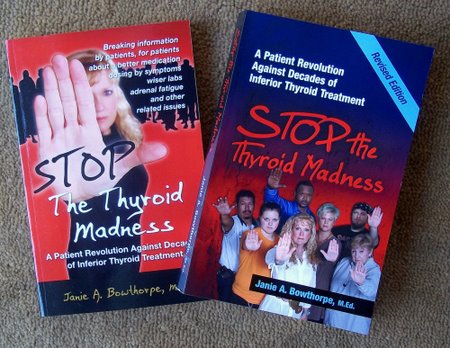
  • Check out the NEW REVISED patient-to-patient book with even more detail (and which doctors seem to respect more than websites).
  • Need to understand all your best options for thy­roid treat­ment? Go here.
  • Want to keep track of these "fringe website" blog posts? ;-) Curious what’s on Janie’s mind? Use the Blog Notification on the lower left of the links. or use an RSS Feed.

Is there a genetic reason many of us do lousy on T4?

deiodinase2Last May, a very interesting article appeared in the May 2009 issue of the Journal of Clinical Endocrinology and Metabolism, titled For Some, L-Thyroxine Replacement Might Not Be Enough: A Genetic Rationale and presented by Endocrinologists in Bristol in the UK. It’s accompanied with an editorial by Endocrinologists Brian W. Kim and Antonio C. Bianco.

This is the same article referred to by Endocrinologist Dr. Gary Pepper on the last Thyroid Patient Community Call on Talkshoe.

Basically, the article states that a genetic variation in the enzyme that converts T4 to T3, deiodinase D2 (also called Type 2 Deiodinase, or 5′-Deiodinase), may be responsible for why so many thyroid patients don’t do well on Synthroid, Levoxyl, levothyroxine, etc, and in turn, do so much better on natural desiccated thyroid like Naturethroid, Erfa’s Thyroid, or the combined synthetic T4 and synthetic T3 (Cytomel).

In other words, where some may have a strongly functioning deiodinase D2 enzyme which converts T4 to the active T3 well, others may have a modified deiodinase D2 enzyme, causing less optimal conversion.

In the Editorial, the two Endos Kim and Bianco explain the reality of “polymorphism”–a condition in nature in which changes or variations occur, and in one patient from another, a change in the DNA.  As related to conversion of T4 to T3,  some thyroid patients have a less effective deiodinase D2 enzyme in the conversion of T4 to T3.  Specifically, there is a common variant of the gene, threonine (Thr) 92 alanine (Ala), and it results in decreased D2 enzymatic activity.

The study proposes that this alteration from polymorphism occurs in 16% of those studied, and concludes that the majority don’t have this problem, and thus, “most do fine on T4-only medications”. But 16% do have this problem and need the combined therapy of T4 with T3.

Bristol was also mentioning this reality in 2004 here, even if they thought it was as low as 5%.

As Dr. Pepper hinted, this study could do wonders to open the eyes of Endocrinologists about the use of desiccated thyroid, or at the very least, about combined hypothyroid treatment with synthetic T3 added to synthetic T4.  And I’m glad for that when so many patients have found Endocrinologists to be narrow-mindedly stuck on Synthroid or other T4-only thyroxine products.

Of course, informed thyroid patients know this is only a baby step in the right direction, even if a good one! So we’ll rejoice for this study, and watch for more progress from the medical community and Endocrinology in general. For example, saying that “most do fine on T4″ simply because they have may a non-variation might be proven wrong as physicians take the time to really look at those “fine” patients, especially as they age and symptoms of an inferior treatment do pop up. And though the combination of synthetic T3 with synthetic T4 definitely gives better results, thyroid patients who then moved to desiccated thyroid with it’s T4, T3, T2, T1 and calcitonin report even better results and clinical presentation!  We’ve also learned that the TSH lab test absolutely sucks when it comes to diagnosis and treatment.  Read TSH Why It’s Useless, or see even more detail in Chapter Four of the STTM book, titled Thyroid Stimulating Hooey.

And finally: do thyroid patients really believe that problems with T4-only treatment is simply due to a genetic abnormality or variation? Maybe. But isn’t it funny that a healthy human thyroid does NOT depend solely on conversion, but also gives direct T3. hmmmmmm

P.S.  Patients also know that the use of the supplement Selenium helps with conversion, by the way, but has never stopped our first-hand knowledge that desiccated thyroid rocks!


  • Hip hip!! STTM has new products to help spread the word, here. Great BUMPER STICKERS, too, here. Spread the word--YOU may make a difference in someone’s life.
  • Check out the NEW REVISED patient-to-patient book with even more detail (and which doctors seem to respect more than websites).
  • Need to understand all your best options for thy­roid treat­ment? Go here.
  • Want to keep track of these "fringe website" blog posts? ;-) Curious what’s on Janie’s mind? Use the Blog Notification on the lower left of the links. or use an RSS Feed.

What the recent Medco scandal is actually telling us–i.e. there’s more to this story

medcoI have been watching with interest the past week about the justified ire of patients being expressed all over patient groups in the internet. And in case you’ve been too busy with school starting or end-of-summer activities, it involves one of the nation’s largest mail order pharmacies as well as the largest Pharmacy Benefits Manager (PBM):  Medco.

In a statement you can read right on their website, they state:

1)  there is a “nationwide shortage of porcine-derived desiccated thyroid”
2)  they are “uncertain about continued availability.”
3)  “ask your doctor if a synthetic thyroid medication, such as levothyroxine is right for you.”

In Medco’s direct message to doctors, they state;

1)  desiccated thyroid does not have the U.S. Food and Drug Administration (FDA)  Federal Drug approval”
2)  the FDA  “may remove any remaining unapproved products from the market.”
3)  the shortage is due to this “uncertainty”.
4) “the American Association of Clinical Endocrinologist recommends levothyroxine over desicccated thyroid, liotrix, combination of thyroid hormone, or triiodothyronine (T3) for the treatment of hypothyroidism.”

Clarification on their statements

If you are just now finding out about this,  do note the following:

1) There is not a nationwide shortage of all desiccated thyroid. There is a shortage of Armour because of its 2009 reformulation. (See my blog posts below about problems with the newly formulated Armour.)
2) Naturethroid by RLC Labs continues to be available. They are working hard to keep up.  See my post on Naturethroid.
3) Desiccated thyroid was around long before the establishment of the FDA, so they are grandfathered in and still work with the FDA guidelines.
4) There has been no statements by the FDA that they are removing desiccated thyroid.

An even more important revelation in this entire Medco scandal

There is actually an underlying message in the entire Medco fiasco that you should find even MORE disturbing: the continued  promotion of T4, aka levothroxine, as an adequate treatment of hypothyroidism.  And this is not just a faux pas of Medco, it continues to be the ignorant opinion of far too many doctors, medical schools and medical boards. All you have to do is look at what has happened in the UK with the Royal College of Physicians to see the idiocy abounding.

Over 100 years ago, desiccated thyroid was found to be an excellent treatment for hypothyroidism.  I give precise details about the first use of desiccated thyroid in Chapter 2 in the Stop the Thyroid Madness book. It worked!

But in the early 1960′s, the tide turned thanks to a batch of desiccated thyroid that turned out not to be what it said it was.  This is documented in the 1970 Pharmacological Basis of Therapeutics.  And pharmaceuticals, especially  Knoll Pharmaceuticals who first tableted levothyroxine aka Synthroid in 1955,  jumped to promote T4-only as a “new and modern medication”.  (See page 41 and 42 in the STTM book).  And doctors and medical schools fell for it hook, line and sinker.

And to this day, levothyroxine continues to be purported as an acceptable and logical treatment choice for hypothyroidism.  But patients all over the world beg to differ.  T4 medications like Synthroid, Levoxyl, Eltroxin, Oroxine and others simply leave all patients with their own unique amount and degree of lingering hypothyroid symptoms, no matter how high you raise it.

I also find it hugely disturbing to refer to AACE (American Association of  Clinical Endocrinologists) as if they are the grand poopah of knowing what’s right for thyroid patients. They are NOT.  Millions of thyroid patients who have switched to desiccated thyroid, T3, or a combo of T4 and T3 will tell them hands-down that they have gotten FAR better results, and most especially with desiccated thyroid like the “old” Armour, and now Naturethroid.

Visiting numerous thyroid patient groups will reveal how patients feel about Endocrinologists they have visited throughout the years.  Their experiences are far from flattering. In other words, with a few exceptions, thyroid patients are NOT impressed with Endo’s.

Medco’s statements are definitely a concern for patients and range from presumptous to unfactual.  But those statements only represent a far wider problem around the world in the medical community.  Clinical presentation and wisdom has been thrown out the window by doctors.  So patients have to continue spreading the word about the far superior treatment of desiccated thyroid, and their problematic experience with T4.

Want to be informed of these posts so YOU can be informed? Curious what’s on Janie’s mind? Use the Notifications on the left at the bottom of the links.

***50% off sale!! All STTM t-shirts are now on sale. I love sales. Not only do they help support this site, they are a great way to spread the word. Go here.   Did you know that Laughing Grape Publishing will send a STTM book directly to your doctor?


  • Hip hip!! STTM has new products to help spread the word, here. Great BUMPER STICKERS, too, here. Spread the word--YOU may make a difference in someone’s life.
  • Check out the NEW REVISED patient-to-patient book with even more detail (and which doctors seem to respect more than websites).
  • Need to understand all your best options for thy­roid treat­ment? Go here.
  • Want to keep track of these "fringe website" blog posts? ;-) Curious what’s on Janie’s mind? Use the Blog Notification on the lower left of the links. or use an RSS Feed.

The intrusion of reality about levothyroxine and depression

depressiont4I’ve been perusing comments in response to the UK’s Royal College of Physicians blundering and dark-age-constructed Diagnosis and treatment of primary hypothyroidism.  And though all comments are quite good and worth your read, I was struck by the comment titled May Reality Intrude? by a man named Charles.

Charles explains that in 1999, his 67-year-old wife had RAI (radioactive iodine) and was then put on levothyroxine, a T4-only medication (aka Synthroid, Levoxyl, Eltroxin, Oroxine, levothyroxine, et al).  And not long after, she complained of having depression.

He had an idea why after reading the New England Journal of Medicine about T3, and proceeded to buy her Armour off the internet.  Without her knowing, he switched medications. Lo and behold, he states “she promptly returned to her usual sunny disposition”. Her physician knew nothing of the switch either, and found nothing to be concerned about in her.

Charles then explained how, at age 74 in 2007, she was near death thanks to an ulcer bleed.  And to continue treating her hypothyroidism, the hospital gave her levothyroxine all over again.  Back came her depression and a feeling of wanting to go home and die.

So Charles brought her Armour to the hospital, and though her physical state was depressing enough, her sunny disposition returned.  And that happy spirit while still on Armour continues today after a full recovery.

And Charles pondered. If his wife had been in a NHS (National Health Service) hospital under the care of a so-called thyroid specialist of the NHS, would she have failed to obtain T3 and instead, sent to a psychiatrist as if her depression had nothing to do with her levothyroxine treated hypothyroidism–the very treatment that the Royal College of Physicians has a dogmatic love affair with?

He then concludes: My wife’s depression was obvious. Since she is equipped with much the same assortment of body parts and associated physiology as others, is it not likely that many levothyroxine-treated patients suffer from less-noticeable depression?

Well Charles, most any thyroid patient who decides to respond to this will tell you unequivacably YES, YES, YES.  Because there’s no research, study or directive that is more profound and telling than the actual EXPERIENCE of patients all over the world with T4 treatment and depression…besides a slew of other side effects of continuing hypothyroidism on T4-only meds.

Did you have depression on a T4 med? Tell us about your experience in the Comments section of this post.

*Want to be informed of these blogs? Curious what’s on Janie’s mind? Use the Notifications on the lower left of the links.

*Scroll down to the June 2nd post and report your experience on the newly formulated Armour. It’s not a happy picture.


  • Hip hip!! STTM has new products to help spread the word, here. Great BUMPER STICKERS, too, here. Spread the word--YOU may make a difference in someone’s life.
  • Check out the NEW REVISED patient-to-patient book with even more detail (and which doctors seem to respect more than websites).
  • Need to understand all your best options for thy­roid treat­ment? Go here.
  • Want to keep track of these "fringe website" blog posts? ;-) Curious what’s on Janie’s mind? Use the Blog Notification on the lower left of the links. or use an RSS Feed.

Thyroid Patients sending a big KISS to this British Doctor!

kiss2

I recently discovered a very humorous and appropo medical blog on the net, written by a United Kingdom General Practitioner who wisely stays incognito. His blog is called The Jobbing Doctor.

And his most recent and humorously brilliant post is titled Hairy legs are better than blood tests! He describes his occasional confusion when blood tests don’t agree with the patients symptoms.

Says the UK doc: “The textbooks teach that the level of circulating thyroid hormones (which are called T3 and T4) are inversely related to the Thyroid Stimulating Hormone (TSH). If your T3 and T4 are low, your TSH will be high: this suggests an underactive thyroid gland. If the T3 and T4 are high and the TSH is low, then you have an overactive thyroid gland. That’s easy, huh!”

But his confusion sprang forth when a patient’s labs showed “a highish TSH, T4, and a normal T3.” Yet apparently her symptoms didn’t imply there was any problem, so he chose to do nothing as far as changing her treatment.

A month later at her next appointment, this patient expressed her approval that he didn’t change anything…because her leg hair and eyebrows were coming back.

And his conclusion?  “Pah! Who needs blood tests!”

Jobbing Doctor, you are discovering what thyroid patients have been learning over and over for years: it’s SYMPTOMS (or lack up) which need to pull the cart, NOT labwork. Sure, we love our labwork. They can give clues to areas where our bodies are screaming for help.  But they definitely do NOT tell the whole story.

Look at the ignoramus TSH lab test. Countless patients have walked into their doctors offices with clear and obvious hypothyroid symptoms–and desperate for a diagnosis–yet the ink spot on the office piece of paper called the TSH lab result proclaims they are “normal”. And that dubious “normal” diagnosis can go on for years before it rises high enough to reveal what was already there by SYMPTOMS.

Or, while on thyroid medication, patients will have a lamebrain “normal” TSH lab result, yet will continue to have their own brand and degree of continuing hypothyroid symptoms which the clueless doctor dismisses as an hysteric female interpretation, motherhood, stress, a need for psychological help….or just “something else”. Uh huh.

In fact, Jobber Doctor, patients have learned that when they are optimal (on desiccated thyroid), along with optimal ferritin and cortisol), they will generally have a free T3 in the upper part of the range, and a SUPPRESSED TSH, with no symptoms of hyperthyroidism.  That is general, and there can be some exceptions, but overall, it has spoken volumes to patients on how inadequate thyroid lab tests can be.  i.e. being in the “normal” range—anywhere in the normal range–can be mean squat.

Thanks for a great post,  UK Jobber Doc. And P.S.  Desiccated thyroid is an even better treatment than thyroxine. :)

*Want to be informed of these blog posts? Curious what’s on my mind? Just use the Notifications at the bottom left of the links.


  • Hip hip!! STTM has new products to help spread the word, here. Great BUMPER STICKERS, too, here. Spread the word--YOU may make a difference in someone’s life.
  • Check out the NEW REVISED patient-to-patient book with even more detail (and which doctors seem to respect more than websites).
  • Need to understand all your best options for thy­roid treat­ment? Go here.
  • Want to keep track of these "fringe website" blog posts? ;-) Curious what’s on Janie’s mind? Use the Blog Notification on the lower left of the links. or use an RSS Feed.