Guess what we, as informed patients, discovered REPEATEDLY? The TSH lab test, which stands for “Thyroid Stimulating Hormone”, is an unfortunately inadequate test to go by. Read more below. ~Janie, hypothyroid patient and site creator


Four stupid things Endocrinologists (and other docs) say vs. what our experiences say:
- “The TSH lab is a reliable physiological marker of thyroid function (i.e. whether you are hypo or hyper).” PATIENT RESPONSE: Reliable? If patients are held to the TSH lab results rather than an optimal free T3, they have continued hypothyroid symptoms….over and over and over.
2. “The TSH is an accurate guide for your medication supplementation amount.” PATIENT RESPONSE: To the contrary, many patients have an ideal TSH (in range) and continuing hypothyroid symptoms. Are you paying attention, docs?
3. “The lower your TSH while on desiccated thyroid or T3, the greater your chance of osteoporosis or heart attack.” PATIENT RESPONSE: Totally FALSE. It’s the low TSH from Graves’ disease (hyperthyroidism) that causes those!! Our low TSH happens due to its sensitivity to T3 in our treatment. We are NOT hyper. In fact, by us going by the free T3 (which lowers TSH) and being optimal (so we don’t see a return of hypo symptoms), we have observed improved bone health and heart issues, as well as proven by testing.
4. “There’s an optimal place to be within the TSH range when on meds, such as between 1 and 2, or ‘fill-in-the-blank’.” PATIENT RESPONSE: Sorry, another ignorant response by Western medicine. We’ve been in what is called an “ideal part of the TSH range” with continuing symptoms!! Again, it’s about having an optimal Free T3, NOT the TSH, that is our goal.
What is the real TSH released by our pituitary gland?
Did you know that the TSH, aka Thyroid Stimulating Hormone, is a pituitary gland hormone? It’s not even a thyroid hormone! It’s one of many “messenger hormones” that come from the pituitary. The purpose of the TSH is to knock on the door of the thyroid to meet the demands of one’s body for more thyroid hormones. The TSH is saying “Hey thyroid gland, you need to release more thyroid hormones”.
Or conversely, if the thyroid gland gets on its exercise bicycle and greatly overproduces thyroid hormones (called hyperthyroidism or Graves disease), the TSH lab result will usually go low. It’s to show that the TSH in your body doesn’t need to knock.
Or the TSH lab result can go low with hypopituitary, and you’ll also see a low free T3 with it.
And the TSH will go quite low in its sensitive response to T3 in our treatment. And that is NOT hyperthyroid.
When was the lab test developed??
The TSH lab test was developed around 1973. It used approximately 200 volunteers to establish the so-called “normal” range. Over the years, additional population studies have been done to back up the range. The “normal” reference range is intended to represent the range of values for those in a so-called “healthy population without a thyroid problem”. The lowest and highest readings to create the range are usually thrown out.
But the question has become: how do they really know that those in the so-called healthy population weren’t already on a slide into hypothyroid? How many millions of hypothyroid patients have been told they were “normal”, even when symptoms persisted that doctors dismissed?
What did Dr. David Derry of Canada state about the TSH?
“The consensus of thyroidologists decided in 1973 that the TSH (lab) was the blood test they had been looking for all through the years. This was about two years after I started practice. Having been taught how to diagnose hypothyroid conditions clinically, I was in a position to watch to see what the relation of the TSH was to the onset of hypothyroidism. What I found was many people would develop classic signs and symptoms of hypothyroidism, but the TSH was ever so slow to become abnormal, rise and confirm the clinical diagnosis. Sometimes it never did. Finally I began treating patients with hypothyroid in the normal manner I was taught. I could not see why I had to wait for the TSH to rise for me to be able to treat them.” <——BINGO!!!
Dr. David Derry
If patients and informed doctors don’t dose by the TSH, what do they dose by?
Answer: the free T3 and being OPTIMAL, not just anywhere in range.
Why does my doctor proclaim I am “hyper” on NDT or T3 simply because my TSH falls below the range, yet I feel great?
Because doctors are confusing our low TSH to the same low TSH with Graves’ disease, the hyperthyroid side of the thyroid problem coin. And with Graves disease can come bone thinning and heart problems due to the excess release of thyroid hormones.
Our situation, though, is totally different. We are simply giving ourselves back the physiologic dose of thyroid hormones we need, whether NDT or adding T3 to T4, or just T3 for some. Thus, it seems to cause the lab result of this man-made test fall below the erroneous “normal” range. And with it comes better bone strength and heart health–both of the latter repeatedly observed and discovered by many thyroid patients! And we feel great! (If we don’t and have problems, it’s more about what NDT or T3 is REVEALING.
Does being a smoker affect the TSH lab test?
Yes, smoking will lower your TSH, patients have noted. See an interesting research study on smoking and your TSH.
Does my biotin supplementation affect the TSH?
Apparently so. There has become a lot of mention and research results1 that imply that biotin (in a variety of different dose amounts), can drive the TSH lab result even lower. And certain high doses of biotin can also push your frees up or down. So just in case, it can be wise to be off biotin for at least 24 hours to counter that issue.
What about a low TSH and hypopituitary–isn’t this its best use?
This is one area we have found the TSH to be of value! i.e. when we see an extremely low TSH (usually close to zero or below range) along with a low free T3, it usually points to hypopituitary, aka a problem with our pituitary gland. The latter is usually due to a diseased pituitary gland, or an adenoma, or a problem with the Hypothalamus, which is the organ that sends it’s messenger to the Pituitary. (The Hypothalamus, Pituitary and Thyroid glands make up with is called a Feedback Loop.) It might also be useful for those who had thyroid cancer and who need to keep their TSH very suppressed.
The bottom line according experiences worldwide?
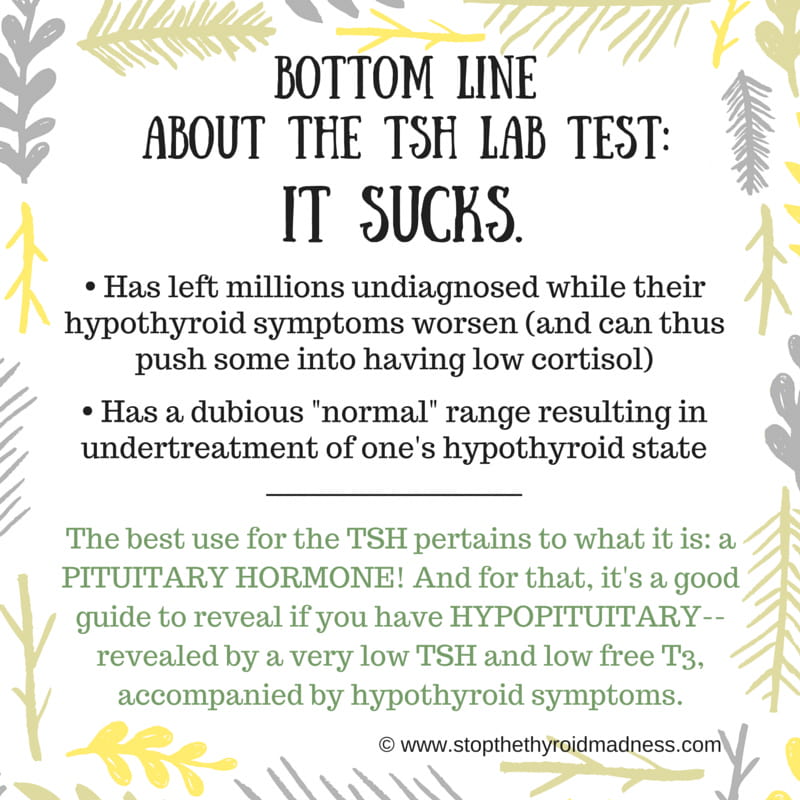
For thyroid diagnosis and dosing….the man-made TSH lab gets an “F” on the thyroid report card, as do doctors who repeatedly use it to diagnose or dose by without giving credence to the free’s, obvious and continued symptoms, and more.
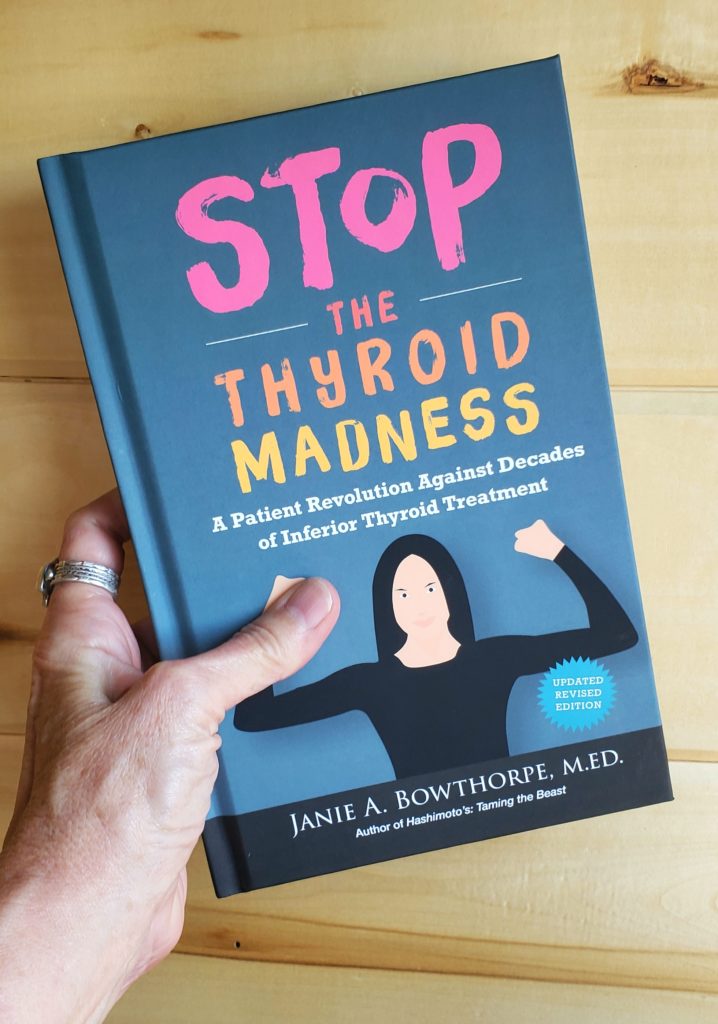
In the updated revised STTM book, see Chapter 4 for more pertinent information on the TSH lab test. And there is SO MUCH MORE in this “bible of patient experiences and wisdom”. It can change your life and make you far more informed in the doctor’s office.
A further note from Janie: I have observed that at least 50% of thyroid patients who come to thyroid groups or forums have a VERY “normal” TSH, even as low as the one’s…with raging hypothyroid symptoms. It seems to take years for the TSH lab result to rise and reflect their hypothyroid state. Not only has the man-made TSH lab been a total failure for diagnosis of hypothyroid for many, it fails the patient even on thyroid supplementation! We can only hope that doctors will start paying attention to “clinical presentation”!
Remember that STTM is an information-only site based on what many patients have reported. Try to teach your doctor, or find a better one.
Footnotes:
Addendum
- Want to order your own labwork?? STTM has created the right ones just for you to discuss with your doctor. Go here: https://sttm.mymedlab.com/
- Want to read more about the TSH and it’s fallacy according to a beloved doctor?: http://www.thyroid-info.com/articles/david-derry.htm
- HERE’S INFORMATION ABOUT NDT and the EQUIVALENT TO WHAT A HEALTHY THYROID PRODUCES: It’s stated that “estimates of average normal secretion for euthyroid humans are 94-110 µg T4 and 10-22 µg T3 daily.” And that is approximately equivalent to 3-5 grains desiccated thyroid. And when you get close to or in that range of desiccated thyroid, you WILL have a suppressed TSH lab, which tells you how inaccurate the established man-made TSH range is. https://www.thyroidmanager.org/chapter/chapter-2-thyroid-hormone-synthesis-and-secretion/
- Get help interpreting your lab results.

Learn from the Stop the Thyroid Madness books. YOU have to be informed to get well. https://laughinggrapepublishing.com
Important notes: All the information on this website is copyrighted. STTM is an information-only site based on what many patients worldwide have reported in their treatment and wisdom over the years. This is not to be taken as personal medical advice, nor to replace a relationship with your doctor. By reading this information-only website, you take full responsibility for what you choose to do with the information on STTM or its outcomes. See the Disclaimer and Terms of Use.