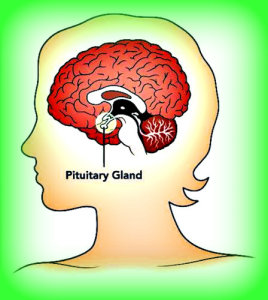
 When not on any thyroid meds, and you find yourself with a very low TSH lab (the TSH is a pituitary hormone), yet you ALSO have a low free T3, plus hypothyroid symptoms, you may have hypopituitarism. And the same can be true if you are on thyroid meds, have a low free T3 and free T4, plus a super low TSH.

Here are the most frequently asked questions concerning this condition, created by Chris, a hypopituitary patient who has worked with other hypopituitary patients for several years. Please note these are quick general answers so it’s recommended you do your own research to learn more.
1) What is hypopituitarism?
2) What are symptoms of hypopituitarism?
3) What causes hypopituitarism?
4) Is adrenal and/or thyroid treatment different if I am hypopituitary?
5) What labs will detect hypopituitarism?
6) If I can’t afford all those labs, can you tell just from TSH? DHEA?
7) Can you detect hypopituitarism from saliva cortisol labs?
8 ) I’m already on HC, can I test cortisol or ACTH levels?
9) Is there any test for hypopituitarism once I’m already on HC?
10) If one pituitary hormone is low, does that mean all of them are?
11) My Dr or Insurance won’t approve further tests — what should I do?
12) Should I start treating the sex hormones right away?
13) Is hypopituitarism curable?
14) My doctor says my cortisol doubled during the ACTH stimulation test, so I am ok-is he right?
15) Could I have a pituitary tumor? Should I get an MRI? Is it gonna grow? Will I need an operation?
16) Are there shades of Gray on this? Does someone get ‘sort-of’ hypo-pit, then then next guy’s labs even more so, then finally one sets off the buzzer and gets a definitive label of Hypo-Pit?
1) What is hypopituitarism?
Hypopituitary is the pituitary gland functioning below where it needs to be, and one or more hormones can be involved. The pituitary is a pea sized gland located at the base of the brain and it runs the adrenals, thyroid, and sex hormones. It also produces growth hormone and stores oxytocin and vasopressin, both of which are made in the hypothalamus. If the pituitary doesn’t put out enough TSH, thyroid hormone production can decrease. It the pituitary doesn’t produce enough ACTH, cortisol (and DHEA) can decrease.
2) What are the symptoms of hypopituitarism?
Because the pituitary may not be sending adequate levels of TSH and or ACTH, you could feel fatigue, weakness, have low blood pressure, feel colder than normal, have a decrease in your appetite, headaches, and depression. Symptoms of hypopit (concerning low TSH, low ACTH, low LH and FSH) are the same as if thyroid-adrenals-gonads are the cause. In most cases you can’t tell by symptoms if you may be hypopituitary or not. If you aren’t getting enough ACTH, you could have symptoms of weight loss and nausea, plus the fatigue, low blood pressure, weakness, and depression. Because of a deficiency of TSH and LH, women could lose their periods, or have problems conceiving. Men could have a decreased libido, erectile dysfunction, and loss of facial hair. If hypopituitary occurs in childhood, the result can be a short stature. Thirst and increased need to urinate can occur is you have an ADH deficiency. (Note: a large body of hypothyroid patients have a “low normal” TSH without hypopituitarism. Why? Because the man-made TSH lab is often slow to reveal the hypothyroid state. Those with hypopituitarism will often have a TSH at 0.8 and lower for women, and 1.8 and lower for men (but it’s important to ALSO do the free T3 to be sure), with accompanying hypo symptoms. See #5 and 6 below.)
3) What causes hypopituitarism?
A common cause of hypopituitarism is head injury. Even a seemingly mild bump to the head can damage the pituitary. A Pituitary tumor can also cause hypopituitary, though perhaps less than 3 percent have this as a cause. Sheehan’s syndrome is another cause, which is any type of blood loss, and where the pituitary at least partially dies from the lack of blood. Blood loss from childbirth, or an injury can result in Sheehan’s syndrome. Other causes can be radiation, antibody attack, and environmental. In most cases, it can not be known for sure what the cause is.
4) Is adrenal and/or thyroid treatment different if I am hypopituitary?
In treating the adrenals and thyroid caused by low ACTH (secondary AI) and low TSH (secondary hypothyroid), treatment is the same as it is for primary Adrenal Insufficiency and primary hypothyroid. Sex hormone treatment can be different with the use of HCG (almost identical to LH) in secondaries hypogonadism (low LH and FSH production in the pituitary which will cause low sex hormones in men and women), whereas primary hypogonadism involves the gonads being the cause of low sex hormones, LH and FSH will go up. The treatment for primary hypogonadism is the use of testosterone (in men, sometimes along with estrogen blocker) and estrogen, progesterone and even testosterone in women. Some men with primary hypogonadism also use HCG, but is rarely used in women.
5) What labs will detect hypopituitarism?
-low TSH (below 1.8 for men, below 0.8 for women) AND a low free T3
-low ACTH (below 30 for am. Is possible to be secondary with ACTH as high as low 40’s)
-ACTH stimulation or ITT that doubles cortisol from a low base value.
-ITT for GH stim
-low GHRH
-low TRH
-low vasopressin (hypothalamic hormone which is stored in the pituitary)
-low renin and low aldosterone
-very low or below range prolactin-usually this test is inconclusive for determing if other low pituitary hormones could be present.
-low oxytocin (rarely tested, is a hypothalamic hormone which is stored and released from the pituitary)
-alpha MSH (rarely tested, is a byproduct of ACTH)
6) If I can’t afford all those labs, can you tell just from TSH? DHEA? Honestly, it helps to go by both the TSH and free T3. i.e. often with women, we’ll see a low TSH, such as less than .8. But it needs to go along with a quite low free T3 to better diagnose hypopit. With men, we often see a TSH in the lower ones without hypopit, so again, the free T3 is needed. If the TSH is low and the free T3 is also quite low, that can be hypopit.
DHEA, if in the lower half of the range usually, but not always, indicates possible secondary adrenal insufficiency. Serum ACTH and ACTH STIM are the best tests for determining if secondary. If one has already started steroid without proper testing, the next best test for determining secondary AI is the renin test.
7) Can you detect hypopituitarism from saliva cortisol labs? No, because the test only shows what cortisol levels are, not what ACTH levels are doing. There is no saliva lab for ACTH as far as I know.
8 ) I’m already on hydrocortisone (HC), can I test cortisol and or ACTH levels? No, once steroid is started, those tests are not reliable. In every case I’ve seen where a doctor uses these tests for dosing a patient’s cortisol replacement, the patient was left undertreated. ACTH will go to pretty much zero in proper cortisol dosing.
9) Is there any test for hypopituitarism once started on HC? For detecting secondary (low ACTH) AI when proper testing hasn’t been done (serum acth, DHEA-S, acth stimulation test), the renin test (with aldosterone) is the next best thing and is highly reliable if the test is done right (fast salt for 24 hours). Renin is low 99% of the time in secondaries….see http://www.ncbi.nlm.nih.gov/pubmed/518024
10) If one pituitary hormone is low, does that mean all of them are? In more than 99% of cases of hypopituitary, 2 to 3 pituitary hormones will be deficient. Keep in mind interpreting tests is subjective. One doc like an osteopath (US) may see problems, an endocrinologist will probably will say your tests are ok. When all pituitary hormones are deficient to missing, this is called panhypopituitarism. True panhypopituitarism is fairly rare. Some definitions say not all pituitary hormones have to be deficient, but most. I go by the the strict definition — all pituitary hormones being deficient or absent in the anterior pituitary. I’ve seen one case of real panhypopituitarism.
11) My Dr or Insurance won’t approve further tests — what should I do? I recommend you first try an osteopath (DO) or holistic type of doctor even if you have to pay it all yourself. In the US, osteopaths are best for dealing with pituitary problems, but the rest of the world, osteopaths are a different type of doc and usually can’t help.
12) Should I start treating the sex hormones right away? From Janie: when Chris originally wrote the answer here, he stated no—that you need to treat cortisol first, then thyroid, then sex hormones etc. We all thought that. But now, we see that it’s all a symphony, so we treat them all at the same time. Chris continues: Low prolactin is not treated, but sometimes prolactin producing tumor (prolactinoma) can be present in hypopit and a drug like Dostinex is used to lower prolactin. Know that sometimes low thyroid can raise prolactin. Treating thyroid may lower prolactin.
13) Is hypopituitarism curable? There is no cure for hypopituitarism. (From Janie: there have been a few over the years that saw their hypopit go away when they treated their low cortisol/low thyroid. Misdiagnosis??)
14) My doctor says my cortisol doubled during the ACTH stimulation test, so I am ok-is he right? Most people with pituitary caused adrenal insufficiency, aka secondary adrenal insufficiency, do double on that test, but from a low base cortisol value. If your STIM test started below mid 20’s for women and below upper 20s for men, but doubled or more, then that suggests possible secondary adrenal insufficiency. A serum ACTH must be tested just before the STIM is started. From what I’ve seen, serum ACTH can be as high as lower 40’s for secondary AI, but most are below 30. Keep in mind the ranges today are even more flawed than they were 2+ years ago when 99% of labs used a range of 10-60. In my opinion a good range for ACTH would be 40-55. See here for a greatly detailed explanation of how to interpret your ACTH STIM test.
15) Could I have a pituitary tumor? Should I get an MRI? Is it gonna grow? Will I need an operation? Most people with hypopituitary are not in that condition because of a pituitary tumor. I estimate that less than 5% of those with hypopituitarism are diagnosed with a pit tumor, but studies have shown over 20% of cadavers have some degree of pituitary tumor present. In my opinion anyone who’s tests show even one low pituitary hormone should get an MRI (make sure is done with and without contrast). You can’t be sure until you have one. If your doc wants you to have a CAT scan instead, then you know you are seeing the wrong doctor. In cases of pit tumor is present I recommend one see an endo who specializes in pituitary tumors. In half the cases, pit tumors don’t grow to large and will stop growing. Any pituitary tumor should be monitored by MRI at least once a year. In the vast majority of cases, an operation is not necessary, but is necessary when the tumor pushes on the optic nerve or pushes against the hypothalamus or sinus cavity. Pituitary tumors usually cause decrease in some but usually not all pituitary hormones, but prolactin secreting tumors (prolactin excess aka prolactinomas) are not uncommon and can cause disruption of the hormones of the pituitary rendering hypopituitary. Tumors can also cause excess TSH (causing HYPERthyroid), excess GH and even excess gonadotropins (LH and FSH), but all of these border on rare. If you are diagnosed with a pituitary tumor, you need to check out www.Pituitarynetwork.org
16) Are there shades of Gray on this? Does someone get “sort-of hypo-pit”, then next guy’s labs even more so, then finally one sets off the buzzer and gets a definitive label of Hypo-Pit? There are varying degrees of hypopituitarism which I see everyday. Most people who have it, don’t get bad enough to have to figure this out and go to their graves not knowing. Most will have tests that are in range. I’ve seen everything from “I suspect slight hypopit for you but not bad enough to treat” (symptoms support, but tests showed a bit off) to a woman in Denmark who almost died from hypopit.
Want to order your own labwork?? STTM has partnered with two key facilities and created the right ones just for you to discuss with your doctor. Go here: recommended labwork
Important notes: All the information on this website is copyrighted. STTM is an information-only site based on what many patients worldwide have reported in their treatment and wisdom over the years. This is not to be taken as personal medical advice, nor to replace a relationship with your doctor. By reading this information-only website, you take full responsibility for what you choose to do with the information on STTM or its outcomes. See the Disclaimer and Terms of Use.