This article is written by me, Janie A. Bowthorpe, hypothyroid and Hashi’s patient, and site owner. Always find a doctor you can work with, which I am not.
Interest in iodine supplementation has grown in leaps and bounds over the years among thyroid patients!
And reported patient experiences, which Stop the Thyroid Madness LLC focuses on, proves that it can change lives, including for Hashimoto’s patients!
Why does my body need iodine?
- Is needed for the very existence of thyroid hormones (1)
- Is anti-cancer (2)
- Promotes optimal brain function (3)
- Plays an important role in your breast health (2, 4)
- Removes fibrocystic breast disease (as reported by numerous patients)
- Rids you of halide toxins like bromide, fluoride, chlorine and more (5)
- Helps with healthy levels of stomach acid (6)
- Is anti-fungal (7)
- …and so much more.(8)
Can’t I get my needs met with iodized salt? What about the small amount of iodine in natural desiccated thyroid?
Apparently not, say many experts. It’s far less than is needed. Plus with table salt, the iodine evaporates, i.e. whatever the factory says is in it, that was before it was shipped to your local store and then before it sat there.
Should I test my iodine levels before supplementing?
It’s often advised to order an Iodine Loading Test (see below), which is easy enough to do in your own home. You then send back your specimen, and wait for the results. But we’ve also seen value when a doctor uses an iodine blood test, too, to some degree. These results can be important in revealing whether you might need to supplement or not. Some have chosen to do an iodine patch test on the skin, but results vary so widely that the loading test is the preferred and the most accurate determination.
True Health Labs (offers the Doctor’s Data one, too)
Can blood testing work? What about a regular urine test?
It seems that blood might work to discern if supplementation is needed if the result is quite low. Same with a regular urine test in combination with the blood test. But the iodine loading test mentioned above gives you a more accurate baseline for how saturated you are, which blood may not. (Also important to know that once supplementing with iodine, blood testing won’t work.)
What are the iodine supplements?
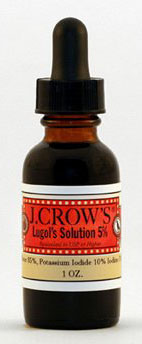
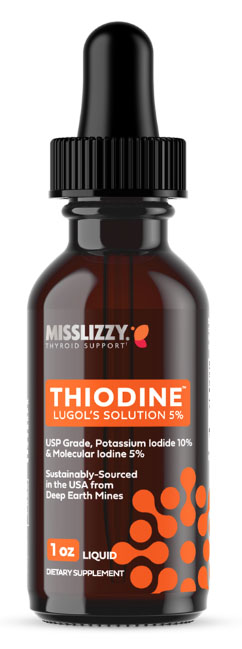
The most popular, besides most well researched, are either Lugol’s liquid, or Iodoral pill form. Lugols comes in 2% and 5%. One drop of the 5% equals 6.25 mg iodine. Iodoral is measured into 12.5 and 50 mg tablets. These can be ordered off the net by searching for either. Janie uses Lugols in her morning drink. A new one on the market is called Thiodine, by Miss Lizzy–the photo above on the right.
Another way to get iodine is via Nascent iodine. But there are positive and negative opinions about Nascent. On the positive side is it’s highly absorbable. On the negative side is that it can be sodium iodide instead of potassium iodide. Lugol’s and Iodoral are one part elemental iodine to two parts potassium iodide—an important combination, say experts. We’ll leave it up to you.
Aren’t there “companion nutrients” I should take before going on iodine?
Experts on the use of iodine state there are key nutrients one should take to counter the detox of bromides, chlorine, fluoride that supplementation will promote, as well as block negative reactions to supplementation. But it can still be important to start LOW with iodine, raise in LOW amounts, and raise SLOWLY. Many start these one month before introducing iodine. Lynne Farrow termed these as “Companion Nutrients”, and they are:
- Selenium: 200-400mcg per day
- Magnesium: 400-1200mg per day
- Vitamin C: 3,000-10,000mg per day
- Vitamins B2/B3 (ATP CoFactors): 100mg riboflavin and 500mg no flush niacin, inositol hexanicotinate form, 1-2x per day
- Unrefined Salt (Celtic): 1/2 tsp. or more per day
See thyroid patient Jane’s (not “Janie” of STTM—this is written by Jane, a thyroid patient) Guest Blog post about companion nutrients here: https://stopthethyroidmadness.com/2013/12/29/companion-nutrients-the-key-to-iodine-protocol/
Note about selenium: it can be quite important to test your selenium levels before getting on selenium. Because of the MTHFR mutation, some people can see high levels, which actually puts us in a low selenium state. But we have to be careful in the use of selenium, perhaps staying on low amounts.
I have Hashimoto’s disease—can I take iodine? Someone is saying all Hashi’s patients should avoid it?
From years or reported experiences in a variety of patient groups, we do know that a body of Hashimoto’s patient report that they do wonderful with supplementation. In fact, some of them report it was the very reason they saw their antibodies go down.
Then there are some Hashi’s patients who have reported an aggravation of their Hashimoto’s antibodies or symptoms after using iodine, or other negative reactions. But there are correctible reasons:
1. Low selenium levels 2. Low copper or zinc 3. Failing to start iodine in LOW amount, raise in LOW amounts, and raise SLOWLY.
And…since the use of iodine will detox you from the Halides, that detox can aggravate antibodies in some. So Hashi’s patients expecially go low (starting dose) and slow (raises) to counter the detox symptoms.
What if I’m allergic to iodine?
There are suggestions by iodine experts that what is seen as an “allergy to iodine” may actually be a reaction to the injected contrast dyes which serve to sharpen the pictures in medical imaging studies (i.e. as in x-rays and CT scans). With reactions to certain seafoods like shellfish that are also high in iodine, they state it’s more likely due to a reaction distinctive allergens, aka certain proteins, found in these seafoods. One of many studies on this issue here.
Steven Rothrock, MD states: Despite the clear evidence that no one is allergic to iodine and there is no direct link between shellfish allergy and use of contrast during CT scans, this myth has been hard to put to rest. In a survey of patients presenting to a pediatric clinic with suspected seafood allergy, 92% of parents mistakenly believed that iodine was the cause of that allergy.1 In a study from 2005, over one third of radiologist and one half of cardiologists would not use contrast media or would alter their treatment for patients undergoing procedures requiring the use of IV contrast (e.g. CT scans and heart catherizations) in those with shellfish allergy. The authors of this study called this practice antiquated and recommended that this myth “take its rightful place in oblivion.”1
Can I use iodine when I have low cortisol?
Some adrenals patients report a worsening of their sluggish adrenal/HPA function due to the important toxin release caused by iodine use. But other adrenal patients report that the proper use of the same supporting nutrients mentioned above overcame the problem, and they were even able to lower their HC. Just remember the manta: LOW, LOW and SLOW. Start low, raise in low amounts, raise slowly
An article by Gabriel Cousens, MD, lists ten points about iodine, and here are four as a start…
- Helps synthesize thyroid hormones
- Reverses hypothyroidism and hyperthyroidism (we have not seen that much, but it might in some if caught early enough, we think)
- Promotes death of unhealthy cells
- Helps prevent certain forms of cancer
Tell me more about iodine and conditions…
Related to breast health: Since the breasts are a major receiver of iodine, women are particularly interested in iodine supplementation. There is already proof that iodine supplementation removes fibrocystic breast disease (it definitely removed Janie Bowthorpe’s), and that can be carried over to the proposed idea that iodine supplementation might prevent breast cancer. See the book Breast Cancer and Iodine by Dr. David Derry.
Related to thyroid: Many hypothyroid patients were hopeful that iodine use would enable them to get off their thyroid medications. For most, though, this has not been the case. But for other patients, some have been able to lower their thyroid medication from using the iodine protocol. And if started early enough in one’s thyroid disease, yes, some have actually been able to avoid thyroid medications!
Related to Hashi’s: We have outright had many Hashi’s patients report iodine use LOWERED their antibodies. It’s about starting on a LOW amount, raising by only a LOW amount, and raising SLOWLY—all to counter the stress of detox.
Related to skin cancer: Since iodine can burn, patients who tried iodine on their skin cancer report it was too uncomfortable. On the other side, there are many testimonies about iodine removing skin cancer. Google “iodine skin cancer”. My own husband has completely removed two pre-cancer growths on each side of his nose with one drop of iodine per side at bedtime and for several weeks.
Some practitioners recommend quite high doses of iodine. Are there other opinions about those high doses?
Yes, here’s one discouraging it: http://www.integrativehealthcare.com/why-i-discourage-high-dose-iodine/ But there are many others who definitely support higher doses for different conditions. So it’s up to you. I, Janie, cannot tolerate the high amounts—it caused a benign tumor on my saliva gland.
FOOTNOTES:
- http://fitsweb.uchc.edu/student/selectives/Luzietti/Thyroid_hormones.htm
- http://jeffreydachmd.com/iodine-treats-breast-cancer/
- http://pmj.bmj.com/content/77/906/217.short
- http://www.drnorthrup.com/unlikely-source-relieves-breast-pain/
- http://drsircus.com/medicine/iodine/iodine-and-detoxification
- https://stopthethyroidmadness.com/stomach-acid/
- https://www.ncbi.nlm.nih.gov/pubmed/6724127
- http://drsircus.com/medicine/iodine/iodine-rescue#_ednref3
**Below is a compilation of iodine information related to your thyroid—both the information itself, or links to websites, or recommended books.
Get that cup of coffee, sit in a comfortable chair, and read. You will then make an informed decision of what might be right for you. (HELP: websites often change the URL from where a topic used to be. If you find a link below that does NOT go the info implied, please see if you find the correct URL and let me know! I’ll change it. )
- Lynne Farrow’s book: The Iodine Crisis: What You Don’t Know About Iodine Can Wreck Your Life
- Lynne Farrow’s article on iodine in salt: http://iodineresearch.com/debunked.html
- Iodine for breast cancer prevention or treatment: www.breastcancerchoices.org/iodineindex.html
- Linus Pauling Institute’s comment: http://lpi.oregonstate.edu/infocenter/minerals/iodine/
- Role of iodine, selenium and other micronutrients in thyroid function: http://www.ncbi.nlm.nih.gov/pubmed/19594417
- Iodine as 65% of T4’s weight, and 58% of T3’s http://www.thyroidmanager.org/wp-content/uploads/chapters/thyroid-hormone-synthesis-and-secretion.pdf
- Videos by Brownstein: http://vitamincfoundation.org/videos/#BROWNSTEIN
- Publications by Abraham: http://www.optimox.com/pics/Iodine/opt_Research_I.shtml
- Excellent articles explaining why iodine can exacerbate Hashimoto’s antibodies i.e. it actually can point to insufficient selenium, zinc, and/or copper levels, or the DETOX. Go here for Part One, then after you read it, go here for part Two.
- Several good articles pertaining to iodine as one of the major players in healing a thyroid. http://www.vrp.com/minerals/iodine-the-universal-nutrient
http://www.vrp.com/minerals/hypothyroidism-the-underdiagnosed-epidemic
http://www.vrp.com/minerals/iodine-the-rest-of-the-story
http://www.laurapower.com/iodinedeficiency.htm - Variety of good articles:
http://www.optimox.com/pics/Iodine/opt_Research_I.shtml
http://www.optimox.com/pics/Iodine/IOD-09/IOD_09.htm
http://www.optimox.com/pics/Iodine/IOD-02/IOD_02.htm
http://www.quackcenter.com/ideficiency.html
http://www.lewrockwell.com/miller/miller20.html
http://www.iodine4health.com
http://www.optimox.com/pics/Iodine/loadTest.htm
http://www.askdoctordavid.com/articles/iodine3_news_82005.html - VRP’s research in light of the nuclear disaster in Japan:
http://www.vrp.com/webinars/the-true-story-about-iodine-fluoride-and-your-health-controlling-a-deadly-trend http://www.vrp.com/minerals/calming-the-chaos-understanding-iodine - * T3 = C15H12I3NO4 = molar mass of 650.9776; * T4 = C15H11I4NO4 = molar mass of 776.87 * Iodine has a molar mass of 126.90; * Iodine content of T3 = (3 * 126.9)/650.9776 * T3 is 59.725 % iodine * Iodine content of T4 = (4 * 126.9)/776.87 * T4 is 65.339 % iodine.
- Desiccated thyroid like Armour has 38 mcg T4 & 9 mcg T3..65339 * 38 mcg = 24.828 mcg iodine .59725 * 9 mcg = 5.37525mcg iodine. But this iodine can be bound and not as usable as what you could get in diet or through supplementation. Each grain of desiccated thyroid like Armour has 30.20325 mcg iodine. Iit also has 1/5 the RDA of iodine (150 mcg). But this iodine is bound and not as usable as what you could get in diet or through supplementation
FACTS ABOUT IODINE AND AUTOIMMUNE THYROIDITIS by Guy E. Abraham, M.D. (This article comes to the conclusion, as bolded at the end, that iodine is not the direct cause of Hashimotos, but lack of. )
In 1912, pathologist H. Hashimoto published in the German language and in a German medical journal (1), his histological findings in four thyroid glands removed at surgery: numerous lymphoid follicles; extensive connective tissue formation; diffuse round cell infiltration; and significant changes of the acinar epithelium. He called this pathology of the thyroid “struma lymphomatosa”, but it became popular under the name “Hashimoto Thyroiditis”.
At the time of Hashimoto’s publication, autoimmune thyroiditis was not observed in the U.S. population until the iodization of salt.
Hashimoto’s thyroiditis is now classified as goitrous autoimmune thyroiditis AIT because the gland is enlarged, in distinction to atrophic autoimmune thyroiditis where atrophy and fibrosis are predominant. Both conditions are chronic, progressing over time to hypothyroidism in a significant percentage of Patients (2).
In several communities worldwide, an increased incidence of AIT was reported following implementation of iodization of sodium chloride (3). In areas of the United States where this relationship has been studied, mainly in the Great Lakes Region, a similar trend was reported. Plus in 1966 and 1968 Weaver et al (4,5) from Ann Arbor Michigan reported: “The salient histopathological feature of the thyroid glands, removed at operation in a five-year period before iodine prophylaxis (1915 to 1920), was the paucity of lymphocytes in their parenchyma, and, more importantly, the absence of thyroiditis of any form” “It should be emphasized that the thyroid glands prior to the use of iodized salt were devoid of lymphocytes, and nodular colloid goiters with dense lymphocytic infiltrates were found after the introduction of iodized salt in 1924”.
Furszyfer et al (6), from the Mayo Clinic, studied the average annual incidence of Hashimoto’s thyroiditis among women of Olmsted County, Minnesota during 3 consecutive periods covering 33 years of observation, from 1935 to 1967. They found the incidence to be higher in women 40 years and older versus women 39 years and less. However, in both groups, there was a progressive increase in the incidence of Hashimoto’s thyroiditis over time. During the 3 periods evaluated, that is 1935-1944; 1945-1954; 1955-1967; the average annual incidence of Hashimoto’s per 100,000 population were 2.1; 17.9; and 54.1 for women 39 years and less. For women 40 years and older, the average annual incidence over the same 3 periods were: 16.4; 27.4; and 94.1.
It is important to point out that the Mayo Clinic study started 10-15 years after implementation of iodization of salt in the area. Therefore,even during the first decade of observation, the prevalence of autoimmune thyroiditis was already significant.
Again, it must be emphasized that prior to the implementation of iodized salt as observed by Weaver, et al,(4.5) this pathology of the thyroid gland was not reported in the US, even though the Lugol solution and potassium iodide were used extensively in medical practice at that time in daily amount two orders of magnitude greater than the average intake of iodide from table salt.
It is of interest to note that prior to iodization of salt, AIT was almost non-existent in the USA, although Lugol solution and potassium iodide were used extensively in medical practice in amounts 2 orders of magnitude greater than the average daily amount ingested from iodized salt (2). This suggests that inadequate iodide intake aggravated by goitrogens, not excess iodide, was the cause of this condition. To be discussed later, AIT cannot be induced by inorganic iodide in laboratory animals unless combined with goitrogens, therefore inducing iodine deficiency.
The pathophysiology of AIT is poorly understood. Experimentally induced autoimmune thyroiditis in laboratory animals by acutely administered iodide required the use of antithyroid drugs, essentially goitrogens, to produce these effects (7-10). These goitrogens induced thyroid hyperplasia and iodide deficiency. Antioxydants either reduced or prevented the acute iodide-induced thyroiditis in chicks (11) and mice (12). Bagchi et al (11) and Many et al (12) proposed that the thyroid injury induced by the combined use of iodide and goitrogens occurs through the generation of reactive oxygen species.
We have previously proposed a mechanism for the oxidative damage caused by low levels of iodide combined with antithyroid drugs (2). i.e. inadequate iodide supply to the thyroid gland, aggravated by goitrogens, activates the thyroid peroxydase (TPO) system through elevated TSH, low levels of iodinated lipids, and high cytosolic free calcium, resulting in excess production of H2O2. The excess H2O2 production is evidenced by the fact that antioxidants used in Bagchi’s experiments did not interfere with the oxidation and organification of iodide and therefore neutralized only the excess oxydant (11). This H2O2 production is above normal due to a deficient feedback system caused by high cytosolic calcium due to magnesium deficiency and low levels of iodinated lipids which requires for their synthesis iodide levels 2 orders of magnitude greater than the RDA for iodine (2).
Once the low iodide supply is depleted, TPO in the presence of H2O2 Molar and organic substrate reverts to its peroxydase function which is the primary function of haloperoxydases, causing oxidative damage to molecules nearest to the site of action: TPO and the substrate thyroglobulin (Tg). Oxydized TPO and Tg elicit an autoimmune reaction with production of antibodies against these altered proteins with subsequent damage to the apical membrane of the thyroid cells, resulting in the lymphocytic infiltration and in the clinical manifestations of Hashimoto’s thyroiditis. Eventually, the oxidative damage to the TPO results in deficient H2O2 production.
Hypothyroidism occurs in AIT when oxidation and organification of iodide in the thyroid gland become deficient enough to affect synthesis of thyroid hormones.In vitro studies with purified fractions of calf thyroid glands by De Groot et al (13) gave compelling evidence that iodide at 10-5 Molar confers protection to TPO against oxidative damage. To achieve peripheral levels of 10-5 Molar iodide, a human adult needs a daily amount of 50 to 100 mg.
DeGroot’s findings can be summarized as follows:1. TPO is inactivated by H2O2.2. KI at 10-5 Molar protects TPO from oxidative damage.3. Potassium Bromide and Potassium Fluoride do not share this protective effect of KI.4. The protective effect of KI is not due to the covalent binding of iodine to TPO but due to the presence of KI itself in the incubation media. Based on the above facts, it is obvious that iodine deficiency, not excess, is the cause of AIT.
References
- Hashimoto, H., Zur Kenntniss der lymphomatosen Veranderung der Schilddruse (Struma lymphomatosa). Arch. Klin. Chir., 97:219-248, 1912.
- Abraham, G.E., The safe and effective implementation of orthoiodosupplementation in medical practice. The Original Internist, 11:17-36, 2004
- Gaitan, E., Nelson, N.C., Poole, G.V., Endemic Goiter and Endemic Thyroid Disorders. World J. Surg., 15:205-215, 1991. (Autoimmune Thyroiditis)
- Weaver, D.K., Batsakis, J.G., Nishiyama, R.H., Relationship of Iodine to “Lymphocytic Goiters”. Arch. Surg., 98:183-186, 1968. (Autoimmune Thyroiditis)
- Weaver, D.K., Nishiyama, R.H., Burton, W.D., et al, Surgical Thyroid Disease. Arch. Surg., 92:796-801, 1966. (Autoimmune Thyroiditis)
- Furszyfer, J., Kurland, L.T., Woolner, L.B., et al, Hashimoto’s Thyroiditis in Olmsted County, Minnesota, 1935 through 1967. Mayo Clin. Proc., 45:586-596, 1970. (Autoimmune Thyroiditis)
- Weetman, A.P., Chronic Autoimmune Thyroiditis. In Werner & Ingbar’s The Thyroid — Braverman LE and Utiger RD Editors, Lippincott Williams & Wilkins, 721-732, 2000. (Autoimmune Thyroiditis)
- Follis, R.H., Further observations on thyroiditis and colloid accumulation in hyperplastic thyroid glands of hamsters receiving excess iodine. Lab Invest., 13:1590-1599, 1964. (Goiter)
- Belshaw, B.E., Becker, D.V., Necrosis of Follicular Cells and Discharge of Thyroidal Iodine Induced by Administering Iodide to Iodine-Deficient Dogs. J. Clin. Endocr. Metab., 13:466-474, 1973. (Goiter)
- Mahmoud, I., Colin, I., Many, M.C., et al, Direct toxic effect of iodine in excess on iodine-deficient thyroid gland: epithelial necrosis and inflammation associated with lipofuscin accumulation. Exp. Mol. Pathol., 44:259-271, 1986.
- Bagchi, N., Brown, T.R., Sundick, R.S., Thyroid Cell Injury Is an Initial Event in the Induction of Autoimmune Thyroiditis by Iodine in Obese Strain Chickens. Endocrinology, 136:5054-5060, 1995. (Autoimmune Thyroiditis)
- Many, M.C., Papadopoulaous, J., Martic, C., et al, Iodine induced cell damage in mouse hyperplastic thyroid is associated to lipid peroxidation. In: Gordon A, Gross J, Hennenian G (eds) Progress in Thyroid Research. Proceedings of the 10th International Thyroid Conference. Balkema, Rotterdam, 635-638, 1991.
- DeGroot Leslie J., et al, Studies on an Iodinating Enzyme from Calf Thyroid. Endocrinology Vol. 76 p.632-645,1965.
- Okerlund, M.D., The Clinical Utility of Fluorescent Scanning of the Thyroid. In Medical Applications of Fluorescent Excitation Analysis, Editors Kaufman and Price, CRC Press, Boca Raton Florida, pg 149-160, 1979. [Non-text portions of this message have been removed]
Important notes: All the information on this website is copyrighted. STTM is an information-only site based on what many patients worldwide have reported in their treatment and wisdom over the years. This is not to be taken as personal medical advice, nor to replace a relationship with your doctor. By reading this information-only website, you take full responsibility for what you choose to do with the information on STTM or its outcomes. See the Disclaimer and Terms of Use.