Did you know that Hashimoto’s, a well-known version of an autoimmune disease, is just one of many kinds of what is caused Thyroiditis?? Check out the information below to learn more about Thyroiditis! ~Janie, hypothyroid patient and site creator
THYROIDITIS is an umbrella term to describe several conditions concerning the inflammation, or the attack, of the thyroid gland, of which Hashimoto’s disease is just one.
Sometimes you will also get the umbrella diagnosis of Autoimmune thyroid disease (AITD). That just means an organ specific autoimmune problem, which can include Hashimoto’s and many of the below, as well as Graves disease.
Symptoms of thyroiditis can first fall in the hyper end of the range (anxiety, nervousness high heartrate or palpitations, heat intolerance, etc), then end up being the same as hypothyroidism, including fatigue, weight gain, concentration problems, swelling and more. When treatment is finally needed, it’s the same as for patients with general hypothyroidism–natural desiccated thyroid.
THYROIDITIS includes all the following:
-
Hashimoto’s disease
Hashimoto’s Disease, aka Hashi’s, is the most common form of thyroiditis and is the most common cause of being hypothyroid, even if other patients can become hypo without a autoimmune reason. Antibodies are present, showing an attack on your thyroid, whether anti-TPO or anti-thyroglobulin. A few might also carry antibodies for Graves’ disease. The underlying cause leans towards your genetics, but environmental triggers also play a role–foods you eat, stress, infections and more. The book Hashimoto’s: Taming the Beast is a good reference about Hashi’s, plus information on all triggers that can affect the antibodies, and how patients have learned to get their antibodies down. The book purposely avoids long stories to chug through, since many Hashi’s patients can have brain fog.
-
Seronegative thyroiditis
This is considered a milder, less aggressive form of Hashimoto’s and often without antibodies, which is why an ultrasound might be needed to firmly diagnosis Seronegative. One can have a goiter. For some, this might be the same as De Quervain’s below.
-
Postpartum thyroiditis
This happens after the birth of a baby, is common, and may play a role in post-partum depression. Antibodies will be present and you may have no pain in the thyroid at all! It will start out with symptoms of hyperthyroidisim, including a fast heartrate, easy weight loss, feeling nervous, tired, and not liking heat. It will move into hypothyroidism, and some women will remain hypothyroid the rest of their lives, while others will have a remission. Cause is not always known.
-
Subacute thyroiditis, also called De Quervain’s Thyroiditis
This form of thyroiditis will involve inflammation and pain of the gland and a quick release of excess thyroid in your blood, but antibodies are not found. It’s uncommon, and some feel it’s caused by a virus of the thyroid, and can occur after one has had a upper respiratory tract viral infection. Pain of the thyroid is common and can be acute. Some have fever. Taking aspirin to reduce inflammation, plus bed rest, is recommended by doctors. Patients can recover from this.
-
Silent thyroiditis
This condition is like having both Hashi’s and Subacute thyroiditis, but does not usually have pain of the thyroid, i.e. “silent”. For some, it is recoverable within a few months, tho others may have lifelong hypo. Cause is generally unknown.
-
Drug-caused thyroiditis
This can be caused by the continued use of lithium, as well as amiodarone, interferons and cytokines. Will continue as long as the medications are used. These drugs may not actually cause thyroiditis, but just plain ole hypothyroidism.
-
Radiation induced thyroiditis
This rare condition can occur after the use of radiation treatment to treat hyperthyroidism, or radiation used to treat head or neck cancer. Pain is common. It can result in lifelong hypothyroidism. No antibodies are present.
-
Acute thyroiditis
Also called Suppurative thyroiditis, this is caused by a bacterial or other infection, and can go away with treatment of the initial infection. No antibodies are present.
-
Riedel’s thyroiditis
This is where one’s thyroid will contain dense fibrosis causing inflammation, and this may be more of a fibroid disease. With this, you can also have hypoparathyroidism, hoarseness from problems to your larynx, and a compression of your tracheal tube. Your thyroid will feel quite hard.
-
Ord’s thyroiditis / Atrophic thyroid or Atrophic thyroiditis
This form of thyroiditis refers to a reduced thyroid size, and is basically very similar to Hashimotos, i.e. one or both antibodies will be attacking the thyroid. It’s more common in European countries. Ord’s/Atrophic Thyroiditis patients tend to see their thyroid atrophy rather than form an enlarged goiter. This can also be called Atrophic Thyroid.
(Important note: STTM is an information-only site based on what many patients have reported or learned in their treatment. Please work with your doctor. This is not meant to replace that relationship or guidance, and you agree to that by reading this website. See the Disclaimer.)
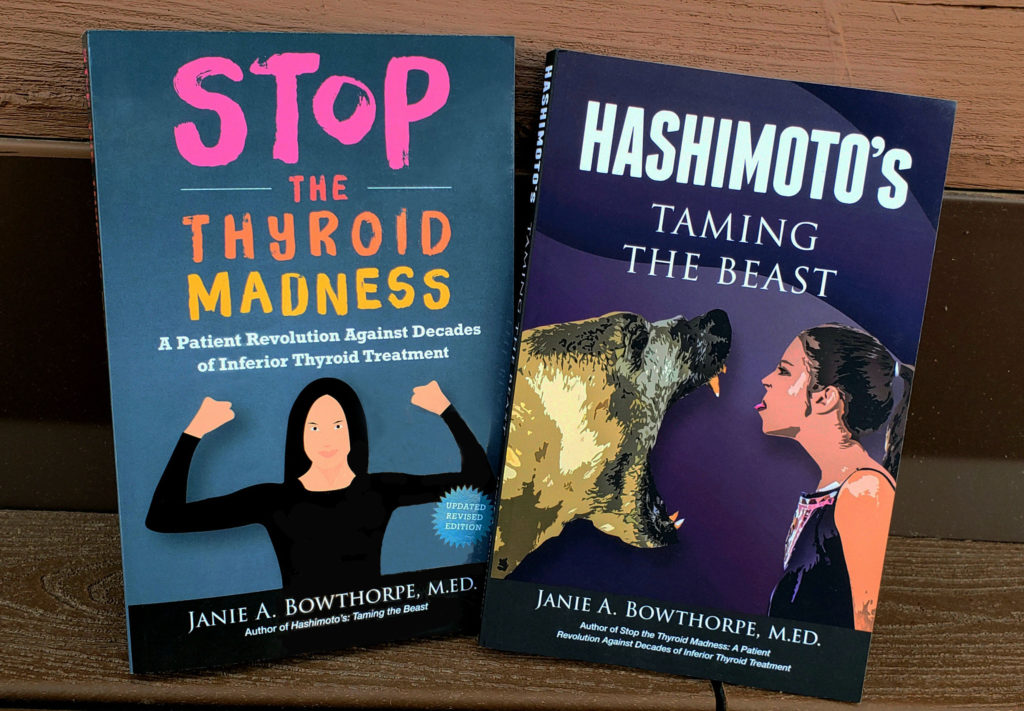
HAVE HASHI’S?? These are the books for you–they are companion books. The right one is specifically about Hashi’s and has a great deal of patient experience information. The left one is just as important, as it covers how patients have learned to treat their hypothyroidism and many other issuess, including adrenal fatigue / low cortisol. https://laughinggrapepublishing.com
Important notes: All the information on this website is copyrighted. STTM is an information-only site based on what many patients worldwide have reported in their treatment and wisdom over the years. This is not to be taken as personal medical advice, nor to replace a relationship with your doctor. By reading this information-only website, you take full responsibility for what you choose to do with the information on STTM or its outcomes. See the Disclaimer and Terms of Use.