This would be good information to share with your doctor, as it’s solidly based on decades of reported experiences and wisdom! Forcing the body to live for conversion alone to T3 has caused a host of problems, say patients worldwide. And if your medical professional doesn’t listen, might be time to find a better doctor. ~Janie, thyroid patient and site creator
Why do patients, as represented by the Stop the Thyroid Madness (STTM) website and books, state that T4-only doesn’t work well enough?
T4, of which is the main ingredient in certain hypothyroid medications, is a thyroid storage thyroid. T4’s purpose is to convert to the active T3. It’s T3 which changes our lives.
But the problem, according to years of reported patient experiences, is that T4-only has NOT been doing the job for six decades as a sole treatment for hypothyroidism. That truth is whether the cause is autoimmune Hashimoto’s, or any other reason for being hypothyroid—unless you think that an elevator that goes up to the 5th-floor-only on a 50-story building is “doing the job”.
Granted, there are those who state they are doing great on T4-only! And we applaud that! But on the other side of the coin, even those who feel they do well eventually state that problems creep up!! We simply aren’t meant to live for conversion alone to T3–the active thyroid hormone. Plus there are just many life situations that can cause that T4 to convert Reverse T3, the inactive hormone.
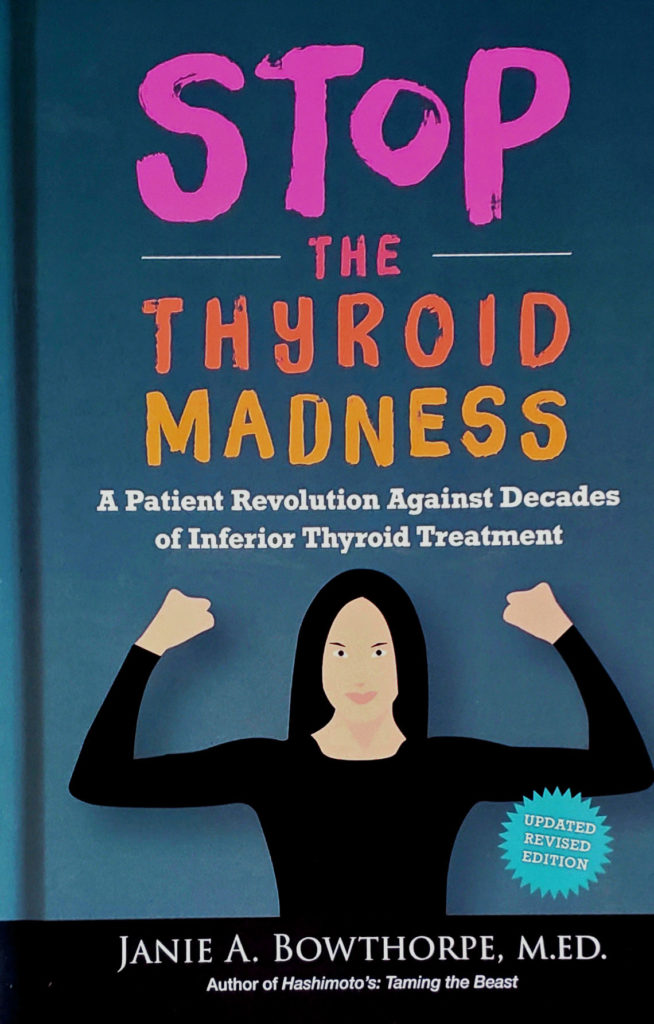
**You can read a lot more interesting information about T4-only in Chapter 1 of the updated revision STTM book–the one with the girl on the front with her fists up. We all HAVE to be informed to get well.
But we’re all different, right?? What doesn’t work for one may work for another, right?
If ten people were playing in a street, and seven were run over, would you still approve of playing in the street because three didn’t get run over at that moment in time—in the name of “We’re all different” or “Whatever works” or “To each his own”?
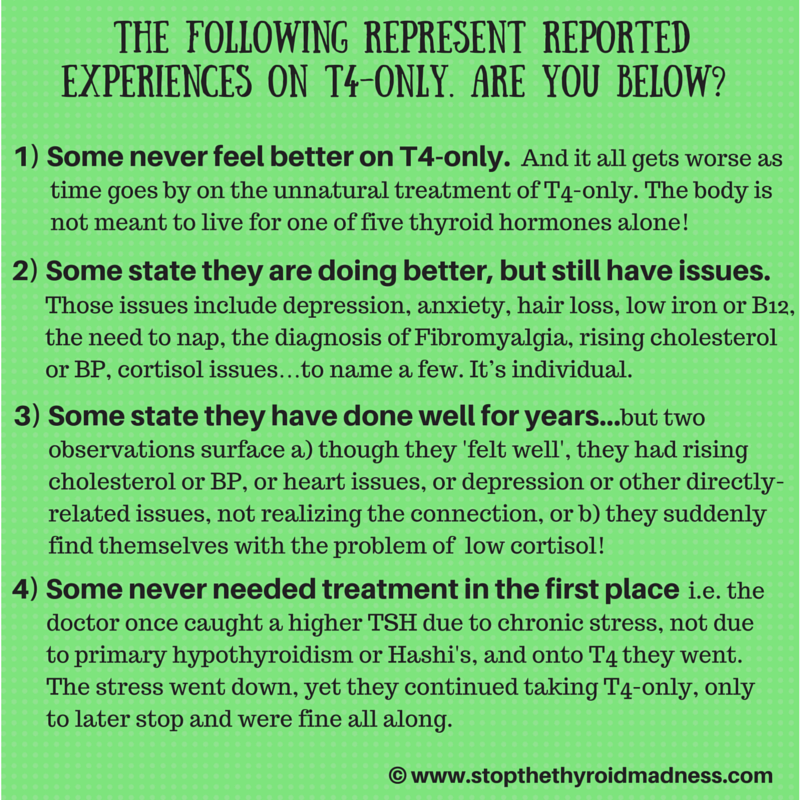
In summary, on only one of five thyroid hormones, 1) Some never feel better 2) Others do better but still have problems like hair loss, depression, anxiety, low iron or b12, rising cholesterol or blood pressure, stressed adrenals, and MORE 3) Another percentage will seem to do well for years (or they thought, not realizing what was actually happening); 4) Some never needed treatment in the first place, since pure and simple chronic stress can raise the TSH..aka secondary hypothyroidism that would go away once stress was relieved.
Why doesn’t T4-only ultimately work well for so many, based on their reports?
A healthy thyroid doesn’t make you totally dependent on conversion alone to T3, the active hormone. It also gives you direct T3, the active hormone. So being on a T4-only med means you are missing out on direct T3.
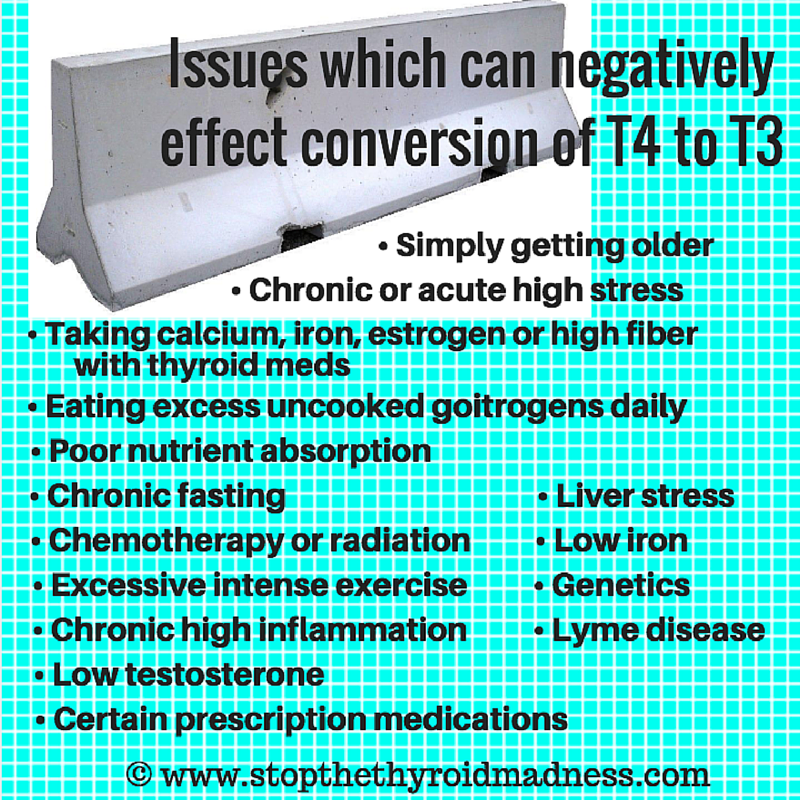
Summary: There are issues which can negatively affect the conversion of T4 to T3. They include: getting older, chronic stress, taking calcium/iron/estrogen or high fiber at the same time, excess uncooked goitrogens daily, poor nutrient absorption, chronic fasting, chemotherapy or radiation, excessive intense exercise, chronic inflammation, low testosterone, certain medications, liver stress, low iron, genetics and lyme disease.
What are common symptoms or problems that T4-only users report?
Problems vary from individual to individual, and some can be felt soon, while other patients report it happening later. Those reported problems include one or more of the following, sooner or later: easy fatigue, poor stamina, depression, decreasing iron levels, decreasing B12, low vitamin D, anxiety, high cortisol, low cortisol, easy weight gain, trouble losing weight, feeling cold when others are warm, having to nap in the afternoons, dry skin, dry hair, thinning eyebrows, aches and pains, rising cholesterol, rising blood pressure, heart problems, heart palps, thyroid nodules…and on and on. i.e. too many T4-only users are still hypothyroid or report problems—whether from the beginning or the longer they stay on!! Here’s a masterful and the best list on the internet of reported symptoms while on nothing but T4.
And what do too many doctors do for T4-only symptoms, as patients have experienced first hand?
Too many of our doctors tend to do is what we call “band-aid treatments.”
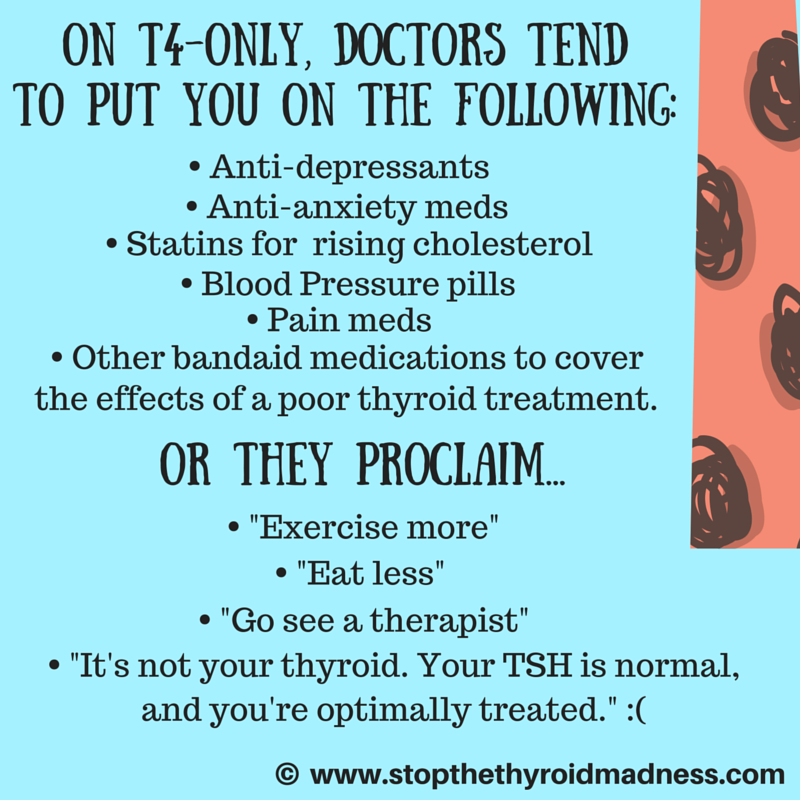
Summary: it’s just too common for doctors to bandaid continued symptoms of hypothyroidism with antidepressants, anti-anxiety meds, statins, blood pressure meds, or pain meds—or to exclaim “Exercise more, eat less, go see a therapist, your TSH is normal”.
But what about Tirosint, a newer version of T4-only?
Tirosint is a liquid version of T4 which patients have reported doing better on than Synthroid or Levo. But many patients still reported problems from forcing your body to live for conversion to T3 alone. Feeling better apparently doesn’t equal getting rid of all symptoms of hypo, or avoiding the problems that too many encounter down the line from forcing their bodies to get T3 from conversion only. We add T3 to that Tirosint, and work to achieve this: https://stopthethyroidmadness.com/optimal/
So what’s a better alternative to being on T4-only?
Those with hypothyroidism, no matter the cause, have reported repeatedly over the years that having T3 added to T4 gives better results, then getting optimal! We are not just forcing our bodies to get T3 from conversion alone, we as patients have discovered over and over. Or get on NDT (natural desiccated thyroid) and raise until your free T3 is optimal, which maintaining a LOW RT3.
How are your adrenals?? Start here to read good information to consider. How are your iron levels? This has info. Because T4-users often see one or both go south on T4. Not all do. But enough do. We have learned repeatedly that to successfully raise T3 in our treatment, our levels of iron and cortisol are important!
I once tried T3 in my treatment, and it gave me problems! Why?
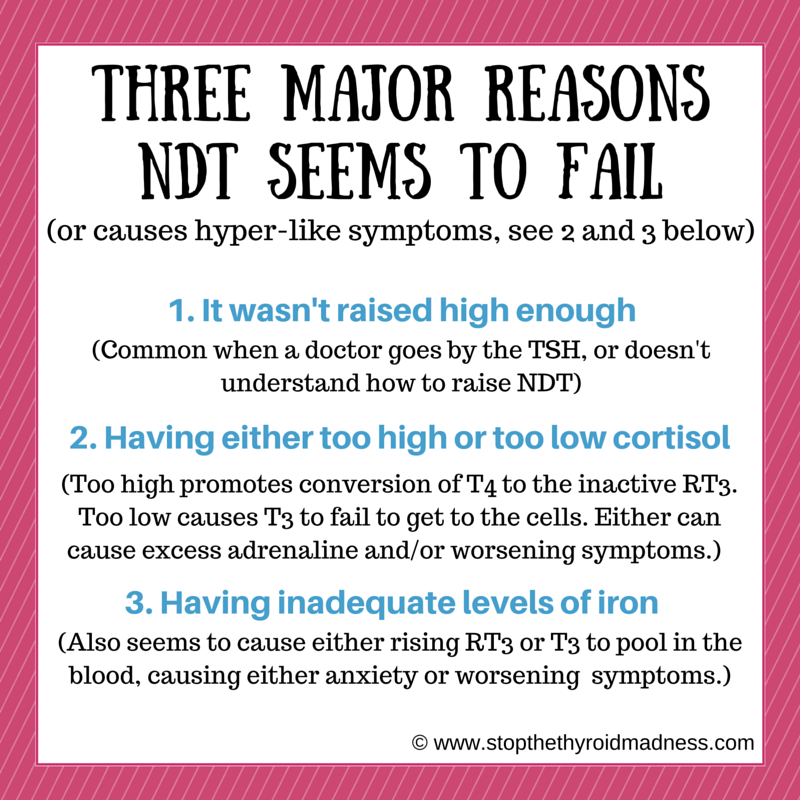
In other words, read this to learn about the problem of too high or too low cortisol or inadequate levels of iron.
As a thyroid cancer patient, my doctor wants me to suppress my TSH on my T4. Is that ok?
TSH does need to be suppressed after thyroid cancer, especially stated by certain medical professional. But…this research implies that doing it with T4 is bad: https://www.targetedonc.com/publications/targeted-therapy-news/2017/march-2017/levothyroxine-linked-to-heart-risks-in-patients-with-thyroid-cancer i.e. patient experiences find it’s better to suppress the TSH with a working NDT, or T4/T3, or T3, as it’s common to see the TSH suppressed anyway on these meds when optimal. NOTE: the TSH will be suppressed before optimal. So what is optimal? A large percent of patients state they have a free T3 towards the top part of the range and a free T4 midrange, both. Good iron and cortisol is important to achieve optimal without problems.
Bottom line??
Years and decades of reported patient experiences and observation tell us that the risk for problems is far too high with T4-only—sooner—or later, for too many. It’s not a pretty picture. So patients feel strongly: Why risk it? Work with your doctor on this. Want to learn more? Listen to an audio version of some of this page.
Important notes: All the information on this website is copyrighted. STTM is an information-only site based on what many patients worldwide have reported in their treatment and wisdom over the years. This is not to be taken as personal medical advice, nor to replace a relationship with your doctor. By reading this information-only website, you take full responsibility for what you choose to do with the information on STTM or its outcomes. See the Disclaimer and Terms of Use.