Your adrenals might be overworked, thus stressed! And that will prevent you from fully getting well as a hypothyroid or Hashimoto’s patients.
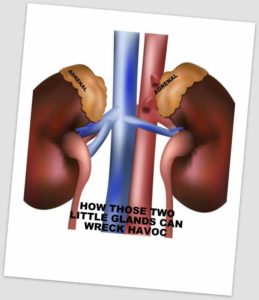
When I started this patient-to-patient movement, we were amazed to discover that an awful lot of us had stressed adrenals. No, not all. But a good amount of us. And stressed adrenals cause problems when you are raising any thyroid med with T3 in it, such as higher heartrate, palpitations, anxiety, and any hyper-like symptoms. T3 is the active thyroid hormone and needed, but patients have to be aware when it’s revealing stressed adrenals!! So here’s information for you to see if you might have a cortisol problem. And work with an open-minded doctor! ~Janie, hypothyroid patient and site creator
Do one or more of the following fit you?? These are stressed adrenal symptoms. And you won’t get fully well if your adrenals are stressed.
- Having hyper-like symptoms when trying to raise a working natural desiccated thyroid, or T3 in your treatment (heart palps, fast heartrate, shakiness, anxiety, or etc)?
- Not doing as well on a working desiccated thyroid or T3 as you hoped, even when your doctor had you raise?
- Have a high free T3 with continuing hypothyroid symptoms (which is called pooling)??
- Feeling anxiety more than you think you should?
- Finding yourself more defensive than normal, or a need to argue, or feeling paranoid, or irritable?
- Having internal or external shakiness?
- Insomnia…or waking up an hour or two after you fall asleep for the night
- Do you wake up in the middle of night, or way too early?
- Not waking up or getting up feeling refreshed in the morning? Waking up feeling sluggish or tired? Or in some, feeling tired again 1-2 hours later?
- Heart palps or higher heartrate
Why would the above happen to you?
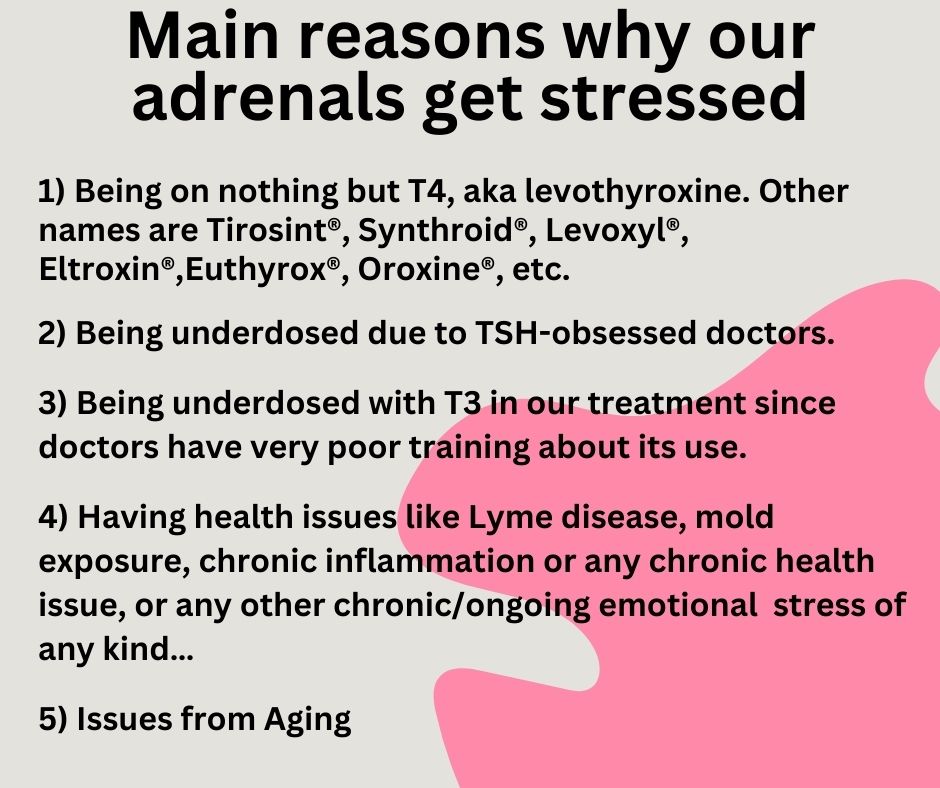
- You were hypothyroid for several years before being diagnosed (either because no one understood, or your doctor kept using the lousy TSH and saying it was normal)
- You have been on nothing but T4-only medications like Synthroid, Levoxyl, Eltroxin, Oroxine, Tirosent, etc (which end up poorly treating hypothyroidism for all too many)…
- You have experienced chronic/ongoing emotional or biological stress of any kind…
- You have chronic inflammation, lyme, or mold exposure, or any chronic illness.…
All the above means your stress-busting adrenals have been working hard to keep you going.
What first happens is your cortisol levels start going very high, aka “high cortisol”. Even a poor diet and excess exposure to heavy metals and toxins could have further stressed your adrenals.1
But the body can only keep up with high cortisol for so long. So then what happens? The second part of the process: cortisol will start to fall, aka “low cortisol”. Note: even the last chapter of the STTM II book by Lena D. Edwards, MD explains this brilliantly and is highly recommended. You can even have a problem in the HPA axis, which is the messaging between your hypothalamus, pituitary gland and adrenals, and can result in the adrenals failing to respond well.2 This can mean adrenal function inhibition.
Aldosterone
Aldosterone is another adrenal gland steroid that can fall, too, patients have reported, from having stressed adrenals. And that can cause those hyper-like symptoms when raising a thyroid med with T3 in it. It also lowers sodium and potassium over time.
You should test your cortisol levels, but NOT by blood
To see what is going on, it is NEVER about guessing. NEVER. Guessing mostly ends up being wrong. Saliva testing is the best way to test, we as patients have found repeatedly. It’s testing what is AVAILABLE for use at four key times in a 24-hour period, whereas blood is testing mostly bound and UNAVAILABLE cortisol, and is only done ONE TIME in a day. Not good. Go here to order a very reliable saliva test and read all the pages on the site. This is NEVER about guessing.
Why is the right amount of cortisol so important?
Cortisol, a corticosteroid hormone, has a variety of important functions, from the metabolism of carbohydrates, proteins, and fats, to affecting the blood sugar levels in your blood, to helping reduce inflammation, to helping you deal with stress. The latter is especially huge.
But the right amount of cortisol plays an important role for you as a thyroid patient in helping get thyroid hormones to the cells! Namely, cortisol raises your cellular level of glucose3 which seems to work with cell receptors, ATP and mitochrondria to receive T3 from the blood to the cells. Without getting to the cells, you have problems.
More signs and symptoms of a cortisol problem, or even low aldosterone
Dysfunctional adrenal output can result in your free T3 going high in the blood rather than reaching the cells, called pooling. Some patients may not realize it’s happening at first. Others will either still feel quite hypo, or can have hyper-like symptoms like anxiety or nervousness, light-headedness, shakiness, dizziness, racing heart, sudden weakness, nausea, feeling hot, or any symptom which seems like an over-reaction to desiccated thyroid or T3, but are in reality the result of low cortisol, or too high levels, or a mix of high and low in the early stages of sluggish adrenal function. Low cortisol can also keep you hypothyroid with hypo symptoms. Also having low aldosterone can create these hyper-like symptoms, too.
- Click here to read actual reported patient symptoms of stressed adrenals
Thus, it can be important for you and your doctor to rule out stressed adrenals. Most patients will notice the strange reactions early on, while a minority may not until they get as high as 3 grains of NDT, or trying to raise T3.
Below are what are called DISCOVERY STEPS which can further prove you need to order and do a saliva test:
DISCOVERY STEP ONE:
1) Do you have a hard time falling asleep at night?
2) Do you wake up frequently during the night?
3) Do you not feel refreshed and ready to go when you wake up in the morning? Do you still feel tired when you wake up? Do you have a hard time waking up?
4) Do bright lights bother you more than they should?
5) Do you startle easily due to noise?
6) When standing from sitting or from lying down, do you feel lightheaded or dizzy?
7) Do you take things too seriously, and are easily defensive and angry?
8 ) Do you feel you don’t cope well with certain people or events in your life?
DISCOVERY STEP TWO:
The following are self-tests to try if you suspect your adrenals are struggling:
Blood pressure test
Take and compare two blood pressure readings–one while lying down and one while standing. Rest for five minutes in recumbent position (lying down, tho some do sitting) before taking the reading. Stand up and immediately take the blood pressure again. If the blood pressure is lower after standing, suspect reduced adrenal gland function, and more specifically, an aldosterone issue—another adrenal hormone. The degree to which the blood pressure drops while standing is often proportionate to the degree of hypoadrenalism. (Normal adrenal function will elevate your BP on the standing reading in order to push blood to the brain.) It can be wise to do this test both in the morning and in the evening, since you can appear normal one time, and not another. (More about how to take blood pressure correctly as well as when diastolic pressure change when one stands up.
Pupil test
This is called the Pupil test and primarily tests your levels of aldosterone, another adrenal hormone. You need to be in a darkened room with a mirror. From the side (not the front), shine a bright light like a flashlight or penlight towards your pupils and hold it for about a minute. Carefully observe the pupil. With healthy adrenals (and specifically, healthy levels of aldosterone), your pupils will constrict, and will stay small the entire time you shine the light from the side. In adrenal fatigue, the pupil will get small, but within 30 seconds, it will soon enlarge again or obviously flutter in it’s attempt to stay constricted. Why does this occur? Because adrenal insufficiency can also result in low aldosterone, which causes a lack of proper amounts of sodium and an abundance of potassium. This imbalance causes the sphincter muscles of your eye to be weak and to dilate in response to light. Click here to see a video of fluctuating pupils, and thanks to Lydia for providing this.
DISCOVERY STEP THREE:
If you recognize anything from above, you badly need to order and do the 24 hour adrenal saliva test, NOT a blood test. Blood is simply measuring mostly bound, unusable cortisol, whereas saliva is measuring what is UNbound and usable, plus at four key points in your awake period. Note that the 4-point saliva test is very adequate. Save your money instead of getting the 6-point.
But you need to also do a test for Aldosterone, which is by blood.

Saliva Cortisol testing is stated to measure your cellular levels at four key times in a 24 hour period—revealing whether you have high cortisol (which can have similar to symptoms to low cortisol), or a mix of highs and lows (which can be problematic in raising NDT and cause too much RT3), or a majority of lows, which is extremely problematic when raising thyroid meds, causing hyper-like symptoms and excess RT3.
Unfortunately, doctors tend to recommend a one-time blood test, or an ACTH Stimulation test, or a 24-hour urine test, but patients have reporting saliva to give them better information.(4)
Blood is measuring both your bound and unbound cortisol—not always helpful, report patients, nor does it tell what goes on at different times. It can look high when you are actually low! The ACTH Stimulatory will tell you how much stimulation your adrenals are getting, but not how much cortisol they are producing. Granted, the ACTH Stim test can be valuable if there is suspicion of a pituitary dysfunction, Addison’s or Cushings.(5) Let your doc help you with that! But we have noted that most patients with sluggish adrenal function have healthy ACTH stimulation. A urine test simply gives you an average of a 24 hour period, and that masks being high one time, and low another, which are important clues to sluggish adrenals. (More detail on this in STTM book)
IMPORTANT NOTE: Patients have discovered there are many supplements they need to be off of for ‘up to’ two weeks to get a clear picture what is going on. But study the page carefully.
How to treat what saliva cortisol testing reveals (testing it NOT about blood cortisol and doctors don’t get that)
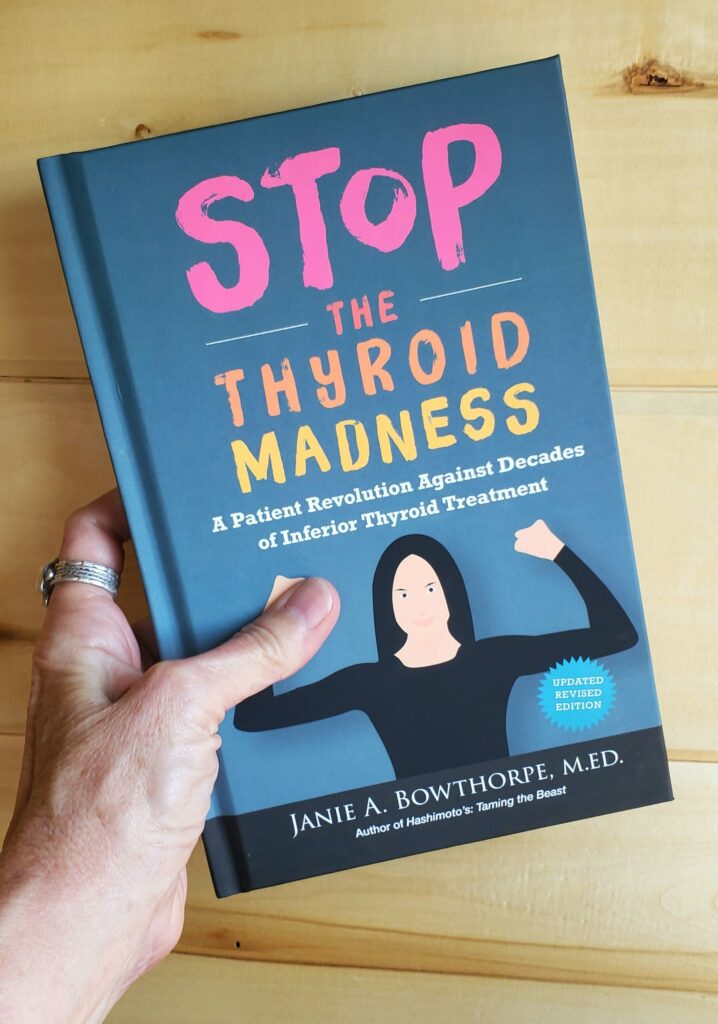
This is where you DO need the updated revision STTM book–shown on the left. It’s available in hardback or soft cover.
Information on what we as patients have learned, especially with treatment, is in chapters 5 and 6 in this updated revision STTM book. Chapter 6 is especially important to read and study.
That book, called Stop the Thyroid Madness: a Patient Revolution Against Decades of Inferior Thyroid Treatment, is also shown here and can be ordered from there as well.
Note this is not a novel. It’s a reference book. You can look things up as you need to know the information. And this book’s patient-to-patient information turns lives around.
Expect that you will need to TEACH most any doctor about what you will learn in those chapters, and especially Chapter 6.
Is it possible I have Cushings disease explaining my high cortisol?
The vast majority of hypothyroid patients, no matter the cause, have observed over the years that their high cortisol had nothing to do with Cushings. It’s just the first response to the causes shown above.
Cushings is usually defined as having an ACTH-producing tumor on the pituitary gland (or less often, elsewhere in the body) or a dysfunction in the adrenals themselves. Again, most of us do NOT have that. But you can always do a test for that, below, in working with your doctor.
1) DEX SUPPRESSION TEST—this is the most common test and measures how your cortisol levels change in response to an injection of dexamethasone, a strong cortisol-like medication.
2) 24-HOUR URINE TEST – if high, could imply Cushings, but even thyroid patients with high cortisol could show high urine levels, so it may not be definitive by itself. Some doctors admit this, as well…
3) 11 pm to MIDNIGHT SALIVA TEST — researchers feel this gives a high sensitivity for the diagnosis6, BUT.…we at patients know from observation that many hypothyroid patients can still have HIGH late evening cortisol not from having Cushings.
An MRI can be another diagnostic too to discern if one’s high cortisol comes from an ACTH-releasing pituitary tumor.
Another small body of thyroid patients could have created what is called “Cushings Syndrome“7. This could happen with someone who is determined to be on HC/Cortef in too high amounts (not doing ones Daily Average Temps to find their right physiologic amount, as taught by Dr. Rind), or being on HC/Cortef even though their saliva results didn’t show the need for it (the reason patients and informed doctors see the need to do saliva cortisol testing). Please work
closely with your doctor on this.
The above is simply information, not a diagnosis. Work with your doctor.
**************
P.S. For “some”, sluggish adrenal function causes extra estrogen production. And sadly, the higher your estrogen, the more bound both your thyroid hormones and cortisol will be. Explains Dr. Hotze (in relation to childbirth and postpartum, but applies to what I explained above):
High levels of estrogen causes an increase in levels of cortisol-binding globulin which–you guessed it–binds cortisol in the blood. The amount of free cortisol available to enter the cell membranes and activate receptors inside the cell is now greatly diminished. In addition, estrogen dominance interferes with the release of cortisol from the adrenal cortex. Another key fact is that cortisol is made from progesterone. When progesterone levels dramatically decline after pregnancy, so does cortisol production. Whether it is an inhibited output of cortisol from the adrenal cortex, an overall decrease in cortisol production or whether cortisol is bound in the bloodstream, all follow with the same result: adrenal fatigue.
- Some people have low cortisol/adrenal insufficiency due to other issues like Addison’s, hypopituitary or a hypothalamus problem. Read about them here.
- Click here to read the most FREQUENTLY ASKED QUESTIONS about adrenal support.
- Why exercising after the baby is born is not a good idea if you have low cortisol.
- Go here to read the Internt’l Hormone Society’s CONSENSUS on CORTISOL REPLACEMENT, and sign the petition
Please let me know if any of links suddenly fail to work. Websites do change occasionally.
(2) https://academic.oup.com/qjmed/article/93/6/323/1536811
(3) http://www.jbc.org/content/239/5/1299.full.pdf
(4) https://www.sciencedirect.com/science/article/pii/0009898181903533
(5) https://patient.info/doctor/pituitary-function-tests
6) https://csrf.net/understanding-cushings/diagnostic-testing/
7) https://csrf.net/doctors-articles/med-induced-cushings/medication-induced-cushings/
Important notes: All the information on this website is copyrighted. STTM is an information-only site based on what many patients worldwide have reported in their treatment and wisdom over the years. This is not to be taken as personal medical advice, nor to replace a relationship with your doctor. By reading this information-only website, you take full responsibility for what you choose to do with the information on STTM or its outcomes. See the Disclaimer and Terms of Use.