Find out more here!
Hide me

* You are viewing Posts Tagged ‘hypothyroid’

T3 to heal adrenals, Selenium, Liver Health–all important info for thyroid patients!

HOW T3, DOSED A CERTAIN WAY, CAN REVERSE YOUR ADRENAL FATIGUE! 

UK’s Hashimoto’s patient Paul Robinson has been a successful T3-only treated patient for more than 13 years, especially because he never did well on either synthetic T4, nor on the combination of T4/ T3. And he learned so much that he compiled all the information on T3 dosing in his book called Recovering With T3: My Journey from Hypothyroidism to Good Health Using the T3 Thyroid Hormone.  You can order it here.

But what I especially find interesting is how he used T3 to cure his flagging adrenal function rather than HC (hydrocortisone).  And here is a short summary of key points, and you can read more by getting his book. He calls this The Circadian T3 Method.

  1. Most of the day’s cortisol is made in the last four hours of sleep, which means your adrenals work their hardest during that time. And like any cell in your body which need T3 to function well, so do your adrenal cells…especially during the time they work the hardest.
  2. With the above in mind, it made sense to Paul that if adrenals are struggling with low cortisol, they clearly need T3 in that early morning 4-hour window in order to function better. How did he do it?  He moved his first T3 dose to one hour before he would normally wake up, held it for a few weeks to see the results, went earlier another half hour, held it for a few weeks to see the effect…and so on. He obtained a lot of data to ascertain what was happening–urine cortisol, blood pressure, pulse, etc. He found that the time which gave his adrenals the biggest boost, and thus better function, was 3 1/2 hours before he normally wakes up.  But he feels that others might find that anywhere in the first three hours of that four hour window, and it’s important to move slowly within that area to find the right time for you based on data.
  3. This protocol needs certain supplements, which include high potency B complex, B12, Vit. C, Vit. D and a good multi mineral. He goes into detail in his book.
  4. This protocol would not work if someone has Addisons, Hypopituitary or Diabetes…and may not work if you have pre-Diabetes blood sugar issues. It’s blood sugar in the cells that reacts positively with T3.

There is much more detail than the above. And Paul makes it clear that this treatment for adrenal fatigue and proven low cortisol should only be done in your relationship with your doctor. So you will need his book to understand it all. We have also been discussing this protocol in the new STTM Facebook Adrenals group–created for friendly discussion of your experiences and anything you learn elsewhere.

SELENIUM, EVEN WITH HIGH RT3, IS A MINERAL YOU NEED!

Check out what thyroid patient Cheryl Alvey has put together about the key importance of selenium for thyroid patients: http://www.stopthethyroidmadness.com/selenium

WHY THYROID PATIENTS NEED HEALTHY LIVER FUNCTION

Not only is your liver the largest organ in your body, it does an astonishing amount of work to keep you healthy. It helps maintain good blood sugar levels, metabolizes fats and proteins, helps eliminate toxins via the bile, stores important vitamins and minerals, and makes cholesterol–the pre-cursor for estrogen, progesterone, testosterone, cortisol, DHEA, and aldosterone.

As for thyroid, your liver is is equally as important:

  • promotes type 1 deiodination for the conversion of  T4 to T3
  • helps with transport of T4 and T4 throughout your body

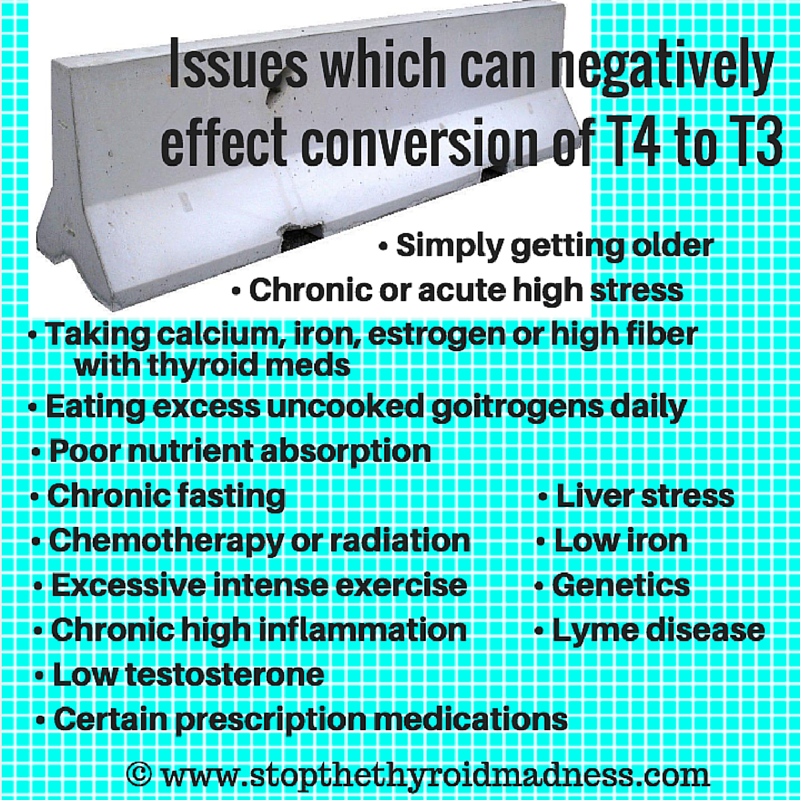
So what happens if your liver isn’t healthy?  Transportation is less optimal, and the deiodination type 1 will change to type 3, meaning T4 will convert to excess RT3! And guess what can make your liver unhealthy? Continued hypothyroidism, which happens to all too many who are on T4-only medications, or those left undiagnosed due to the TSH. Hypothyroidism is worsened with adrenal problems, and low iron.  And liver function can become unhealthy or stressed if you eat poorly  You can read more about all this here.

In the meantime, what can one do to promote better liver function? Milk thistle is one highly recommended way by many (use Milk Thistle supps from the seeds to avoid estrogenic affect). Also look into dandelion root /leaf, Sassafras, Burdock, Goldenseal and Yellow Doc root, Red Clover and Echinacea root. Ask someone knowledgeable at your local health food store.

I DID THE JUICING FAST

Yup, I watched the DVD “Fat, Sick and Nearly Dead”, and it just resonated with me–both for my yearly weight loss diet which I do after Christmas (to take off the result of all those Christmas goodies), and the immense nutritional benefits.  So I got a new juicer (I chose the Masticating juicer because it gets out more juice-see those on Amazon), shopped for all the veggies and fruits I’d need to use, and began. As I write this, I am approaching my 12th day. Yes, I’ve lost weight–belly is smaller…so is face. But even better, I know I’ve done a wonderful thing for my body with all the nutrients one gets from the juicing of a variety of mostly veggies, and some key fruits.  I’ll probably finish soon, but will always do juicing for veggies a few times a week, because I simply can’t stand them otherwise. And juicing them is quite good if you add a juiced fruit like an apple.  Cheers!

PATIENT YOU-TUBE STTM VIDEOS

See thyroid patient Sam Aliyev’s latest YouTube video.  If you do one about the message of STTM, let me know and I’ll post about it.

Has STTM benefitted you?? Want to Pay It Forward? Go here.


  • Hip hip!! STTM has new products to help spread the word, here. Great BUMPER STICKERS, too, here. Spread the word--YOU may make a difference in someone’s life.
  • Check out the NEW REVISED patient-to-patient book with even more detail (and which doctors seem to respect more than websites).
  • Need to understand all your best options for thy­roid treat­ment? Go here.
  • Want to keep track of these "fringe website" blog posts? ;-) Curious what’s on Janie’s mind? Use the Blog Notification on the lower left of the links. or use an RSS Feed.

Taking your temp, Selenium and RT3, TPA’s Autumn Newsletter, and HealthcheckUSA’s discount to STTM readers

NOTE: after posting the below yesterday, November 6th, WordPress changed the date to October 6th, and it showed up BELOW my Halloween post.  So, I’m removing what I posted yesterday, reposting for today, Nov. 7th, and I’ll add the two relevant comments that were already given to this post, below.    Janie)

(Photo graphic by thyroid patient Sam Aliyev of Azerbaijan, Baku city.)

  • TAKING YOUR TEMPERATURE CORRECTLY?? Possibly not. 

Thanks to Dr. Broda Barnes, informed thyroid patients know the importance of taking one’s temperature, especially just before we get out of bed in the morning. According to Barnes, we can suspect a thyroid problem if that temp is below 97.8. Conversely, healthy thyroid function (or adequate treatment) would  put our before-rising temp from 97.8 to 98.2. (Menstruating females would need to be aware of higher temps right after ovulation.).

Today, we favor the mercury thermometer over digitals for accuracy. But are we using the mercury thermometer correctly? Maybe not.

A discussion between thyroid patients recently underscored the need to leave it in the mouth longer than the 5 minutes we thought was adequate. Thyroid patient Jennifer states: At 5 minutes it read 97.6, at 10 minutes it read 97.8 and at 15 minutes it read 98 degrees. After that, it stayed 98 degrees.  We then discussed the fact that manipulating the muscle in the back of throat could have caused the final temp. But her experiment, as well as others, underscored that we need to be holding that mercury thermometer in our mouths no less than five minutes, and ten is probably better.

  • DOES SELENIUM REALLY CAUSE A RISE IN REVERSE T3 (RT3)?  THINK AGAIN.

The above statement about selenium causing excess RT3 has oft been repeated from group to group for a few years. But it may be very wrong.

For example, this study shows selenium did not cause a rise in RT3, and in fact, lowered  it. Here is one which shows LOW levels of selenium can result in increased RT3. This medical book states that though RT3 comes from T4, it also concludes that  low selenium increases RT3.

In other words,  though the enzymes that convert T4 to T3,  and convert T4 to RT3, are selenium dependent to do their job, that doesn’t mean that selenium is going to increase your RT3.  Bottom line, many thyroid patients love selenium, especially with its power to lower Hashimoto’s antibodies, and being anti-cancer. Suggested levels are no more than 400 mcg.

  • TPA’s AUTUMN NEWSLETTER IS OUT–many good articles!

TPA stands for Thyroid Patient Advocacy, and is a UK charity organization started by Sheila Turner. Check out the articles below in thelatest newsletter.

Page 5: The Big Question – Is There an Anti-T3 Conspiracy.  Eric Prichard critically questions why those in Endocrinology need to cite numerous anti-T3 studies, in spite of many other studies which reveal the activeness and superiority of T3. Is the UK and other dark age countries ever going to get it?

Page 9:  Why I Believe T3 Should Be the Very Last Treatment that Thyroid Patients Consider.  Don’t let UK’s Paul Robinson’s title fool you. He believes in the efficacy of T3, but underscores why it can be complex to dose with just T3.  Especially compelling are what follows Paul’s article, titled MEMBERS SUCCESS STORY.  Story 1 is about an individual who, when dosing T3 in the early morning hours, was able to get off all adrenal meds. Story 2 is about a gal’s successful transition from T4 to T3.

Page 15:  Thyroid Patients Have Come a Long Way, Baby….But We Still Have a Way to Go!  Though there are now numerous patient groups on the net and many lives have changed, Janie Bowthorpe (yes, me) explains how many doctors still have a long way to go in understanding how T4 and TSH fail patients, just as desiccated thyroid or T3 have turned miserable lives around.

  • HEALTHCHECKUSA WENT UP ON SALIVA TESTING….BUT HERE’S HOW YOU CAN GET THE ORIGINAL PRICE!!

On the Recommended Labwork page, you’ll see several lab facilities where patients can get their own labwork done. HealthcheckUSA is a favorite for many. Unfortunately, their “Adrenal Hormones Saliva Testing Kit from ZRT labs (Dirunal Cortisol and DHEA-S)” went up, from $170.00 to $ $265.00. But there is GOOD NEWS:  STTM’ers can keep the price of $170.00 by placing a PHONE ORDER for the saliva at 1-800-929-2044. The customer will need to mention STTM!!   MENTION STTM to get the discount.

  • READING THIS BLOG POST VIA AN EMAIL NOTIFICATION??

If you want to respond to this post, click on the title at the top of the email, which will take you directly to the blog post on the STTM site. Then click on Comment.


  • Hip hip!! STTM has new products to help spread the word, here. Great BUMPER STICKERS, too, here. Spread the word--YOU may make a difference in someone’s life.
  • Check out the NEW REVISED patient-to-patient book with even more detail (and which doctors seem to respect more than websites).
  • Need to understand all your best options for thy­roid treat­ment? Go here.
  • Want to keep track of these "fringe website" blog posts? ;-) Curious what’s on Janie’s mind? Use the Blog Notification on the lower left of the links. or use an RSS Feed.

One more kooky & hilarious video! Plus more about bipolar, pregnancy, mistakes patients make.

HUMOROUS VIDEO ABOUT ADRENAL FATIGUE:   In my blog post last February 15th, 2011, I sent you in the direction of a kooky, creative and hilarious You Tube video titled “Our Holy Miracle of the Infallible TSH Test”.

Well, creator and thyroid patient Brian Foreman has brilliantly done it again, but this time, it’s about adrenal fatigue and titled “Why Isn’t My Thyroid Medication Working?”  Have fun watching it, and get ready for a good laugh here and there.

Want to know more about adrenal dysfunction? Go here to find out about the problem, and do the Discovery Tests tests to see if you might have it.  Note that it’s critical, if the self-tests seem to point to an adrenal issue, to do a 24-hour adrenal saliva test to see what is going on at four key times during a 24-hour period.  Here is a compilation of what patients have learned in how to treat low cortisol, and this page is important to share with your doctor. If you want even more detail, it is strongly recommended by thyroid patients to order the REVISED STTM BOOK, and see Chapters 5 and 6. This can be carried right into your doctor appointment with key areas highlighted and bookmarked.

******************************

BIPOLAR, DEPRESSION and HYPOTHYROID: A thyroid patient emailed me with just one more article on the connection between having a bipolar disorder and one’s thyroid, including the fact that there is “a strikingly high rate of autoimmune-caused thyroid problems in people with bipolar disorder”, aka Hashimotos disease.

And even if depression is your main problem, the article mentions “gently pushing your thyroid status over toward the “hyperthyroid” end of normal, if you happen now to be toward the hypothyroid end of normal”, in order to adequately reverse the depression problem. I constantly think back about my own mother who suffered from depression, succumbed to having shock therapy, and ended up on anti-depressants the rest of her life because of her use of Synthroid.  So we know that treating hypothyroidism with direct T3, such as is found in desiccated thyroid, is far better. 

******************************

IS THERE A BABY KNOCKING IN YOUR BELLY?  I often see pregnant women in forums wondering how their babies are doing and how the thyroid works in helping their babies, or hurting them if the mother is pregnant and hypothyroid.  Here is an article sent to me that can help inform as to changes in your thyroid function when pregnant, how thyroid hormones affect the brain of the fetus, and the role of iodine.  It can underscore how important proper treatment is while pregnant.

What about adrenal fatigue which so many thyroid patients find themselves with, and pregnancy? A gal named Anne has written about this issue here. She has Addisons disease, which is more about a disease process and can be autoimmune, but her comments can be very applicable for those of you with sluggish adrenal function. Share all of this with your doctor. Need to find a good one?? Go here.

*******************************

TWO COMMON MISTAKES  MADE BY PATIENTS:  In patient groups, here are two common mistakes I see patients make:

  1. Not doing the 24 hour adrenal saliva test if adrenal dysfunction is suspected:  I can’t stress this enough:  patients have learned repeatedly they shouldn’t have rushed into cortisol treatment if they or their doctor’s “suspect” an adrenal problem. Yes, STTM has outlined several self-tests, called Discovery Steps, that you can do in your own home to see if anything is suspicious. There is also a checklist of symptoms related to adrenal problems. But the problem is two-fold:  symptoms of high and low cortisol can be exactly the same, and ‘where you are low’ and ‘where you are not’ can dictate how your treatment should be.  Some only need to lower high cortisol, some may do well on simply adaptogens like Ashwagandha or Rhodiola, some do well on Isocort or OTC adrenal cortex, and some outright need to be on prescription hydrocortisone. Teach this to your doctor. Here is where you can order your own saliva tests, and then take them into your doctor’s office.
  2. Not getting copies of labwork: Contrary to how your doctor says it, you have a right to have copies of your own labwork. And you should! Patients often come on groups seeking feedback from other patients, and yet, have no idea what their labwork was, or the ranges. Getting copies of labwork is just one step of many in being a pro-active patient. Here is how to read labwork according to the experience of thyroid patients.
Remember: Stop the Thyroid Madness, aka STTM,  is a patient-to-patient informational site meant to educate and inspire you with that information. Talk to your doctor about what you have learned; use the STTM revised book right in the office, and push for what you believe in, and you can go a long way to feeling MUCH better.

  • Hip hip!! STTM has new products to help spread the word, here. Great BUMPER STICKERS, too, here. Spread the word--YOU may make a difference in someone’s life.
  • Check out the NEW REVISED patient-to-patient book with even more detail (and which doctors seem to respect more than websites).
  • Need to understand all your best options for thy­roid treat­ment? Go here.
  • Want to keep track of these "fringe website" blog posts? ;-) Curious what’s on Janie’s mind? Use the Blog Notification on the lower left of the links. or use an RSS Feed.

New discovery about low magnesium & oxalates, plus a GOOD UK article, and when your spouse is hypo and wants out of the relationship!

HAVE LOW MAGNESIUM LEVELS AND SYMPTOMS? Do you have a hard time raising any of your mineral levels?

I have been working to raise my miserably low RBC (red blood cell) magnesium levels for a good year. And in spite of a strong commitment to my magnesium supplementation as well as oil, I continued to have typical low-magnesium symptoms–most especially lower leg cramping after hiking or heavy duty activity. Why was that?  I think I may have discovered one contributing factor, and this may apply to you.  It’s called high OXALATE food consumption.

Oxalate is an “organic acidic salt compound” commonly found in foods of plant origin. It’s also produced in your body by the metabolism of glyoxylic acid or ascorbic acid (vitamin C).  And it is normally excreted out of your body via urine, and sometimes the bowels.

But it turns out if you consistently eat a LOT of food containing high levels of oxalates, on top of what your body naturally produces, your body will have excessive levels. This may be exactly what happened to me this year, also causing chronic hives (scratch~scratch~scratch). The latter pushed me to do research, and voila, I realized I had consumed far too many high-oxalate foods (which in turn produced excessive histamine). And my eyes popped out when I read this:

“oxalates strongly bind to minerals and vice versa (e.g., calcium, magnesium, zinc and potassium), and reduces the absorption of your minerals as they both come out via your urine.”

It’s a negative love affair for your cellular mineral levels!!

What are foods which are the highest in oxalates? In alphabetical order, they include:

almonds, amaranth, black beans, brazil nuts, beets, blackberries, buckwheat, carob chips, carrots, cashew nuts, cannellini beans, celery, chocolate, corn meal, dried apricots, cooked tomatoes, great northern beans, green peppers, hazelnuts, marshmallow root, milk thistle, navy beans, oil of oregano, okra, peanuts, pecans, pine nuts, pink beans, pinto beans, potato chips, potato flour, rice bran, rhubarb, sesame seeds and tahini, slippery elm bark, all soy, spinach, star fruit, sweet potatoes, teff (flour and whole grain), quinoa (whole grain), white bean flour, and yucca powder.

And what was I eating daily as I was working on the final updating of the revised STTM book this year? Cocoa-covered almonds! Almonds are considered a very-high-oxalate food, as is cocoa.  That was on top of the slivered almonds in my morning yogurt, as well as my consumption of pecans, spinach, and okra. I also drink iced tea daily, which can have higher levels of oxalates. And many times, I grabbed small amounts of frozen sugar-free carob chips every few hours. ~~blush~~

I am currently on a low oxalate diet (besides a great herbal blend four times a day to counter the itchiness and histamines).  And I am curious that by lowering oxalates, I just may finally be able to get my magnesium levels up and far faster.  We’ll see. To see a good blog post and list of oxalate foods (high and low), called Roo’s Clues, go here.

And for more to the oxalate story, including its connection to autism, leaky gut, depression, kidney stones, yeast overgrowth and arthritis, read this.  B6 is also crucial in lowering oxalates.

**************************

UK thyroid patients are clapping at the latest article which appeared in the July 3rd “The Mail”, a UK based, Sunday only magazine. It’s titled  “For Twelve Years I was a victim of The Great Thyroid Scandal” by Matthew Barbour. You can read its entirety here.

**************************

WHEN YOUR HYPOTHYROID SPOUSE OR LOVED ONE IS RUINING YOUR MARRIAGE or RELATIONSHIP:

Over the years, I’ve gotten several emails, and mostly from men, who are emotionally suffering.  But it’s not because they themselves are hypothyroid. It’s because their spouse/girlfriend is, and many of the latter seem to be in the throes of adrenal fatigue and low cortisol, as well.

The correspondents all seem to love their spouses dearly. But their spouses are defensive, over-reactive, paranoid, depressed and/or reclusive—all typical symptoms of having low cortisol. Depression is especially a problem even for those who just have undiagnosed or T4-only treated hypothyroidism.  And most all of those who email me are facing extremely unhappy relationships at the least, and pending divorces at the worst, even while still loving their spouses and wanting to stay married or connected.

If this fits you,  there is a brand new group you can join called Hypothyroid Spouses.   This is NOT just for men. If you are a women in relationship with a man who is like the above, you are welcome, too.

Note that you will need to very specific when you ask to join as to why you think you need to be in this group. This is a moderated and private support group, and is NOT for anyone but those in a relationship with a challenging hypothyroid and/or adrenal spouse.


  • Hip hip!! STTM has new products to help spread the word, here. Great BUMPER STICKERS, too, here. Spread the word--YOU may make a difference in someone’s life.
  • Check out the NEW REVISED patient-to-patient book with even more detail (and which doctors seem to respect more than websites).
  • Need to understand all your best options for thy­roid treat­ment? Go here.
  • Want to keep track of these "fringe website" blog posts? ;-) Curious what’s on Janie’s mind? Use the Blog Notification on the lower left of the links. or use an RSS Feed.

Thyroid Tidbits: Men with low iron, Reverse T4 (yes, I said it correctly), Inflammation in thyroid patients, plus more

(No, the tatoo isn’t mine. It belongs to a gal who says STTM helped changed her life. Amazing and brave! :) )

MEN CAN HAVE LOW IRON, TOO:

I’ve seen a few hypothyroid men who have found themselves with low iron. In fact, either iron anemia is growing in men, or we’re just hearing from them more thanks to the internet.

And remarkably, it has become personal for me. Turns out my own husband is very low, which explains the fatigue he had been experiencing lately. Sadly, taking iron pills give him a headache, so he will eat high-iron foods daily, and will be exploring Floradix, a liquid herb-based iron. Men, get all the needed iron labs!

REVERSE T4 (yes, I said it correctly)

I’ve been having an email chat with a scientifically-minded guy named Brian who also has a sister with a major in bio-chemistry. And something dawned on both of them concerning “levothyroxine” which is the synthetic term for T4.  The prefix LEVO means the ”left-hand” version of a molecule, and thyroxine is the biological term for the real T4.  Says Brian: “Levo-thyroxine means it has exactly the same atoms in exactly the same order, but not the same shape (handedness), so if enzymes or proteins have to chemically “fit” it to work, they may not be able to. He concludes this can be one reason being on synthetic T4-only does not work, and knew it was alluded to by Dr. Mark Starr.

But Brian continues: In just the same way that levothyroxine is the mirror-image or “left-handed” version of regular thyroxin, RT3, or Reverse T3, is the mirror-image or “left-handed” version of T3.  If we were consistent with our terminology, in other words, levothyroxine would be known as “Reverse T4″. Says Brian, just as Reverse T3 is biologically inactive , so is Levothyroxine, thus “Reverse T4″. I love it!

CHECK OUT WHAT THIS MEDICAL TRANSCRIPTIONIST SAID:

In a facebook discussion,  a female medical transcriptions has had a realization. Namely, in almost every report she is transcribing into text or digital format,  a patient with the diagnosis of hypothyroidism also has a medical history of depression and/or anxiety. You can read about depression & anxiety here. Of course, no patient who is informed is surprised! They are HYPOTHYROID symptoms.  And she then notes the prescription ordered by the doc: Synthroid.  WAKE UP DOCTORS. You are only dooming your patients to a lifetime of depression, anxiety and far more.

WHY MANY OF YOU HAVE INFLAMMATION (and don’t even know it), WHAT IT DOES, AND HOW TO TREAT IT

One thing I see a lot when doing phone consultations, as well as on thyroid patient groups, is evidence that someone has low-grade inflammation. In fact,  research has already shown that a large body of folks with hypothyroidism have higher levels of CRP (C-Reactive Protein) which is a lab test marker of inflammation.  That inflammation, in turn, puts you at a higher risk of heart disease.

Another clue that you have an inflammation problem is having higher ferritin levels (i.e. ferritin looks great, or is too high) along with poor iron serum/% saturation lab results.  In other words, in the presence of chronic inflammation, your iron will be diverted to your ferritin iron storage, and less will be in your serum and saturation.  You can also find yourself with very low TIBC (Total iron-binding capacity). The TIBC is measuring the protein “transferrin”, made in your liver, and which transports your iron through your body. If this is the case, you can’t take high levels of iron supplementation, as explained on the above ferrritin page and more in the book.

What do you do? 1) Treat your hypothyroidism properly–a huge step in lowering that inflammation–with desiccated thyroid, NOT Synthroid. (Read the Things We Have Learned page on STTM, or even more details in Chapter 3 in the new Revised STTM book). 2) Treat proven low cortisol with HC or hydrocortisone. If saliva cortisol tests (Don’t guess! Do a saliva test!) reveal you have adrenal dysfunction, cortisol supplementation will help counter inflammation.   (Read the Adrenal Info and How to Treat page on STTM, or more details in Chapter 6 in the new Revised STTM book.) 3) Use Krill Oil as a supplement. Krill Oil is an even better marine fish oil with rich amounts of Omega 3 fatty oils,  and research with even a low dose of 300 mg proves that it does a bang-up job in reducing inflammation as well as pain in joints associated with rheumatoid and osteoarthritis.  My own husband is on 1000 mg a day.

HAVE THE REVISED SECOND EDITION OF THE STTM BOOK YET? IT’S WORTH IT.

I am frankly extremely proud of the Revised Second Edition of the STTM book.  In spite of being a lot of hard work, it is good to see all the additions, details and corrections throughout the entire book.  There is much more on labs and how to read them, ferritin and iron, adrenal dysfunction and how to treat it, reverse T3 and how to treat it, plus a completely new chapter on good supplements and foods.  I added a little more hidden humor, which was fun.  There are now 36 more pages, too, and at the same price.  You can see more about the book here.  The book is ideal since you can bring that right into the doctor’s office with the information highlighted and bookmarked. As far as Kindle or other readers, yes, I’m already aware that some of you have requested it. But right now, it’s the book only.  But I’ll make announcements in the future as to what might be coming up.

P.S. Seeing this blog post via the email notification? If you have a comment to make, click on the title, which will take you directly to this blog post on the net, and comment there.


  • Hip hip!! STTM has new products to help spread the word, here. Great BUMPER STICKERS, too, here. Spread the word--YOU may make a difference in someone’s life.
  • Check out the NEW REVISED patient-to-patient book with even more detail (and which doctors seem to respect more than websites).
  • Need to understand all your best options for thy­roid treat­ment? Go here.
  • Want to keep track of these "fringe website" blog posts? ;-) Curious what’s on Janie’s mind? Use the Blog Notification on the lower left of the links. or use an RSS Feed.