I, too, followed the lives of Jackie (the female) and Shadow(the male) –the bonded eagle pair in the Big Bear Valley area in California.
In fact, they say there are”millions” of us who have been following these eagles, this wonderful and committed pair, plus their new eaglets, thanks to the webcam.
So I completely understand the grief and mourning about the physical loss of Jackie! I feel it, too.
The photo to the left is Jackie feeding a tiny pull-off to Luna and Sandy from one of the MANY fish that Shadow flew in. Those two were SO in sync, don’t you think??? And boy oh boy was Jackie a GOOD mother.
And Shadow kept them fed when dear Jackie never came back to the nest due to being quite sick and unable to fly weeks ago. Luna and Sandy, now teenagers and sub-adults, finally flew off for their own new adventure in life…even though only one parent was there to witness it. 🙁
And we were thankful how the The Ojai Raptor Center, where someone brought Jackie after finding her in water, clearly struggling, tried their best to save her. Please save her!! But she was far too gone and finally left her body in the nighttime or very early morning of August 10th.
Post Jackie’s Death
What surprised me after Jackie left her body is what occurred in human groups focused on this Eagle pair. One side was where mourning folks had deep and understandable grief, plus concerns about Shadow, the male Eagle left behind and how he was coping with this. They also strongly felt that Jackie would want to be buried where she grew up around Big Bear. Was there too much humanizing of how these eagles felt or thought?
The other side leaned into the belief that this committed bond between two eagles was simply evolutionary strategy and nothing more than biological instincts for raising offspring in a challenging wild environment. That nothing was at all like humans nor were there sentimental, sentient emotions in this bond. Was there too much biological-mechanical thinking about these eagles, void of any form of emotion or choice?
I take a middle ground and here’s why:
1. There is research evidence that birds show signs of feeling distress, fear, contentment, and even grief…in a birds conscious way of showing them. Shadow’s confusion and distress might have gone on during the times he kept vocalizing for her. He couldn’t say inwardly “I miss you. Where are you?” But he could “vocalize” his concern by calling for her, and even feel distress as some research shows of birds. Even parrots are known to show depression if their needs aren’t being met.
2. Just as we as human feel pain, so can birds. And they make it clear they don’t like feeling pain.
3. Birds can definitely focus on a target, and so can humans. Think of how Shadow would focus on a fish, extend his claws, and VOILA, he had that fish!!
4. Eagles like other birds have a form of episodic memory. Jackie and Shadow always knew how to get back to their tree and nest. Humans also have memory.
5. Did you know that chickens seem to “feel” their chick’s anxiety if the chick is in a stressful situation? And the hens show that same anxiety?
6. Have you seen those videos on YouTube where ravens slide down snowy roofs, and keep going back up to do it again and again? That implies they like fun and play.
Bottom line
There was a guy named Frans de Waal who studied primates. But he concluded that a variety of mammals, which includes us and birds, are emotionally smarter than we give them credit, even if the LEVELS are different between us and them. He even wrote a book titled Are We Smart Enough to Know How Smart Animals Are?
So though we shouldn’t assume that Eagles think exactly like we do, or can think abstractly the way we can, we can at last consider that they do have emotions, their unique forms of intelligence, and their ways of being conscious.
Hello my thyroid friends. I am updating this in 2025. I ended regular blog posts in 2022 after the physical passing of someone dear to me. And that loss underscored that I need to have an important break from what one was doing before, like writing blog posts and more.
But I do want to tell you what happened to me in 2022, as it will apply to any of you.
If you didn’t know, still being hypothyroid has many symptoms. The best list on the internet is this one. I say “the best” not to criticize other lists. I say it because this list is not only based on 23 years of reported patient experiences and observations, it doesn’t include symptoms which are more related to adrenals in order to puff the list up.
And one symptom is the “inability to conceive”. l didn’t have this problem. But some women do when they are still hypothyroid, either from not being diagnosed, or being treated poorly on T4-only, or underdosed even with T3 in their treatment.
Here’s more specifically what I want to tell you…
I was at a restaurant eating my breakfast one morning, but it was actually a brunch. I eat my “breakfast”
around 1pm. Why? Because I’m doing intermittent fasting from approximately 10pm the night before until about 1pm the next day. I do this to keep my insulin levels down (I have a touch of insulin resistance I want to fight against). It’s also anti-dementia, anti-Alzheimer’s to do it. Plus doing it keeps my weight down beautifully. It’s not hard for me to do, as I get my energy from fat when fasting. I don’t even notice it much.
The waitress walked up to me. She said “I remember you from a few years ago!” with a smile on her face.
I asked how?? She said that she had waited on me before, and that I was the reason she had been able to turn her inability around to have more children around! She now has three sons instead of the one when I met her.
I had apparently found out she was on Synthroid, told her about Stop the Thyroid Madness, about a better way to treat hypothyroidism and all related no matter the cause. She has now been on Armour instead of the Synthroid she used to be on—the latter which prevented her from getting pregnant again. She was now doing fabulously. She showed me a photo her now three darling sons, all thanks to throwing Synthroid to the wind and now having T3 in her treatment.
She also underscored that she has been using her new STTM knowledge to guide her doctor, who is willing to listen. That is the kind of doctor we all have to work to find. I’ve done it. I know that those of you in the UK, as one example, have it hard, though.
But it’s also important to know that anyone reading this can do fabulously with T4 and T3, or with T3-only if there is an RT3 problem to treat. You just need to READ this: https://stopthethyroidmadness.com/optimal. And I don’t mean skim the latter page. Read it all.
And do consider getting the STTM books, which are here. The bottom line is that doctors have terrible training when it comes to either hypothyroidism or Hashimoto’s, and believe in that terrible training. So it means YOU, ME, ALL OF US have to be better informed when we walk into the doctor’s office in order to counter whatever they try to do that will not help you.
Four days ago, I was finally able to compose a blog post about two issues: that something fishy/suspicious seemed to be going on with Armour desiccated thyroid for a certain body of hypothyroid or Hashimoto’s patients. Plus some comments were also going around that needed better balance.
For anyone new to this topic and scratching your head about any part above:
1) Armour is a brand prescription of porcine desiccated thyroid that has been around for many, many decades. It was, in fact, the only most successful hypothyroid treatment. 2) Desiccated Thyroid has all five hormones (T4, T3, T2, T1 and calcitonin) and has been changing lives all over again since the turn of this century, unlike T4-only which appeared to be a poor treatment for too many patients since 1960. 3) Over the past few years, Armour was the only desiccated thyroid that patients reported was still working, unlike what patients were reporting about Naturethroid, WP Thyroid, and NP Thyroid. And all three of the latter were recalled with most strengths after numerous patient complaints!
What has been brewing about Armour desiccated thyroid?
Turns out that some patients, in different locations, have been noticing and reporting a downhill slide with Armour, whereas before, they didn’t have those problems. For some on the same dose, their labs plummeted, and in this group, there were occasional posted labs to prove it. Other patients in this group simply noticed a strange return of symptoms after doing well for quite awhile.
The other problem
Unfortunately, a strong statement was also going around that Armour was working for “NO ONE”!! But that was unbalanced and false. For those who were paying attention, there have been another body of patients who are still reporting and experiencing Armour as working, and found the latter statement of “NO ONE” insulting to their own experience. And some of these patients have labs to prove it is still working, too.
Is there a possibility that a large body of us will find Armour not working like it used to? Yes. It happened before in 2009. Yet, even with the latter, and even though it appeared to be a huge percentage who had problems in 2009, there were STILL a minority who claimed they were still fine. Patient experiences DO HAVE gray areas.
Today, no one is a magical soothsayer. And with a variety of opposite patient experiences going on, we are nowhere near being able to claim that Armour is currently working for NO ONE. We need time and more experiences to truly figure out what is going on.
Four Armour Exploration posts were created on the Stop the Thyroid Madness (STTM) facebook page
Below are mention of the four graphic questions. Keep in mind that STTM is not, nor am I, a polling business. This is informal. But it doesn’t take away what we are getting from the comments to each question.
For each question below that was posted on the STTM Facebook page, I also refer here and there to the two camps: those who experienced clear changes vs those who experience still doing well. When you see reference to “optimal“, this refers to having a free T3 in the upper part of the range, and the free T4 around midrange–an important goal we learned about years ago. If we don’t get optimal, our good results eventually backfire. We wanted to differentiate backfiring from not being optimal, to backfiring due to Armour having changed for the negative.
QUESTION #1: Asking where people live who had optimal frees, then redid labs on the same amount of Armour, and now saw their labs were messed up.
This was an attempt to see if locations are common for those who once had optimal labs, then on the same amount and new labs, saw negative changes in their lab results. Before each below will be either GREEN square (representing those experiencing Armour still working), a RED square (representing those whose labs shows a solid experience of a changed Armour) or a BLUE square (representing either a neutral statement, a statement without enough proof, a statement that didn’t fit what the graphic was asking for, or other.)
Had a few state a negative change to labs, but there were problems identifying this as Armour being bad. For example, one possibly had high RT3 (didn’t test it) and another suspected a nodule changing her labs.
One stated she felt she was good, then moved to T4/T3, but we don’t have enough information as she didn’t post labs or go into more detail.
One guy did mention that all labs are showing optimal and have for four years. (Wish we could have seen the labs, but four years is strong). Another gal said basically the same, but no labs. More positive comments like this under the “other” below.
A gal mentioned feeling achy, but no thyroid labs to help explain why and could be about low iron. So better info is needed.
Two gals mentioned previous optimal labs, then they went off. One of the two mentioned she’s getting adrenals checked before saying what caused it.
A gal found herself with “crazy high T3”. Another was over range. But more needs to be explored, as a cortisol problem can do that, too.
One gal had symptoms and raising did nothing, so she stopped the Armour. (What we can’t discern with this is were her raises still too low, which would do nothing for her. Need better info to have a strong lean.)
Another gal says she was stable for years on Armour, then her labs were abnormally low in May and June.
A gal in Ireland experiences all is fine, but no labs for more solid proof.
One gal states optimal on 4 grains plus 25mcg T3. This has been mentioned a few times before and makes you wonder if adding T3 to Armour is a good idea right now. Thus the green.
QUESTION #2: If you are in the camp still experiencing good results with Armour, where do you live?
This is an attempt to discern if locations (i.e. where certain lots of Armour were sent) would explain why some experience still doing well on Armour.
Answers all over the map, though in the US, there were more in the east than the west, and only some in the middle area of the US. Other countries were represented, too, as STTM is for worldwide experiences. This did not give us any definitive answer.
QUESTION #3:This was to see if those who experienced a change in Armour had noticed a change in the tablets.
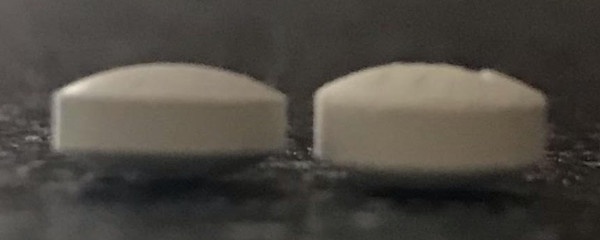
This was sent to me by thyroid patient Kristen. On the RIGHT was Armour tablet in former bottle. On the LEFT is in current bottle!
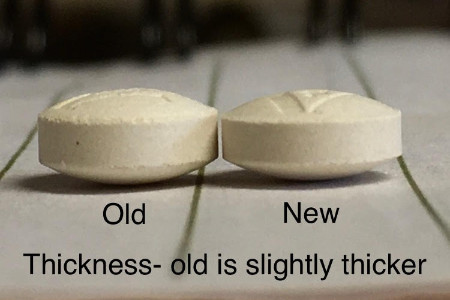
And THIS one is by thyroid patient Janet and again, newer one on right this time is also less thick! Both of these could mean either less of a filler, or a different pill presser? We need more info.
Then the following comments:
No changes from Texas.
No changes in any way for over a year.
Tastes the same, same shape, same size (and seems to be working)
Same size; same smell.
Same smell, but looked and tasted different.
Felt better on a different script of Armour, but all were the same with the tabs size, smell, etc.
Pills from Dec. 2020 and May 2021 are different (now darker in color and less depth). This fits the photo above.
Gal said the new ones are smaller, but no photo produced to give confirmation. You could say the photo with the newer bottle pill on the left is “smaller” in depth.
A gal states the working tablets smelled like roasted meat; new ones are medicinal/chemical. But she can’t verify it was Armour. (Would like to hear more feedback from others.)
Last month’s tablets dissolve quickly. This month have to bite in to dissolve. This could also fit what we’re seeing in the photo, as right one (older one) looks chalkier, and new one looks firmer.
QUESTION #4: This question asked how much Armour you have been/are on, and to see labs (free T4, free T3 and RT3) from both camps: those who experienced a negative change in their symptoms with labs to prove it, and those who still experienced doing quite well, and with labs.
Unfortunately and as seen often in groups, getting labs posted can be like trying to suck a thick malted ice cream through a skinny straw. It’s challenging. But below is what we got….
Lots of comments that had nothing to do with labs. But the labs posted showed either potential pooling, or not optimal, or lowered T4 due to rising RT3, or simply a too high RT3. Hard to come to conclusions.
MISCELLANEOUS REPLIES THAT DIDN’ T ALWAYS FIT THE QUESTION, but still interesting…
On 240 mg Armour for years and no problems. No labs.
Doing well on Armour.
From Sweden: Doing good on 240 mg Armour plus 20 mg T3. Another positive response when using both. Hmmmmm
Some negative replies about Armour that may be more about underdosing. All were pretty low. So not strong enough information.
At least FOUR different people commenting that ARMOUR IS WORKING WITH SOME T3.
One interesting comment wondering if COVID did this to a lot of people who have had sudden negative problems.
One gal feels like a mess with 180mg five days a week, 360mg two days a week. Odd dosing for sure!
Doing great on 360 mg twice a day and 25 T3 twice a day. (She may have Thyroid Hormone resistance, thus the high amounts. 8 years of of doing great, which is strong for Armour working for her)
At least three comments for “No issues”. Another comment for “No difference”
Summary
The four Armour Exploratory graphic questions underscored the same situation going on for awhile: differences in experiences, meaning one camp experiencing Armour has changed for the negative, and another camp experiencing still doing quite fine on Armour. So looks like we need more time, more reports.
In the meantime, those who went downhill can definitely consider switching to using synthetic T4 with synthetic T3. And do know that people are using different brands of each successfully. And it continues to be important to learn this page: https://stopthethyroidmadness.com/optimal
Others may end up adding T3 to that Armour, but it will be important to have the right amount of cortisol, we as informed patients know first hand. Raising T3 in the presence of a cortisol problem all too frequently results in hyper-like symptoms as T3 climbs high in the blood without the right amount of cortisol. The right amount of cortisol helps that T3 attach to cell receptors. Here’s a saliva cortisol test you can order: https://saliva-cortisol.squarespace.com/
Hello to my fellow hypothyroid-of-any-cause or Hashi’s patients!
Wow, I am steps away from 20 years (!!!) of making my focus about patient-reported experiences, observations, and wisdom!! Blows me away. ~JanieA.Bowthorpe, M.Ed.
Let’s talk about the desiccated thyroid brand called Armour.
I caught wind awhile ago that there seem to be strong, black and white rumors going around in some patient groups that today, Armour is working “FOR NO ONE”. Insert loud obnoxious voice: “FOR NO ONE!!” Black and white. Attention-getting end of story.
But to the contrary, there are opposite reports, too—others whose symptoms or labs prove it’s working for THEM still, even after picking up new prescriptions, one after another, and redoing labs to figure things out. So it’s not yet accurate to say it’s working for no one.
Rumor, rumor
Or there’s the recent rumor mentioned to me that I am “not caught up with what is going on”. That made me laugh. I’m still doing the same thing I’ve been doing for near 20 years…listening, evaluating, and reporting on consistent patient reports. The exception is that I’ve been delayed in getting this up due to having a very sick husband due to Agent Orange.
In fact, when anyone states “Janie is not caught up with what is going on”, in tandem with “It’s working for no one”, it’s basically insulting (do they realize this?) the body of hypothyroid patients who report and show excellent lab results and feel goods on Armour even still today. Because what I report is not about “Janie”. It’s about the patients who are reporting what they report. And it is definitely not consistent among patients that “Armour isn’t working for anyone”.
What about those whose labs strongly imply it’s not working like it used to??
It is also a fact, and I’ve seen them, that some have labs that make us very, very suspicious as to what is going on. They now have off-looking labs after having had perfect-looking “optimal” labs. Both!! I caught wind of that many weeks ago but have still been evaluating what I’m seeing from those patients, too, plus delayed due to what’s going on in my private life.
So this all leads to questions about what is going on when another body of patients go downhill on the same amount….
Is it a bad batch or two? Have some patients gotten the bad batch or a changed Armour, while others haven’t yet?? (We saw that happen with previous bad NDTs). Have the makers of Armour fallen to using crap porcine powder not made in the US? Is it just a matter of time?
The bottom line is this…
We do not have all the answers. Why? Because for those who have experienced that something is wrong with Armour (having had optimal labs, then their labs went to pot), others are expressing doing just fine with optimal labs to prove it. This needs to unfold to see….
Why some find themselves with bad labs after having had optimal ones, yet… 2. Others still have labs which are optimal.
And with that unfolding, it is clearly a reach (watch certain people overreact to THAT! lol) to state that at the current time, it works for “no one”. In fact and as stated, there is also still a clear body of people who have an optimal free T4 and free T3 on Armour with labs to prove it. That’s also why Stop the Thyroid Madness has a page about the gray areas of our experiences and observations.
Want to open-mindedly investigate all this?
Here’s what you can do so we can have better answers:
1) Keep an eye on your labs while on Armour to see which camp you fall in. That’s the free T4 and free T3, and comparing a before optimal set of frees to an updated one. BUT, it won’t be a strong comparison if you weren’t optimal before. If you have a midrange free T3, or a free T3 just above midrange, it does eventually backfire with fallen frees. Years of experiences have shown that for the majority. The individuality is when it backfires. https://stopthethyroidmadness.com/optimal Instead, the strong proof that Armour may have changed is when someone used to be optimal, then new labs on the same amount aren’t showing it at all anymore. I wish I knew the name of the guy who first revealed this to me weeks ago to thank him.
2) Watch your Reverse T3. (RT3) If RT3 goes above the bottom area of any range, it will become impossible to become optimal with your free T3 and free T4 over time. Then a backfire somewhere down the line. Here’s info about the RT3: https://stopthethyroidmadness.com/reverse-t3 3) If you can, ask if there is a batch number you can be aware of for your latest prescription. Or another idea is that if you fall in the camp that once had truly optimal frees, but have them no more, let others know if you tried to raise Armour or not to get out of your current mess.
4) Report back to this post as to what you are seeing, discovering…without making black and white pronouncements that insult other’s experiences that are the opposite.
By the way…and bottom line
It’s also okay to use synthetic T4 with synthetic T3, or continue to use Armour if it’s working for YOU, or EVEN start it and watch those labs! You can still use this wise patient information in either use: https://stopthethyroidmadness.com/optimal
Addendum: The bottom line message in this blog post is that it has clearly been an overreach to state it’s “working for no one!”at this early stage in patient expressionsand questions as to what might be going onwith Armour. All the latter is the point being made here. And NEITHER are we in a race. Is it possible that Armour will be better proven to have gone downhill? Of course. But let’s have more integrity in our approach about this, which I have always valued in my own approach as a Thyroid Patient Activist, because at the current day and time, it’s not yet as clear what is going on for “most” like it was with Naturethroid, WP, and NP. We are in a suspicious and exploration phase!
NOTE: if you are reading this via the email notification signup (bottom of any page on the Stop the Thyroid Madness [STTM] website), none of the links will work in the email. Click on the title of the blog post, which will take you to the actual post, then click on the links.
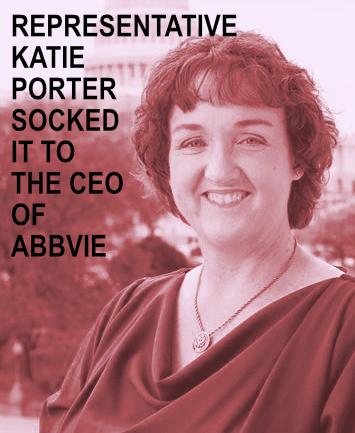
Recently, US Representative Katie Porter thoroughly and pointedly GRILLED Richard A. Gonzalez, the CEO of the pharmaceutical company, Abbvie (formerly Allergan). In fact, she figuratively pulled his pants down.
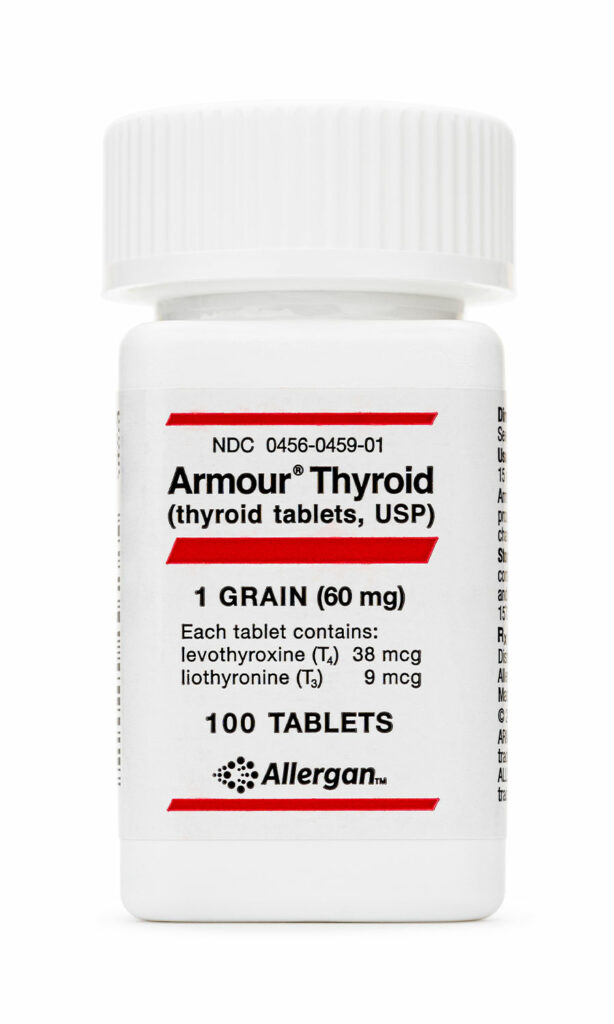
And if that company name sounds only vaguely familiar, Abbvie makes the life-changing Armour desiccated thyroid—a porcine-based hypothyroid medication which has clearly changed lives since the 1890s once a patient or their doctor clearly understands how to use it correctly. And years of patient reports show that it has done this far more aptly than T4-only like Synthroid or Levothyroxine for millions.
Additionally, Armour desiccated thyroid by AbbVie is the ONLY remaining desiccated thyroid product on the US market (more information about that below), yet it’s price has gone FAR too high for the financial comfort of many patients.
And why did Representative Porter successfully slaughter Mr. Gonzalez? It was about the ridiculous INFLATED PRICES, the hollow justification of the inflated prices, their enrichment of shareholders over the well-being of patients, and the lies from the company.
Humira and Imbruvica
Now granted, the medication focus of what she did was on the ridiculously HIGH prices for an anti-inflammatory medication called Humira, of which the price has been raised 27 times!!
It was also focused on the NINE times price increases of Imbruvica since 2013, a cancer medication made by AbbVie.
We are the new price gouging target
Whether you have autoimmune Hashimoto’s disease or any cause of hypothyroidism, we as thyroid patients are now the unfortunate and egregious target of a ridiculous price raise a few years ago for the LIFE-CHANGING Armour natural desiccated thyroid. This price gouging has not been easy for a large body of hypothyroid or Hashi’s patients whose well-being depends on a now much higher price for Armour desiccated thyroid with its T4, T3, T3, T1, and calcitonin.
Even worse for hypothyroid or Hashi’s patients…
There have been recalls of RLC’s Naturethroid and WP Thyroid, as well as twice of NP Thyroid by Acella. Something badly changed in all of them when the only US distributor of porcine powder ceased to make it. So Armour is the ONLY US-made desiccated thyroid left, and which continues to work for the vast majority if they and their doctors understand how to use it correctly and how to spot and treat the cause of perceived problems!! It’s a medication which has completely changed lives since the 1890s. Also see Chapter 2 in the updated revision STTM book.
Even compounders are stating they are having a hard time finding a consistent and quality porcine powder anymore.
YET THERE ARE PATIENTS WHO SUFFER FINANCIALLY because of the ridiculous price increase of Armour desiccated thyroid a few years ago by AbbVie.
Another whammy: Insurance companies and Medicare
Not only do hypothyroid or Hashimoto’s patients have to deal with a now MUCH higher price for Armour (as compared to the previous affordable price that was there for years), we have many insurance companies as well as Medicare refusing to cover this life-saving and safe medication.
For Medicare, they wrongly believe it’s dangerous if you are over the age of 65. Yet, there are MANY, MANY hypothyroid patients over 65 who report changed lives on desiccated thyroid, especially once they and their doctors understand how to use it…and especially understand how important it is to have the right amount of cortisol and iron before raising natural desiccated thyroid.
Kudos to Representative Katie Porter
Want to see her downsizing of Richard A. Gonzalez, the CEO of the pharmaceutical company, Abbvie? Go here and play the video. Below the video, you’ll see a transcript.
What’s next?
Good question. We’ll just hope that this disgusting revelation about AbbVie by Representative Porter will continue to emphasize that PATIENTS NEED AFFORDABLE MEDICATIONS and not for the sake of extravagantly lining the pockets of CEO’s and shareholders.
Please note: YOUR COMMENT WILL NOT BE APPROVED if you get into political ranting or controversial political names of any kind. This is only a post to discuss how medication prices affect you, your thoughts on the gouging, or to send support and thanks to anyone like US Representative Katie Porter for unmasking and making naked to anyone’s eye about pharmaceuticals, price gouging, and related.
Here’s the YOUTUBE version of Rep. Porter’s takedown of CEO RIchard A. Gonzalez.
Here’s the Wikipedia page for Representative Katie Porter.
POST SCRIPT: There appear to be some people who themselves are so political that they negatively accuse this post and myself, Janie Bowthorpe, of being “political”. That is ridiculous and shows who is the one being political.This post would have gone up whether the Representative was Democrat, Republican, or Independent.
The bottom line is that this post is about standing up to those pharms who price gouge. Period. A few years ago, Armour just suddenly went FAR higher in price, even while other brands (which we can’t use anymore because of the recalls) stayed where they were back then. So depending on what someone has to take to get out of their hypothyroid state, the price became ridiculous, all while other NDTs stayed the same lower price, So stop making it political, and focus on the message.