Find out more here!
Hide me

* You are viewing the archive for the ‘Related conditions due to hypo’ Category

Have you tested your B12? It’s a deficiency thyroid patients need to catch.

b12 Just two months ago on January 15th, I wrote an article titled Ten Reasons You May Still Feel Bad.  Nearly every hypothyroid patient can have some of those ten problems, and if so, they need to be discovered and corrected.

And one of those issues was low B12. B12 is a vitamin which has a key role in cell metabolism of your entire body, giving you energy, sharpness in your brain, and healthy nervous system functioning.

And unfortunately, a certain percentage of hypothyroid patients have low levels of this important vitamin, largely due to digestive issues common with hypothyroidism– either undiagnosed due to the lousy TSH lab test, or undertreated on T4 meds like Synthroid, Levoxyl, Levothyroxine, Eltroxin, etc.

Symptoms of low B12 can vary from person to person, but can include numbness and tingling in your hands or feet,  tremors, poor reflexes, tongue soreness, leg pain, or difficulty walking with balance.   Psychologically, you may have memory issues, confusion, or depression. Young women may have difficulty getting pregnant due to low B12.

When doing lab work, you want a result in the upper end of the range.  To correct inadequate levels of B12, you’ll want to use high oral B12 (methylcobalamin is the recommended form of B12), B12 cream, or injections by your doctor (especially if you have pernicious anemia) .  It’s also recommended to increase your consumption of meat and dairy products, which can be rich in B12.

March 27, 2009 is the kick-off date to begin an awareness campaign of B12 health, with September 23rd being “Vitamin B12 Awareness Day”. And I highly recommend the book Could It Be B12? An Epidemic of Misdiagnoses by Sally Pacholok, R.N. and Jeffrey Stuart, D.O., who are spearheading this awareness.

Have you found yourself with low B12? Tell us your symptoms, how you treated it, and how long it took to stop the symptoms.

Want to be notified of these blog posts? Curious what Janie is ranting about this time? Use the Notification on the bottom left of the links.


  • Hip hip!! STTM has new products to help spread the word, here. Great BUMPER STICKERS, too, here. Spread the word--YOU may make a difference in someone’s life.
  • Check out the NEW REVISED patient-to-patient book with even more detail (and which doctors seem to respect more than websites).
  • Need to understand all your best options for thy­roid treat­ment? Go here.
  • Want to keep track of these "fringe website" blog posts? ;-) Curious what’s on Janie’s mind? Use the Blog Notification on the lower left of the links. or use an RSS Feed.

I met hundreds of millions of women today…in one woman

bunny Michelle, 40-or-50-something, came over to my house today to go over some paperwork. I hadn’t taken my Armour yet, and I said “Excuse me, I need to pop my thyroid meds under my tongue.”

“Oh, I take thyroid meds, too.  Synthroid” she explained as she was writing on the papers with her pencil.

Now when I hear something like that, being who I am, I’m like a bear in a china cabinet who suddenly smells honey.  So as not to overwhelm,  I casually say “Oh, I used be on Synthroid.” And after a long pause while we are going over the paperwork, I say “Did you know there’s a worldwide patient revolution going on against medications like Synthroid?”

At the point, she raises her head in curiosity.

I then stick my paw in the honey: “You and I and millions have been put on meds like Synthroid and then told we are “normal” because the TSH says so. But all of us have continuing symptoms of hypothyroidism.  It’s a lousy medication. “

And when I laid out what those continuing symptoms were, her eyes got as big as saucers and she was shaking her head up and down in recognition. “Depression, rising cholesterol and blood pressure, easy weight gain, fatigue, less stamina than others, dry hair and skin, feeling cold, etc”, I told her.

And the most profound aspect of Michelle? She lives her life like the Energizer Bunny, going and going and going. She told me she often doesn’t get home until 6 pm doing her job, and she clearly has a lot of professional responsibilities.

But does an active Michelle mean that Synthroid works and is just as good a thyroid treatment as desiccated thyroid? You know the answer. She revealed that she’s quite tired when she comes home, wishes she had more energy, and still has issues with her weight, even though she lost some when she got on Synthroid.

And reading between the lines, it was clear that Michelle is probably on an anti-depressant, a statin, and a blood pressure medication.  And…she clearly has an adrenal problem that’s only going to get worse. She has a terrible time falling asleep at night (high cortisol), and is very sensitive to light and noise (high or low cortisol).

Suddenly it dawned on me. I am sitting across hundreds of millions of women, and some men. I am listening to how millions live their lives–making a living, maintaining a home, loving their spouses and children, interacting with people.  But underneath it all, it’s not a pretty picture. They cope, and they cope again.  And they dish out their money for more medications to treat the very symptoms caused by an inferior medication. And as they age, they’ll pay each of their millions of prices, just as my mother did, and as I was headed.  Energizer bunnies with faulty batteries.

P.S. Barack Obama has a health care reform plan. Will it change the lives of those 50 million with thyroid disease in the US, or will it only continue this T4-only travesty and health care scandal?  Are we headed in the same insane direction as the UK when it comes to T4-only?  Express your opinion.


  • Hip hip!! STTM has new products to help spread the word, here. Great BUMPER STICKERS, too, here. Spread the word--YOU may make a difference in someone’s life.
  • Check out the NEW REVISED patient-to-patient book with even more detail (and which doctors seem to respect more than websites).
  • Need to understand all your best options for thy­roid treat­ment? Go here.
  • Want to keep track of these "fringe website" blog posts? ;-) Curious what’s on Janie’s mind? Use the Blog Notification on the lower left of the links. or use an RSS Feed.

Dr. Richard B. Gutler’s comment is disgusting!

shameonyou And again, on the heels of my post below about Sheila Turner of the UK’s TPA (be sure and read it–good comments, too) comes a blog post by Dr. Richard B. Gutler of California, an Endocrinologist (why are we not surprised).  And his message?
1) That the NHS is correct to ban Armour

2) That Armour is a “second drug” that causes harm.

3) That it’s only “fringe” patients who don’t do well on T4

4) That none of the above patients are hypothyroid

5) That they don’t feel well on T4 because of other reasons

6) Therapy is not needed if the TSH is below 10

You know what patients have a fantasy about, Dr. Gutler?? That folks like YOU become hypothyroid and are put on T4. You’ll then see your blood pressure rising, or your cholesterol doing the same, or depression and fatigue setting in, or your adrenals overworking, or weight gain and a host of other continuing symptoms of hypothyroid while on T4, whether right away or down the line. OH WAIT. Those are all due to something else. Gee, let’s put you on anti-depressants, statins, blood pressure meds, pain meds, anti-anxiety meds since those “other” reasons never seem to be fixed.  OH WAIT. They DO get fixed when these same patients are switched to Armour or any other desiccated thyroid, and have addressed their low cortisol or low ferritin thanks to years of undiagnosis or undertreatment with T4.

SHAME ON YOU.

p.s. It’s because of opinions like yours that the Stop the Thyroid Madness book has been sent to patients in over 16 countries, so far. People want to find out the TRUTH.

Update: you can read Sheila’s and UK-TPA’s response here: http://www.stopthethyroidmadness.com/uk-tpas-response-to-the-rcp/

See more from Sheila that gives UK patients hope: http://www.stopthethyroidmadness.com/relationship-between-the-RCP-and-MHRA/

Want to be notified of my blog posts? Curious what’s on my mind? Use the Notification method to be informed. Look on the bottom left of the links where you can sign up. )


  • Hip hip!! STTM has new products to help spread the word, here. Great BUMPER STICKERS, too, here. Spread the word--YOU may make a difference in someone’s life.
  • Check out the NEW REVISED patient-to-patient book with even more detail (and which doctors seem to respect more than websites).
  • Need to understand all your best options for thy­roid treat­ment? Go here.
  • Want to keep track of these "fringe website" blog posts? ;-) Curious what’s on Janie’s mind? Use the Blog Notification on the lower left of the links. or use an RSS Feed.

A real life horror movie: suckered by Big Pharma marketing. Part 2

(Want to be notified of my blog posts? Curious what’s on my mind? Use Notifixious to be informed. Look on the bottom left of the links where you can sign up. )

Recently, after we watched a semi-scary movie about being suckered, a friend brought up my blog post of last July where I described a terrifyingly-real horror movie.

The plot: stunningly convince hundreds of millions of individuals worldwide that what is obvious, isn’t. i.e. it’s all in your head, you are adequately treated on Synthroid, Levoxyl, Eltroxin, Norton, et al,  and not only that, we’ll bandaid your continuing problems with more medications.

A second plot: also completely hoodwink those with top notch higher medical educations and experience by churning out the the exact same poppycock, and reward their stupidity with gifts.

The central villian: Big Pharma, followed by the doctors who bought the lie

Exactly a year ago this month, Science Daily came out with an article, citing two York University researchers who estimated that the U.S. pharmaceutical industry spends almost twice as much on promotion as it does on research and development, contrary to the industry’s claim. In other words, the researchers estimated that $57.5 billion in US dollars was spent on pharmaceutical promotion in 2004–the year they were studying. Yes, I said BILLION.

Breaking that down, Big Pharma spent approximately $61,000 per physician in promotion of their products.  And they concluded that both figures were UNDERestimates.  In other words, they concluded that the US pharmaceutical industry is marketing-driven rather than “life-saving”.

And adding fuel to the fire: most doctors believe every thrust of that marketing. I recently participated in comments with other wonderful patients in response to a DO/Endocrinologist, Dr. Thomas Repas, who has clearly bought the Big Pharma marketing when it comes to levothyroxine. You can read his posts and our comments here, here, and here.   Dr. Repas is exactly the kind of doctor who has  starred in our horror movie, and the kind of doctor that patients have lamented about for years.  Read the  Give Me a Break list of comments made by doctors, as well as further comments on the January 1st blog.

But Dr. Repas is in good company. Doctors have believed the Big Pharma lie about T4-only medications, and against desiccated thyroid like Armour, Naturethroid, etc. for 50 years.  In the patient-to-patient  Stop the Thyroid Madness book, you can read about the first tableting of Synthroid in 1955 and the strategic and successful promotion of T4-only, in spite of the fact that T4 was known to be unstable for decades.

And today, more than 50 years later, very few of us have been untouched by the Big Pharma push for levothyroxine T4-only treatment.  My own mother was suckered, and I was suckered.  And until patients started to make a huge push for desiccated thyroid treatment the last few years, nearly every single doctor around the world had been suckered.

We still have a way to go. But we’ll get there, bit by bit.


  • Hip hip!! STTM has new products to help spread the word, here. Great BUMPER STICKERS, too, here. Spread the word--YOU may make a difference in someone’s life.
  • Check out the NEW REVISED patient-to-patient book with even more detail (and which doctors seem to respect more than websites).
  • Need to understand all your best options for thy­roid treat­ment? Go here.
  • Want to keep track of these "fringe website" blog posts? ;-) Curious what’s on Janie’s mind? Use the Blog Notification on the lower left of the links. or use an RSS Feed.

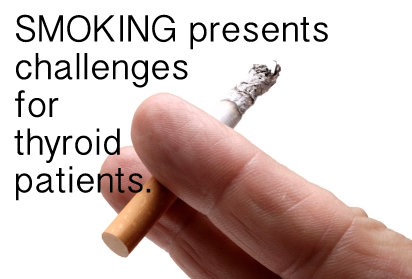
Puff. Puff. Puff. If you are a cigarette smoker & hypothyroid, you might want to read this!

Who, as a smoker, hasn’t heard how deleterious tobacco smoking is for your health. Not only will you acquire health problems directly related to smoking, but your life is shortened by 10-15 years average according to statistics. My own father died at age 63 directly related to his smoking.

But in spite of strong reasons to quit, most smokers will tell you it’s NOT easy. Why? Because the nicotine in tobacco is the addictive bogeyman. Nicotine stimulates those pleasure centers in your brain, besides being a substance which “gets you going” by releasing both blood sugar and adrenaline. The American Heart Association states that “Nicotine addiction has historically been one of the hardest addictions to break.”

But for hypothyroid patients, tobacco smoking presents another whammy.
Namely, it stresses your adrenals over and over. And with adrenal fatigue being a common side effect of treating hypo with T4 meds like Synthroid, Levoxyl, Eltroxin, et all, as well as being dosed by the lousy TSH, you’ve got a third reason to fall into adrenal fatigue if you are a smoker.

Additionally, another factor in the difficulty of quitting is that cortisol decreases when you try to quit. A 2006 research report found that the lowered cortisol after quitting is associated with smoking relapse and with reports of increased withdrawal severity and distress. So, when you already have adrenal fatigue, and you quit smoking–a double whammy against being successful.

What’s the solution? If you don’t have adrenal fatigue and want to quit, it may be wise to have a good adrenal support on hand, such as Isocort or any quality OTC adrenal product at your health food store. If you DO have adrenal fatigue, staying away from cigs may require adding additional cortisol to your daily amount. Chapters 5 and 6 in the STTM book have good information to help you with cortisol support.

Are you a smoker with hypo? Don’t hesitate to respond to this post with your experience. (Please note that replies are not for questions.)

READ DEBORAH’S STORY ABOUT HER ATTEMPT to STOP SMOKING.


  • Hip hip!! STTM has new products to help spread the word, here. Great BUMPER STICKERS, too, here. Spread the word--YOU may make a difference in someone’s life.
  • Check out the NEW REVISED patient-to-patient book with even more detail (and which doctors seem to respect more than websites).
  • Need to understand all your best options for thy­roid treat­ment? Go here.
  • Want to keep track of these "fringe website" blog posts? ;-) Curious what’s on Janie’s mind? Use the Blog Notification on the lower left of the links. or use an RSS Feed.