* You are viewing Posts Tagged ‘ferritin’

Ten reasons you may still feel bad: health is like a chocolate cake

Want to be notified of my blog posts? Curious what’s on my mind? Use Notifixious to be informed. Look on the bottom left of the links where you can sign up. )

Today I baked a chocolate cake for my son’s birthday. It was excellent. Why? Because it was the result of several important ingredients. Leaving any of them out would have resulted in a cake less than great.

And your health and feel-goods as a thyroid/adrenal patient, including your ability to successfully get off HC,  is like my son’s cake: a combination of ingredients that you have to get right. Below are ten “ingredients” to investigate and find out which may not be right in you for good health and feel-goods.

1) The right amount of cortisol: Too little cortisol or too much cortisol has its consequences. Too little results in thyroid hormone still pooling, continued hypo symptoms, plus hyper in some. Too much can mean easy bruising, rising blood pressure, fluid retention, a round face, etc.  And both can increase anxiety, feeling poorly, etc.  Watch for symptoms and compare your daily averaged temperatures. Also, have you checked your aldosterone?

2) The right amount of desiccated thyroid: I have a friend who was stuck on 3 grains Armour out of habit. But she continued to have hypothyroid symptoms out of habit. I finally convinced her to talk to her doctor. Labs showed her free T3 was just a few points over mid-range, and having a free T3 towards the top seems to work better for most. So she did raise, and it finally did the trick.

3) Optimal B12 levels: Since hypothyroid patients can have digestive/absorption issues, B12 levels can be lower than optimal. Symptoms include fatigue, weakness, feeling faint, breathless, bruising, heart palps or others. Don’t take a chance. Get a B12 test. You want the result to be at the top of the range.

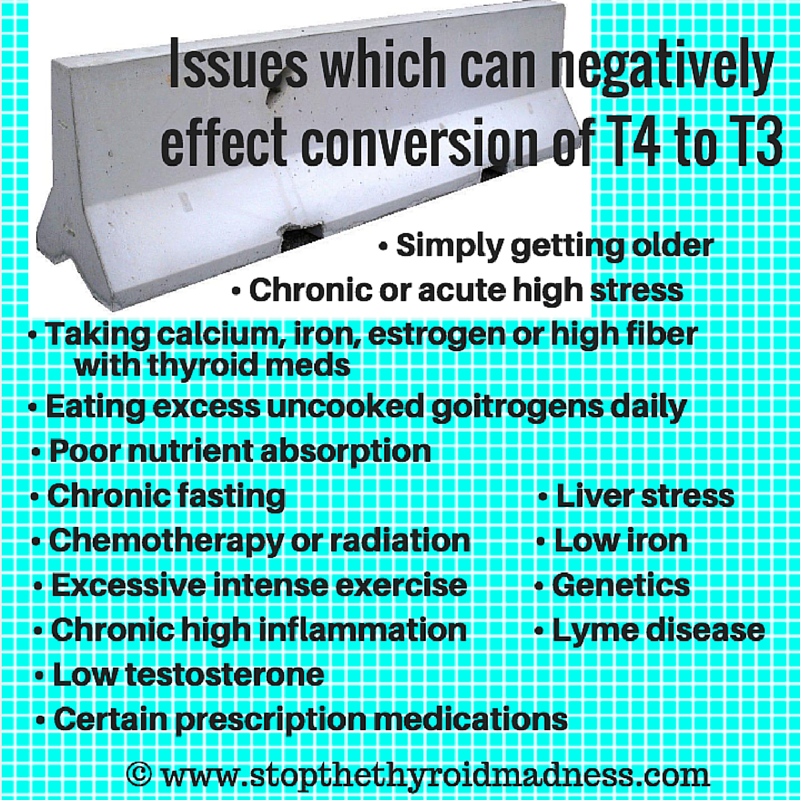
4) Plenty of Ferritin (storage iron): Low ferritin means you have no iron in storage to draw upon. And it also means you are probably anemic.  Additionally, low ferritin adversely affects the conversion of T4 to T3. Symptoms include fatigue, depression, weakness, achiness, breathlessness or others.  Have a ferritin test.  Optimal is 70-90.

5) Good digestion: Hypothyroid patients can have low hydrochloric (HCL) stomach acid levels. That not only contributes to acid reflux because of the overgrowth of bad bacteria, it means you don’t absorb nutrients well (including low B12 mentioned above). As a result, it’s crucial to give that acid back to yourself.  A tablespoon of Apple Cider Vinegar mixed in water and taken twice day helps many. Or try taking Betaine, which is HCL in pill form, or any other quality HCL or digestive product.

6) Recognition and treatment of Gluten intolerance: Some thyroid patients lack a particular digestive enzyme, intestinal glutaminase, that helps digest gluten in various food products. As a result, they don’t absorb nutrients well. Symptoms include bloating & gas, aches, stiffness, fatigue, burning or numbness in arms or legs, rashs or hives, worsened allergies & others. Your chance of have a gluten problem is higher if you have Hashimotos disease. If you suspect a possible problem, eliminate all gluten from your diet. Also consider having your doctor run a Celiac antibodies blood test.

7) Controlled EBV: At least 90% of adults have the Epstein Barr Virus (EBV) sitting dormant in their bodies. EBV is what causes mononucleosis, but you don’t have to have had mono to carry the virus.  Because hypothyroidism lowers your immune system, it’s not uncommon for thyroid patients to have activated EBV. I did, and my symptoms included extreme easy fatigue, ringing in my ears, achiness and some swelling of my lymph glands. Some may have a sore throat return and other symptoms.  Ask your doctor to test EBV. You’ll then need to ask about treatment options, which include beefing up your immune system.

8 ) Sex hormone balance: When your thyroid or adrenals get out of balance, your sex hormones can follow suit, from estrogen dominance to low testosterone.  When estrogen dominance occurs, you can feel depression, fatigue, and sore breasts.  Low testosterone can equal lower energy and mood. Ask your doctor to test all your sex hormones.

9) Taking plenty of supplements: There are a variety of good supplements everyone with thyroid or adrenal issues should take for good health. They include high potency B-vitamins, Vit. C (1000-3000 mg. or to tolerance), Selenium (around 200 mcg), minerals including magnesium, probiotics, Vitamin D (1000 iu), iodine, and others.  In addition to these, I also take CoQ10 (for heart and blood pressure health), and my favorite: a green powder which I stir in my orange juice.

10) Exercise: If you are a couch potato, you’re going to feel like one. Instead, do what it takes to get moving, which promotes all sorts of good health. If you have adrenal fatigue, keep it very light and easy.  If you just have hypothyroidism, get out and walk.

P.S. My chocolate cake: I think cake mixes are just as good as homemade. I use Devils Food Cake. But the icing is ALWAYS homemade: cream one stick butter, add about 4 cups powdered sugar, 1/2 cup cocoa, then cream or half-n-half.  Shake some sea salt in. Add two tsp. vanilla.  Beat, beat.  Taste. Modify as needed. YUM.

Oprah is spelled D*e*n*i*a*l; the hamster wheel of her life

(Want to receive notification of each blog post that comes up here? Just go to the Notification on the left of this page below the links and sign in with Notifixious).

Well, here we go again.

As this first week of Oprah’s “Best Life Week” series ends, we all know that Oprah has announced she is going on a weight loss and exercise plan once again (hamster wheel turning, turning…).   Oh…and did I mention that she said her hypothyroid was cured?

(Wait. Do I hear a collective and worldwide SIGHHHHHHH among thyroid patients??)

Thyroid patient Mary Shomon now shares my own long-held concerns in an excellent summary pertaining to Oprah’s thyroid and weight saga.  Oprah has been remarkably uninformative about her diagnosis and details, and leads those uninformed to believe they can stop taking their medication and be cured.  And Oprah appears to have ignored a slew of emails over the years from all camps of thyroid advocacy!

Just as bad is a visit in the pages of O Magazine. On page 151 of the January issue, and right next to the article about Oprah’s weight gain, is a side article titled The Truth About the Thyroid.  And the longest paragraph is about the use of the TSH lab test and its so-called normal range–one of the worst tests ever created to diagnose and treat hypothyroidism. Additionally, the article ends with the mention of a prescription of synthetic thyroxine–a medication which leaves nearly everyone with lingering hypothyroid symptoms.

But the disappointment in Oprah has to go farther than a general call to be educated about thyroid disease. There is a need to be specifically educated about the scandal of thyroxine treatment, about the fallacy of the TSH lab test which leaves patients undiagnosed for years or undertreated when on meds, about the rampant problem with adrenal fatigue in thyroid patients on thyroxine or those left undiagnosed (and where Oprah may be headed), and about a far better treatment with desiccated thyroid like Armour, and optimizing other areas, including ferritin, B12, and our overall health.

Let’s not give up.

Success is like lottery tickets: you have to make several attempts before that magic one makes it. Eventually, your email can be the one that finally stops her hamster wheel of “eat less, be hungry, exercise more, it’s not my thyroid” mentality.  Tell Oprah about your success, others success, the patient-to-patient site www.stopthethyroidmadness, and more.  And don’t hesitate to share your email below.

Doctors still have a long way to go a.k.a. Those symptoms might just be the thyroid!

Just as I was finishing up the post below about a short summary on the Endocrinology Today website, I saw a link at the bottom of the page that interested me.  It took me to a blog post on the same site from December 10th titled “Why can’t it be my thyroid?”.

And a slew of thyroid patients around the world, as well as a growing body of doctors,  would completely disagree with this post.

Namely, a DO explains the problem of patients arriving in doctors offices with “innumerable possible symptoms of hypothyroidism” including “fatigue, cold intolerance, decreased energy, weight gain, depression, hair loss, low libido, menstrual irregularity and others.”

Yet, he bemoans, these patients have a “normal TSH” which is “well within the normal laboratory reference range.” He also refers to their normal free T3 and free T4, and states there is no history to suggest pituitary dysfunction or that the TSH is unreliable.”

He then proceeds to pat himself on the back because he 1) will treat some patients with a high-normal TSH and other clinical features,  2) he will treat to a low-normal TSH of less than 2.0, but like the good-boy-doctor, “still within the normal laboratory reference range” and 3) he will not induce iatrogenic hyperthyroidism, even if symptoms persist. (yikes)

“Iatrogenic hyperthyroidism”??  Since “iatrogenesis” refers to harmful medical procedures, he’s probably referring to a TSH below the range, which in his mind, equates to hyperthyroidism.

***Then comes the observation that has made many thyroid patients shiver, since so many doctors have said it: because he feels that adding T3 to T4 has more negative results than positive, he explains to his patients that there may be causes of their symptoms besides the thyroid.”

THUD.

So here is my 6-point response to any doctor who might share these beliefs:

1) There’s hardly a thyroid patient around who hasn’t had a so-called “normal” TSH in spite of clear and obvious hypothyroidism.  The TSH lab test frequently lags behind what is reality in the body, and has been doing so since it’s creation in the early 1970’s (see Chapter 4 in the Stop the Thyroid Madness book for history).

2) Having a “normal” free T3 and free T4 means nothing. It’s “where” the result falls in that range that means something. i.e. patients all around the world are noticing that having a free T3 mid-range or lower in the presence of hypothyroid symptoms is usually a BINGO lab result pointing to hypothyroidism.

3) Exactly because doctors tend to dismiss clear hypothyroid symptoms as “something else” thanks to a lousy TSH reference range, a burgeoning number of thyroid patients are falling into adrenal fatigue with its low cortisol, which serves to mess them up even more.

4) A huge body of thyroid patients who are on desiccated thyroid hormones (aka Armour, Naturethroid, etc), and who finally have a complete removal of symptoms with a normal temperature and heartrate, also have a suppressed TSH lab result, and not one iota of “iatrogenic hyperthyroidism.”

5) When it appears that adding T3 to T4 is having negative effects, the problem is most likely adrenal fatigue that needs correction, and/or low ferritin, NOT deciding that the symptoms must be from another cause or T3 doesn’t work.

6) “Fatigue, cold intolerance, decreased energy, weight gain, depression, hair loss, low libido, menstrual irregularity and others” may be shared in other conditions, but you are most likely missing CLEAR symptoms of hypothyroidism, both in the undiagnosed patient with a so-called normal TSH, or with a patient treated with the lousy thyroxine, which leaves most everyone with continuing hypothyroid symptoms.

“I’m sorry. It IS your thyroid” is exactly what patients need to hear.

Addressing folks who do well on T4 aka Synthyroid, Levoxyl, etc.

I received a reply to a post below that I was unable to approve because it mentioned someone by name. And the reply was not particularly friendly, and definitely not accurate. lol. But the reply brought up some good issues, which I have no problem addressing.

Namely, can I agree that there are some people who do well on T4-only treatment such as Synthroid or Levoxyl??
I can…sorta. I have a friend whose husband is one of those seemingly lucky individuals on T4, with no thyroid, who leads a fairly active and happy life. Considering how lousy I did, he amazes me. But I did notice something else about him: he has high and rising cholesterol and is on statins. That’s a classic symptom of a poor treatment and continuing hypothyroid, even if he does have much better energy that I ever did.

And by observing him, and knowing a few others who subjectively feel they do well on T4, I came to the following conclusion: though some may do better than others on T4, I have yet to find anyone on T4 who doesn’t have some kind of side-effect of a poor treatment, whether they are treating it with statins, treating it with antidepressants, or not treating it at all & denying it. Sure, some may do better than others, but the proof is in the pudding if you look deep enough. And, at the very least, I’m just plain suspicious that ANYONE on T4, even doing subjectively well, is going to have symptoms of a poor treatment creep up on them as they age. The body was not designed to live on conversion alone.

Can I agree that some people just canNOT tolerate desiccated thyroid like Armour and need to be on T4?
Initially, that may be. The gal that wrote me stated she felt a lot better on T4, and that no matter what she did, she couldn’t tolerate Armour. I believe her. If Armour was that miserable, she should be on T4 for the time being, or even better, a synthetic T4/T3 combination. But I also believe that even if she feels she did everything to a “t” and still couldn’t tolerate it, there was more for her to learn that she didn’t get the first time around when it came to her adrenal fatigue treatment. I see it too many times. And perhaps, over time, it will become more clear.

Do some proponents of desiccated thyroid go overboard in their fervor? I don’t doubt it one bit. We’re human. And we hope you are forgiving. But once you get past however you view are communication shortcoming, do know that our fervor is based on the fact that a huge volume of individuals are having lives changed due to desiccated thyroid (and/or treatment of low ferritin, and/or treatment of adrenal fatigue). And it’s too widespread and global not to have fervor, besides common sense that a treatment that gives us back what our own thyroids would be giving us is just plain remarkable.

So, do know that if you are on T4, and feel well, I’m behind you. It’s your life, not mine, and I believe you. But neither can I stop my belief and too many observations that if you are truly hypothyroid and need treatment, desiccated thyroid is a superior choice, now or later, whether you are lucky enough to have escaped adrenal fatigue, or whether you have a challenging case of adrenal fatigue that can be adequately treated!

Good grief! Stop the judgment!

Six years ago, when I got involved in thyroid patient advocacy by starting the Natural Thyroid Hormone Users group on Yahoo, I did it because I was amazed and shocked what switching to desiccated natural thyroid did for me! There I was, on the brink of applying for Social Security Disability after YEARS of misery & lack of answers, and simply changing to a different thyroid treatment completely turned my life around. I owe some of that change on what I found out on Mary Shomon’s Thyroid group in early 2002.

And it dawned on me: if desiccated thyroid with its T4, T3, T2, T1 and calcitonin did this for ME, what could it do for others?!I  A group was NEEDED with a direct focus on desiccated natural thyroid.

And over time, as NTH grew and other fine internet patient groups evolved and grew, other patients were just as amazed at what it was doing for them, as well.  This wasn’t coming across at ALL as a treatment only for “some”. It was coming across as a treatment that might just benefit quite a large body on individuals! We also learned by the seat of our collective pants about low ferritin, low cortisol, low B-12, Celiac and gluten intolerance–you name it.

From all the above came the STTM movement: a patient-to-patient compilation of all we have learned–and then the book with even more information.  The STTM movement was created because “internet groups” were NOT enough to get the word out about the efficacy of desiccated thyroid, nor were they enough to change the huge and rigid medical establishment. Change had to come from the bottom up–in other words, educate patients, who in turn can take the new information into their doctor’s offices.

But sadly, with the success of patient information about the amazing results of desiccated thyroid treatment has come veiled criticism and overblown misconceptions within our own ranks. And it’s a sad thing to behold!

Namely, we can now read a September 10th internet blog “conversation” by so-called thyroid patient advocates who imply that it is “dogma and narrow-minded” if anyone dares state there just might be a thyroid treatment which JUST MIGHT BE better for most all thyroid patients. IMAGINE the audacity!! I guess it was just as “dogmatic and narrow-minded” when it was first suggested there were better ways to deal with certain health conditions than bloodletting. I can hear it now: “To deny bloodletting is just boxing people in!” “Offering bloodletting as a choice is helping people expand.”

And contrary to the self-righteous tone, condescending misrepresentations, and veiled criticisms towards certain patient groups, this patient movement is not a one size fits all movement.  Instead, it’s a “one size JUST MIGHT BE a better alternative” than the other available alternatives, and we strongly encourage that each patient consider finding a doctor to help them give it a try.  And, if something about desiccated thyroid isn’t working, we strongly encourage patients to look at particular reasons that can underlie problems.

If you think T4 is working for you, go for it! The same goes for the use of T3 only, or synthetic T4/T3, or certain ratios of T4 and T3.  Choice is a blessing we can all respect.  Just keep an eye out for depression, rising cholesterol, less stamina than others, adrenal issues and/or a myriad of other continuing hypo symptoms that just might creep up on you as you age on these treatments.  Or, consider that we’ve seen many people on these treatments, who, when they switched to desiccated thyroid like Armour, Naturethroid, Westhroid, etc, they reported even better results. (The use of T3-only for high RT3 is a different issue and is where T3-only may be absolutely needed and good. We also respect those who have ethical issues with animal products.)

Finally, I encourage others who consider themselves thyroid patient advocates to TAKE A BIG BREATH and TAKE THE TIME to be in open-minded dialogue with all patients, including me and all of us over here, instead of openly ignoring our existence or deciding what we promote is simply narrow-minded dogma.  You might find that direct communication and kindness is a far better method to help thyroid patients instead of the underhanded veiled bashings and misrepresentations within this recent blog conversation.

The STOP THE THYROID MADNESS book is out!

UPDATE: I am pleased to announce that the most gutsy, revolutionary, comprehensive and practical book on the subject of diagnosis, treatment, and medications for hypothyroid, as well as related conditions, including low ferritin, adrenal fatigue and other problems which befall hypothyroid patients…is out! This is YOUR book as a patient-to-patient book.

The link below will take you to the Publisher’s website. On the home page, you can read about the publisher. Then click on the PRODUCTS page to see the book and information. Click on the DOUBLE GREEN ARROWS to open up the entire text plus shipping information.

www.laughinggrapepublishing.com

******************************************

Yup, it’s done. It’s complete. And I can say without a doubt that there is NO book on hypothyroid as hands-on as this one. Why can I say that? Because the book is based on YOUR EXPERIENCE and thousands like you. Because this is THE patient-to-patient book. Yes, I wrote it, but YOU wrote it, too.

Where is the STTM book available? It will FIRST be available right here on the site in approximately two weeks. It’s about 300 pages and will sell for 19.95. So keep coming back here.

Is the STTM book a copy of the website? Not exactly. Yes, you will see some things in the book that ARE on the website. That was important. But….you will also find a chapter totally on T3. You will learn some history that’s not on the website. You will get more details on adrenal support. You will have new stories of others. You will read a chapter totally written for and about doctors. And there’s much more that is not right on the STTM site…little details inserted here and inserted there.

Why did I write it? Because though the STTM website has done WONDERS to reach people, MORE is needed. There are folks out there who are NOT coming to the web, or even know to look for answers, and this book will reach them. And….it can simply be more productive to have a BOOK to refer to and a BOOK to read when you are traveling in the airplane or waiting in the doctor’s office. AND…..FINALLY, we have something to HAND THE DOCTOR when he or she doesn’t get what we are talking about…or to our family or friends when they don’t get it, either.

Get ready. I’m excited. I hope you are too. img_0261.JPG

P.S. Guess what Oprah Winfrey may be drinking daily?? Soy milk. And since soy is a known thyroid inhibitor, guess what she’s doing to her thyroid? Quoted directly from her site: Thanks to all the yogurt and calcium-enriched soymilk she consumes, she’s getting an average of about 1,100 mg of calcium daily OOPS.

Beware: major hormonal changes can affect your adrenals!

I normally don’t write about me here, but more on thyroid advocacy issues. But this time…it’s going to be ME, because YOU need to be aware of what happened to me…because it can happen to you.

I appear to have adrenal fatigue.

Now understand this: I didn’t have it when I got on Armour over 4 years ago. I raised my Armour without a hitch, except for low Ferritin twice that I had to correct. And for approx. 3 1/2 years, I’ve been optimal with Armour with a perfect mid-afternoon temp of 98.6

So why adrenal fatigue now?? It helps to explain it this way: Two years ago, in Dec. of 2004, I entered serious peri-menopause. My progesterone fell rock bottom while I still had a youthfully high estrogen. And I’ve had to deal with the misery of severe estrogen dominance for two years. I’ve used compounded progesterone cream for those two years, but it was often never enough to stop the symptoms of estrogen dominance.

Also, Dr. Lam states the following and it explains me to a T: In early stages of adrenal fatigue, cortisol output is high as the body attempts to neutralize the stress by producing more of it. However, when too much cortisol is produced, it will have multiple undesirable effects. For example, cortisol blocks progesterone receptors, making them less responsive to progesterone. Progesterone normally produced by the adrenals comes to a halt in favor of cortisol. Insufficient progesterone production leads to an imbalance of estrogen to progesterone…(aka estrogen dominance). And voila–I did have high cortisol in the morning and noon. I had done the saliva adrenal test just a month after my progesterone had dropped.

Finally, this past October, I noticed the estrogen dominance FINALLY stopped, as did my periods. A huge victory. :) But in early December, after a particularly busy day on a Saturday, I majorly crashed………and haven’t recovered since.

And ALL my symptoms point to adrenal fatigue. First, my temps fell. And they were all over the place. My highest would only be 98.3, and one night, I was 97.1. That was VERY wrong for me.

Next, I started waking up EVERY night between 3-5 am. A typical adrenal symptom. Also, if I felt emotional about something, my body would get VERY hot. At first I thought it was a hot flash…but it was different.

And I was achy for 1 1/2 weeks. That stopped when I raised my Armour and got my temps back up. But even without the achiness, I have felt fatigued all over, and just bad.

Also, I fail the blood pressure test in the mornings. The other day, my supine blood pressure was 135/84. Standing, it was 115/84. A good sign of adrenal fatigue. I also have a faster and a pounding heartrate.

I have sent off my saliva samples…but have no doubt what the results are going to be. So….I am going to start the very adrenal support that I have written about in so much detail here on STTM. Because there is simply too much stress in my life to think that practicing all the other adrenal support methods are going to help my adrenals recover, or even help me feel better.

And by the way, for the past year and more, I have always given myself 5000 mgs of Vit. C and high dose B-vitamins, plus E. I have exercised regularly by walking. But it wasn’t enough to stop what a huge female hormonal change has done to me. I now am using Licorice Root daily (which stops some of the breakdown of cortisol in your liver) and 1/2 tsp sea salt, stirred in orange juice and my morning yogurt. And I’ll have to start on cortisol.

What can you do to not find yourself in my shoes? For one, if you enter peri-meno, even without the presence of adrenal fatigue, I would start on some mild OTC adrenal support now, which I was never on. Also, do whatever you can to counter excessive emotional stress in your life during this time by finding times to laugh and doing what you enjoy. I have been stuck with a job that wore me down, and family issues that stressed me terribly, and I’m sure that played a part.

COMMENTS TO THIS POST ARE WELCOME :) (I could use pats on the back because this makes me SICK), but if you have questions, this is not the place for them. Go to our forums here: www.stopthethyroidmadness.com/community And by the way, I will update this particular blog post when I get my adrenal saliva test results back…and as I progress in my treatment. My fingers are crossed.

Click here to see the continuation of my comments on my own Adrenal Fatigue.

UPDATE as of Feb. 2009: for those still reading all the way down here, I became fully meno by 2008 and remarkably, require no progesterone or estrogen to feel good.  I did start having constant nighttime waking up and probably could use a little progesterone at bedtime. I do use testosterone gel to keep my muscles healthy and stronger.  And my adrenals are still fine.  I’m on 4 grains Armour plus a slew of good supplements.