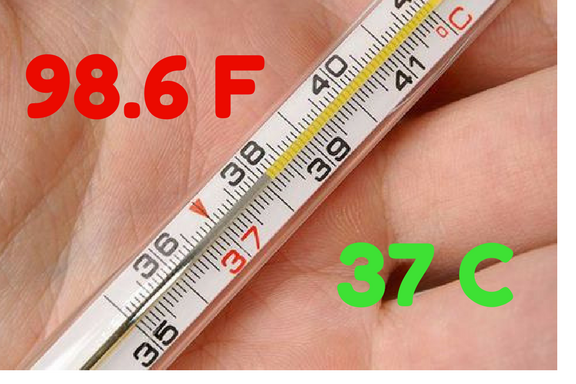
We as hypothyroid patients no matter the cause have found value in knowing our temps! This page is information that I hope helps you be more informed. ~Janie, site creator and hypothyroid patient
When you hear the phrase “Take your temperature”, you usually associate it with being sick and looking for a fever.
But your temperature can also be one of many clues of your metabolic health! And the latter can be negatively impacted when you are poorly treated for your hypothyroid state, whether due to an autoimmune cause like Hashimoto’s, or any non-autoimmune cause.
As a hypothyroid patient, taking your temperature can be an important aspect in three ways:
1) it can provide a “clue”, along with symptoms, in diagnosing your hypothyroidism
2) it can provide a “clue”, with the free T3, free T4, and RT3, in helping you find the right dose of T3 in your treatment.
3) it can provide a “clue”, with the saliva cortisol test, if you need to order the latter.
HOW DOES MY TEMPERATURE DIAGNOSE HYPOTHYROIDISM?
Generally, the average mid-afternoon temperature of an adult with a healthy thyroid and a healthy metabolism is at or close to 98.6 degrees Fahrenheit or 37.0 degrees Celsius. So if you take your mid-afternoon temp and find it much lower, you have been given a strong clue that you may be hypothyroid and/or undertreated (or your low cortisol is keeping you hypothyroid). And a few report their mid-afternoon temp being in the 96’s. BRRRR.
Another temperature clue occurs first thing in the morning before you raise from your bed. Dr. Broda Barnes, a doctor who paid attention to clinical presentation and prescribed the pre-reformulated Armour, found that a healthy before-rising morning basal temp should be between 97.8 – 98.2 (he used a mercury thermometer under the arm for ten minutes). If it’s higher, you may be hyperthyroid, and if it’s lower, you are most likely hypothyroid. If using an oral thermometer in the mouth and want to compare it to the way Broda Barnes did the underarm, leave in your mouth for five minutes, then subtract 1/2 degree from your result to make it closer to underarm temp taking — the latter which is usually lower.
WHAT ABOUT INFORMATION THAT IMPLIES WE ALL HAVE LOWER TEMPERATURES THAN IT USED TO BE?
A lot of optimally-treated hypothyroid patients are still seeing a mid-afternoon temperature close to or at 98.6. That implies that researchers are not understanding how prevalent hypothyroidism can be in the volunteers they are testing.
HOW DOES MY TEMPERATURE HELP ME WITH RAISING MY THYROID MEDS?
Once you have T3 in your treatment, whether a working natural desiccated thyroid, or T4/T3, or T3-only, and are consistently raising your doses, you will see your temps climb to healthy levels with increasing feel-good symptoms to match. We’re noted that In many patients, reaching the average temp around 98.6F/37C can happen before you are even on your optimal amount. NOTE: if you have problems raising T3 in your treatment, it’s always about what it’s revealing, not a problem with T3 itself. Read this.
HOW DOES MY TEMPERATURE TELL ME ABOUT MY ADRENALS??
Two ways: to discern a cortisol problem in the first place…and later if on Hydrocortisone (HC) or ACE (Adrenal Cortex), to find the right amount of either. NOTE: most people with low cortisol need the power of HC. ACE is weak.
For either, you take it three times a day–first, 3 hours after you wake up, then 3 hours after that, then 3 hours after that. Add them, divide by 3, and you get your first of five days of a Daily Average Temps, also called DATS (see the adrenal info page, Discovery Step Two, Test Four). If a few of those five daily averaged temps is more than .2F off from another (or .1C), that could be a sign that you have adrenal dysfunction, a common condition with hypothyroid patients. (Dr. Rind mentions .2 to .3F, but a lean towards .2 seems better)
But if you are using the DATS to find the right amount of HC or Cortex, you wait until you have been on either for five days, the start doing your DATS. The latter waiting period is true if you have raised HC or ACE. (Chapters 5 and 6 of the updated revision STTM book explains this in detail).
Dr. Rind has an excellent temperature graph you can use to understand temps.
WHAT KIND OF THERMOMETER SHOULD I USE?
Though Dr. Rind above doesn’t recommend the old-fashion oral mercury thermometers, we as thyroid patients have found them quite useful and more accurate as compared to most digital thermometers, which tend to be off up to a degree one direction or the other. Yes, some digitals are definitely better than others. But when in doubt, use your Mercury thermometer.
We as patients also found it important to leave it under our tongue long enough, i.e. five minutes minimum. Where to find a Mercury thermometer? Ebay, or an antique store. A second alternative: a Geratherm, which is a liquid non-mercury thermometer. May be more accurate than other digitals. Bulky.
P.S. Since the bulk of what’s related to STTM pertains to patient experience rather than “opinion”, we did some tests with both digitals and mercury, putting them in the same mouth at the same time, and repeated measurements. The mercury was consistent; the digital would frequently change.
WHAT ABOUT UNDER MY ARM?
Yes, this was done by Dr. Broda Barnes. He states to leave it there 10 minutes, and once you get a temp, add a minimum of half a degree to it. So if your underarm temp is 98.1, your bodily temp may actually be 98.6.
WHAT IF MY TEMPERATURE IS HIGH, YET I HAVE HYPOTHYROID SYMPTOMS?
We have discovered this to be a potential clue that there can be an antibodies attack on the thyroid, called Hashimoto’s Disease, making it wise to do the two antibodies tests to confirm or rule it out. Don’t let your doc just test one antibody against the thyroid! Do both! Or order you own here. P.S. You don’t necessarily have Hashi’s if the result is low.
High temperatures can also be the result of low iron, low aldosterone, and/or low estrogen. Your temp can also go up if you are producing excess adrenaline (which you might be able to notice by having palps, anxiety, shakiness, etc)
WHAT ABOUT MENSTRUATING OR OVULATING WOMEN?
Your internal body temperature can be very reactive to your female hormonal state, making it lower or higher than normal. So knowing what it going on within is important to evaluating a temperature. Check your temps before days 19 – 22 of your cycle, with the first counted day being the day you started your period.
DO TEMPS CHANGE AS ONE AGES?
Yes. They seem to lower. But that could be related to the slowing down of the thyroid in aging, and a potential need for thyroid treatment with T3 in our treatment.
WHAT DOES HAVING A LOW TEMPERATURE DO TO YOU?
Low body temp may create a ripe and friendly environment for pathogens like bacteria and viruses to grow. It can also make your enzymes less effective, since enzymes need the right temperature to do their job. The result is poorer detoxification via your liver.

MIDDLE: The classic updated revision STTM book, totally patient-to-patient
RIGHT: the patient-to-patient Hashimoto’s: Taming the Beast. A companion book to the middle one.
Important notes: All the information on this website is copyrighted. STTM is an information-only site based on what many patients worldwide have reported in their treatment and wisdom over the years. This is not to be taken as personal medical advice, nor to replace a relationship with your doctor. By reading this information-only website, you take full responsibility for what you choose to do with the information on STTM or its outcomes. See the Disclaimer and Terms of Use.