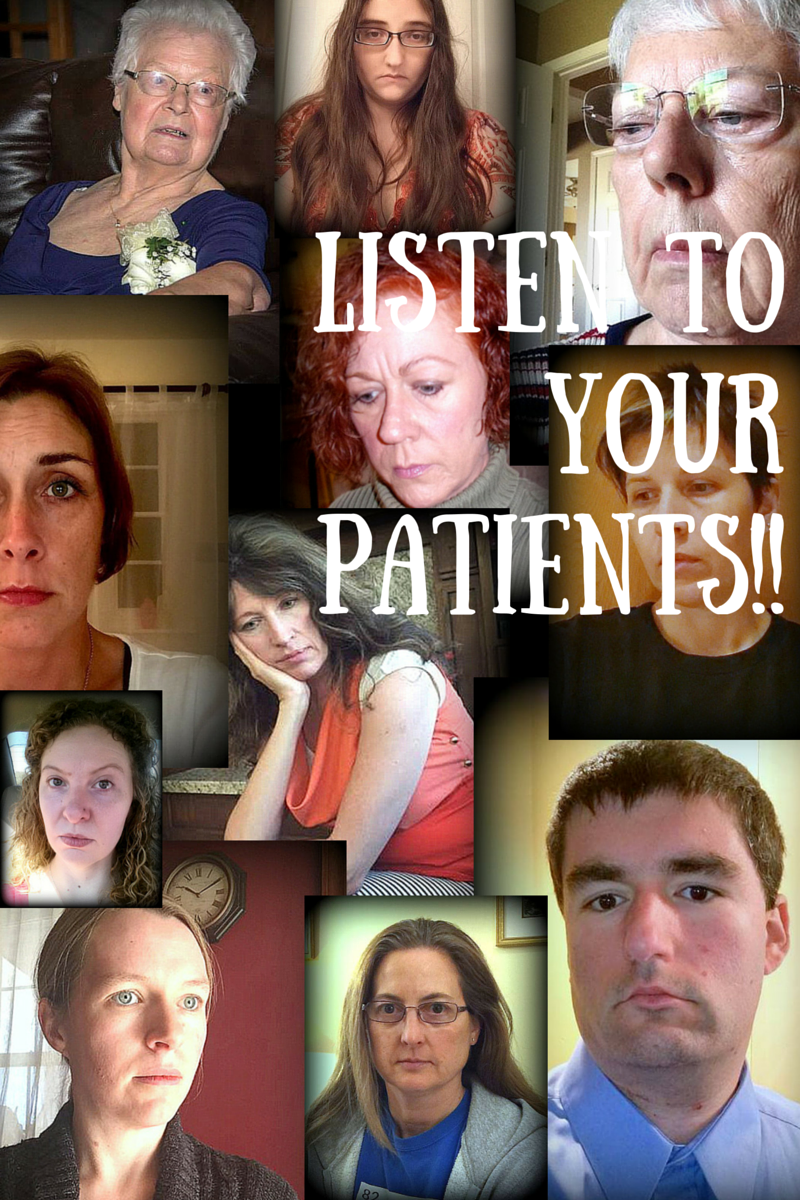


Find out more here!
Hide me

* You are viewing Posts Tagged ‘tsh’

The Good Housekeeping fiasco asks a huge question: when is the media going to catch up with the real world?

As informed thyroid patients, we’ve all been talking about it in patient groups, blog posts, and amongst each other.  About.com’s Mary Shomon did a good write up in her blog post, and you can see one of several different Facebook group conversations here as well as the article and our comments after it, here.

And if you haven’t caught up with it all yet, here is a summary of the extremely sad misinformation and implications contained in an article of the latest issue in the Good Housekeeping magazine:

  1. that the first step to diagnosing your potential hypothyroid problem is the use of the thyroid-stimulating hormone (TSH) lab test  (a test which informed patients worldwide exclaim has left them either undiagnosed for years or undertreated! http://www.stopthethyroidmadness.com/tsh-why-its-useless)
  2. that your TSH may only point to hypothyroidism if it comes back at 10 or higher (Hogwash!! say informed thyroid patients, who have been hypothyroid with a TSH in the two’s! See above.)
  3. that the only other tests you may need are the T4 and antibodies  (which informed patients have found is only PART of what you need, which needs to include the very important  free T3!  http://www.stopthethyroidmadness.com/recommended-labwork)
  4. that it’s worthy to quote a Dr. Daniels who states ”There’s no compelling evidence that medication helps patients whose TSH is in the 5.0 to 10.0 range,”  (exactly the kind of doctor which nearly all informed thyroid patients state has kept them repeatly sick for years!  http://www.stopthethyroidmadness.com/give-me-a-break )
  5. that if you have “other problems”, such as infertility or depression, your doctor might suggest medication (when, oh when, are doctors going to GET IT that depression and infertility are key symptoms of ongoing hypothyroidism!! http://www.stopthethyroidmadness.com/long-and-pathetic )
  6. that T4 meds like Synthroid are T4 hormone are the go-to medication (and are the very medications which have kept patients sick, disabled, or with problematic hypothyroid symptoms  for  over 50 years! http://www.stopthethyroidmadness.com/t4-only-meds-dont-work )
  7. that the “potency can vary” for desiccated thyroid…as if that’s a good reason to be concerned about its use  (potency is set in a predictable range and is made according to the strict guidance of  the United States Pharmacopeia , say the makers of desiccated thyroid, and desiccated thyroid has been changing lives ten fold for decades!  http://www.stopthethyroidmadness.com/natural-thyroid-101)
  8. And last but not least…that you need to be on-guard about online patient information (yet wise and repeated “patient experience” has changed not only patient lives, but the way open-minded doctors are practicing in their own offices!! http://www.stopthethyroidmadness.com/things-we-have-learned 

All the above, appearing in what we all thought would be considered a long-standing good magazine, only underscores the irresponsibility and ignorance of the media about REAL LIFE!! Who wants to subscribe to any magazine, or listen in seriousness to any news program, talk show, or internet website that allows this kind of DARK AGES BALONEY on its pages??  I don’t.

P.S. One particularly personal tragedy is the author of this article, Susan Carlton. She is clearly hypothyroid, yet completely duped by the pharmaceutically-brainwashed medical field which clings blindly to a poor medication and inadequate labwork.  She is ALL OF US LOOKING AT OURSELVES all those years when we believed in the doctors we went to and emptied our pocketbooks to try and find out why we had depression, infertility, rising cholesterol and blood pressure, linger aches and pains, poor stamina and fatigue, weight gain, hair loss, anxiety…and so many more symptoms of undiagnosed or undertreated hypothyroidism. 

And sadly, how many of us also thought that actions similar to “drinking more java (for energy)”, or “honing crossword skills (for focus)” or attending a “spinning class”  (for our weight gain) was going to help us!  They didn’t help at all. They just sent us closer to adrenal dysfunction and disability.

***********************************

If you could speak to the author, Susan Carlton, in kindness and wisdom, what would you say to help her get past the brainwashing she is a victim to, as you were??

If you could speak to Good Housekeeping and all media like Oprah, CNN, MSNBC, ABC, FOX, what would you say about the repeated misinformation?


  • Hip hip!! STTM has new products to help spread the word, here. Great BUMPER STICKERS, too, here. Spread the word--YOU may make a difference in someone’s life.
  • Check out the NEW REVISED patient-to-patient book with even more detail (and which doctors seem to respect more than websites).
  • Need to understand all your best options for thy­roid treat­ment? Go here.
  • Want to keep track of these "fringe website" blog posts? ;-) Curious what’s on Janie’s mind? Use the Blog Notification on the lower left of the links. or use an RSS Feed.

Why do some patients escape adrenal dysfunction?? I think I know why I did.

Anyone who has read my story of nearly 20 years of absolute misery on T4-only meds would think I’d be right in the thick of adrenal fatigue / HPA dysfunction and low cortisol.  Those were horrible, miserable, stressful, debilitating years.

Yet, I escaped it.

For awhile after I entered the thyroid patient activist field, I felt guilty. That was especially true as I saw how terribly people suffer with low cortisol.  But I also realized there was something potentially amazing to be discovered as to WHY I escaped it.

But years went by, and I have always been extremely busy as an activist: daily emails to take care of; constant updates to the website, keeping track of Yahoo and Facebook groups; thinking about and writing the blog; activities around the book, phone consultations, and so much more.  I have also fought to have an important private life.

So, it wasn’t until recently that I readdressed this question: why did I escape adrenal dysfunction? Was it genes which gave me strong adrenals?? That thought has drifted through my mind many times.  But I wasn’t sure. So recently, I took some time to really search my past to find answers. And something else really stood out.

Namely, because I had always been a fitness and health buff, I was big into supplements. Sure, I was unable to do hardly anything about fitness part of the equation–my T4-induced and crippling dysautonomia killed that.  But my belief in supplements never ended.   That was impressed into me by my mother who always stressed taking a vitamin pill as a child.  I also remember her putting my cigarette-smoking Dad on Vitamin C  in the 1970′s, having read it might delay his inevitable lung cancer. (It was too late.)

So when I became a young adult, married with little children, I learned even more about supplements, and took them. And one thing I remember always taking all those years as a young adult was high amounts of Vitamin C.  High amounts of Vitamin C!! That stood out to me.  And below are facts about Vitamin C and adrenals:

VITAMIN C and ADRENALS:

  1. “Of all the vitamins and minerals involved in adrenal metabolism, vitamin-C is probably the most important. It is essential to the adrenal hormone cascade and manufacture of adrenal steroid hormones.  It acts as an antioxidant within the adrenal cortex.” ~ www.bluemountainrx.com/adrenal.htm
  2. “While the adrenal glands need numerous nutrients to function normally, perhaps the most important of them all is vitamin C. The highest concentrations of vitamin C reside in the eyes, brain and adrenal glands. ~ http://www.adrenalfatiguefocus.org/adrenal-fatigue-and-vitamin-c.html
  3. “Healthy adrenal function requires vitamin C, and some of the highest concentrations of vitamin C in the whole body are found in the adrenal glands.” ~ http://www.naturalnews.com/029842_vitamin_C_adrenals.html
  4. “Vitamin C is utilized by the adrenal glands in the production of all of the adrenal hormones, most notably cortisol. When you are faced with a stressful situation, your vitamin C is rapidly used up in the production of cortisol and related stress-response hormones.” ~ http://www.adrenalfatiguerecovery.com/vitamin-c.html
  5. “The adrenal gland is among the organs with the highest concentration of vitamin C in the body. Interestingly, both the adrenal cortex and the medulla accumulate such high levels of ascorbate. Ascorbic acid is a cofactor required both in catecholamine biosynthesis and in adrenal steroidogenesis.” ~ http://www.ncbi.nlm.nih.gov/pubmed/15666839

There is much more on the net than the above, as well. And in fact, the important relationship between Vitamin C and your adrenals was proposed in 1951. This was huge, to me, as to why I may have escaped adrenal dysfunction. Even the use of B-vitamins and magnesium are important, tho I don’t remember what I was taking of those.

ANOTHER CLUE: I had a conversation with a gal recently. Like me, she suffered a long time, yet did not fall into adrenal fatique. I asked her why she felt she escaped it. She explained that she had worked for a naturopath for many years, and thus, took many supplements, including high dose Vitamin C. I was dumbfounded.

MY CONCLUSION: Whether I have found the irrefutable reason as to why I didn’t fall into adrenal fatigue and low cortisol may not be answered inconclusively. And who knows if some of us just have genetically strong adrenals.  But I lean to believe that my early use of high-dose Vitamin C all those miserable years may have been a huge factor, along with B-vitamins which can also be depleted. Today, I take a minimum of 2350 mg daily via my buffered C powder, and in water, and usually double that amount, as I like taking it before bedtime for the magnesium.  I am also a fanatic about adding squeezed lemon to my water or occasional fluoride-laden iced tea.

WHAT THIS MEANS FOR YOU: Adrenal patient experience has shown that once your adrenals or HPA function drops, as does your cortisol, the use of hydrocortisone is usually the best way to treat it.  See the adrenals page here.  And patients have learned in leaps and bounds on how to use HC with their open-minded doctors (…if they can even find a doctor who looks beyond his dogmatic training.  It’s not easy.)  But the use of high dose Vitamin C might not be something you want to ignore, whether you have to use HC or not:

  1. “Sufferers of adrenal fatigue are hit particularly hard by vitamin C deficiency. The production of cortisol and other adrenal hormones, characteristically low in this disorder, is dependent on an ongoing supply of vitamin C. If this supply dwindles, so too does the secretion of adrenal hormones. This feeble response from the adrenal glands places the body under further stress, further increasing demand for the vitamin C. The importance of intervention with the appropriate amounts of this nutrient should not be overlooked.”   ~ http://www.adrenalfatiguefocus.org/adrenal-fatigue-and-vitamin-c.html
  2. Have you heard of Scurvy? This is a progressive disease from the  deficiency of vitamin C that ultimately leads to death.  And Linus Pauling wrote in his 1979 book, Biomolecular Sciences,  that death from Scurvy is actually “adrenalcortical failure”. That is profound as to the importance of Vitamin C with YOUR adrenal health and/or recovery.
  3. “In two separate studies about vitamin C supplementation (1,000–1,500 mg per day for one week), ultramarathon runners showed a 30 percent lower cortisol level in their blood when compared to runners receiving a placebo. In another study of healthy children undergoing treatment with synthetic corticosteroids, 1 gram (1,000 mg) of vitamin C, consumed three times a day for five days, resulted in significantly lower cortisol levels compared to healthy children given a placebo. In a study of lung-cancer patients, a dose of 2 grams of vitamin C, given daily for one week prior to surgery, was able to bring elevated cortisol levels (resulting from the surgery) back to normal ranges in a significantly shorter period of time compared to patients receiving a placebo. ~ http://cortisolconnection.com/ch8_3.php

What about you? If you escaped adrenal dysfunction while going through years of misery on T4-only meds, or being held hostage to the lousy TSH lab result, why do YOU think you escaped it?

************************

* IODINE: Finally, I have updated the iodine page on STTM–long overdue.  Thanks to VRP for pointing out that their links have changed.  You can read many different links about iodine, the controversies and more, and decide for yourself what is right for you.

* FINDING A  BETTER DOCTOR: Want to try to find a better doc that the vast majority of cows…oops, doctors? Go here.

* TALK TO OTHERS: Talking to other patients is what started me on new path years ago. You can too, here. Scroll down to view them all.


  • Hip hip!! STTM has new products to help spread the word, here. Great BUMPER STICKERS, too, here. Spread the word--YOU may make a difference in someone’s life.
  • Check out the NEW REVISED patient-to-patient book with even more detail (and which doctors seem to respect more than websites).
  • Need to understand all your best options for thy­roid treat­ment? Go here.
  • Want to keep track of these "fringe website" blog posts? ;-) Curious what’s on Janie’s mind? Use the Blog Notification on the lower left of the links. or use an RSS Feed.

How does your insurance deal with desiccated thyroid? Here’s Wendy’s story with Armour.

Wendy is one of those gals that tries to adhere to “natural” in regards to her medication choices. She switched over to Armour from Synthroid about three months ago.

The transition was slightly trying, says Wendy. Her doc didn’t believe her that she shouldn’t be on a low dose for more than a couple weeks without upping it. So she  went hypo all over again. (See why here.)

But after successfully upping the dose, she will now shout that it’s been the BEST thing  in every way!  She tells folks that being on Synthroid was like having your hand amputated and replaced with a hook, while being on Armour was like have it replaced with a fully functional prosthetic.  Her skin is softer, hair is not shedding nearly as much, her mood has changed in a good way, memory has returned, fogginess has faded. She feels closer to her old self than she has in almost give years.

Now the bad news…

All this time, she only paid $15 for her Armour at the local Walgreen’s. But as of April 1st, it will be considered a Tier 3 drug under her insurance plan–United Healthcare.  Exclaims Wendy in outrage and sadness:  “This means that the natural drug I love, that has restored my in so many ways that the synthetic t4 only drugs never could, will now cost 85 bucks! Who can afford that?!

And here’s the awful irony: Synthroid, the worst medication ever thrust upon us in the treatment of hypothyroid, is Tier 2 (i.e. costs less), and generic T4-only is Tier 1 (costs even less).  i.e. if you are under this insurance, you have to pay big bucks to feel a thousand times better.  She has no clue why this is happening, but warns that it might start to happen across the board for others as well!

Here’s what happened: most insurance companies classify drugs under Tiers.  Tier 1 is generally generics.  And since the Acella “generic” brand of desiccated thyroid entered the market last November, her insurance company decided Armour is now a brand name, thus under Tier 3 and now $85 for Wendy. Seems a bit greedy when it could have risen to Tier 2….

But here is potentially good news for some of you. There is a bill to stop the Tier expense. You can read about it here. Unfortunately, tho, it “will not impact self-funded health plans which cover about half of all employees with health insurance. Federal legislation is needed to change that.”

Does your health insurance cover your desiccated thyroid?

***************************************

Canadian Pharmacy price updates for Erfa: See the latest prices here.

How medical journals affect the prescription practice of your doctor: An interesting article on this found here. And here’s an article about how the author of a medical article fails to state his association with the pharmaceutical of the product he is writing about–one more conflict of interest and influence on your doctor!

Ridiculous! Basing “normal” for Hashimotos patients by the TSH, a pituitary hormone, NOT a thyroid hormone: Read it here and weep.

Vit. D can help you stay sharp: So many benefits from optimizing your Vit D, and here’s one with your brain.

Need to talk to others? See all your alternatives here.


  • Hip hip!! STTM has new products to help spread the word, here. Great BUMPER STICKERS, too, here. Spread the word--YOU may make a difference in someone’s life.
  • Check out the NEW REVISED patient-to-patient book with even more detail (and which doctors seem to respect more than websites).
  • Need to understand all your best options for thy­roid treat­ment? Go here.
  • Want to keep track of these "fringe website" blog posts? ;-) Curious what’s on Janie’s mind? Use the Blog Notification on the lower left of the links. or use an RSS Feed.

Thyroid Tidbits that just might tickle your fancy, give you hope, or make you laugh in derision

A GOOD REPORT ON THIS OVER-THE-COUNTER THYROID SUPPORT

A gal recently used the Contact Me form on STTM to ask if I’d ever compiled patient experiences on ThyroGold–a nonprescription, over the counter, desiccated thyroid formulated by Dr. John C. Lowe and made from the thyroids of New Zealand cows who are pasture-fed. I said no–haven’t heard yet from anyone on it long enough.

But just thirty minutes later, here comes an email from a gal who has been on it four months, feels very good with many noted improvements. She is so thankful, and stated STTM gave her the confidence to feel she could work with ThyroGold. And lo and behold, her TSH-worshipping, Synthroid-prescribing doctor is watching her progress, and pleased.

COCONUT OIL AND ALZHEIMERS

Many a thyroid patient have heard of the benefits of coconut oil, especially as a food product which can stimulate your metabolism.

But a Dr. Mary Newport discovered in 2008 that just 4 teaspoons a day of virgin coconut oil just might have the right ingredients–medium-chain triglycerides which produces ketones by the live–to stop the onset or even reverse some of the damage caused by Alzheimer’s.  She witnessed this in her own husband. You should read her story here, and more on the Coconut Ketones website here.  Since my mother, and her father, both got Alzheimers by the time they were eighty, this especially interests me!

In fact, coconut oil just night have the same successful results with Parkinson’s disease, Huntington’s disease, multiple sclerosis and amyotrophic lateral sclerosis (ALS or Lou Gehrig’s disease), drug-resistant epilepsy, brittle type I diabetes, and type II (insulin-resistant) diabetes. WHOA!!

Says Dr. Newport:

Our cells can use ketone bodies as an alternative fuel when glucose is not available. Brain cells, specifically neurons, are very limited, more limited than other cells, in what kinds of fuel they can use to function and to stay alive. Normally, they require glucose (sugar), but they can also use ketone bodies. Humans do not normally have ketone bodies circulating and available to the brain unless they have been starving for a couple of days or longer, or are consuming a ketogenic (very low carbohydrate) diet, such as Atkins. In Alzheimer’s disease, the neurons in certain areas of the brain are unable to take in glucose due to insulin resistance and slowly die off, a process that appears to happen one or more decades before the symptoms become apparent. If these cells had access to ketone bodies, they could potentially stay alive and continue to function.

P.S. Did you see the “one or more decades before symptoms become apparent”? That means we need to be on coconut oil daily NOW,

ARE ENDOCRINOLOGISTS FROM ANOTHER PLANET?

A patient on STTM’s Facebook page recently reported that since her HMO would only allow her to see an Endocrinologist, off she went to the appointment.

And what does her new Endo tell her? Ready? That her TSH was fine, low T3 & T4 meant nothing, and there is NO evidence that Adrenal Fatigue is real (in spite of the fact that when she tries to raise her Armour, her heart goes wacky–a sure sign of low cortisol). She concluded that there is “nothing like being lectured on things when you know more than they do.” She felt forced to keep her mouth shut by his reactions if she did try to teach him something, and just resigned to “agreeing with everything he said and left”.

And her summary of that Endo escapade? “My dose of Armour is right, makes no difference I’m fatigued, had to quit my job, leg swelling so bad I can hardly get around. None of that mattered. ONLY the TSH test.”

And unfortunately, her comment about knowing more than the doctor is very, very common now thanks to STTM and patient groups. All we can hope for are those doctors who are humble and open-minded to what we now KNOW to be true!

TWO OF THE MOST IMPORTANT CHAPTERS IN THE STTM BOOK

Chapters 3 and 11

REMEMBER ME MENTIONING THE GAL WHO PUT THE STTM BUMPER STICKER ON HER HUSBAND’S CAR?

Well, he got followed into the Barber Shop this time by a male nurse! So now, he wants something to hand out to these folks who keep approaching him. haha. So she has made copies of the STTM FLYERS and he’ll have them in the car from now on. This is reaching people…one by one!


  • Hip hip!! STTM has new products to help spread the word, here. Great BUMPER STICKERS, too, here. Spread the word--YOU may make a difference in someone’s life.
  • Check out the NEW REVISED patient-to-patient book with even more detail (and which doctors seem to respect more than websites).
  • Need to understand all your best options for thy­roid treat­ment? Go here.
  • Want to keep track of these "fringe website" blog posts? ;-) Curious what’s on Janie’s mind? Use the Blog Notification on the lower left of the links. or use an RSS Feed.

As a hypothyroid patient, you might want to think twice about drinking water out of plastic bottles

As a hypothyroid patient, think you are fine drinking that purely fine mineral water from a plastic bottle? Think that fluoride and chlorine are the only substances we need to worry about when it comes to our thyroid health?? Think again.

Thyroid patient Amy McMullen, who has contributed before on STTM’s blog as a GUEST POSTER (Confessions of a Undercover Thyroid Advocate) and has a passion about human rights, has written another important article below which should be of keen interest to all of you.

BPA—A POWERFUL ENDOCRINE DISRUPTER THAT AFFECTS YOUR THYROID

Perhaps you have read recently about how the chemical Bisphenol A (BPA) is found to be prevalent in our food and water. As a hypothyroid patient, I was surprised to see that not all articles about this harmful substance adequately describe the connection between thyroid function and BPA. This is an oversight that should be addressed since hypothyroidism is estimated to affect over ten million people in the US and this number is growing. It makes perfect sense to look to environmental toxins as a likely culprit in this serious health epidemic.

BPA is a synthetic estrogen and an endocrine disrupter that causes multiple health problems. There are over 200 studies linking it to breast cancer, obesity, attention deficit disorder, early puberty in girls, genital abnormalities in boys and girls alike, polycystic ovary disease and infertility in women and prostate cancer in men. Studies indicate that up to 92% of Americans have BPA in their urine. Also BPA doesn’t leave the body quickly; fasting adults still had BPA levels in their bodies after 24 hours.

BPA comes from many plastic sources. It’s used as a hardener in plastic manufacturing. Many tin cans have plastic linings that contain BPA including soup and tomatoes, and it’s also in plastic water bottles, some infant formulas and canned juices. BPA is also found in PVC water supply piping.

How does BPA relate to thyroid disease? According to a several good studies, BPA is a thyroid receptor antagonist. This means that BPA will interfere with the binding of the thyroid hormone T3 with cell receptor sites. This will cause hypothyroidism, not only with people with under-functioning thyroids but also for those who are currently taking medications for hypothyroidism or even those who have normally functioning thyroids. BPA was found to accumulate in many organs when injected into rats including the lung, kidneys, thyroid, stomach, heart, spleen, testes, liver, and brain. In this way, BPA has the potential to interfere with thyroid hormones in each organ that has accumulated the substance. A study also indicates that the levels of BPA that are considered safe (upper limit of emission is set to 2.5 ppm [µg/liter], which is more than 90 µM) are high enough to inhibit thyroid hormone receptors. Yet another study shows that BPA appears to accumulate in rat fetuses in significantly high levels and disrupts thyroid function in baby rats.

There’s also evidence that BPA may influence the metabolism of endogenous steroids, which may be a factor in adrenal fatigue and its treatment, as well as and its treatment, as well as dysautonomia stemming from adrenal problems. Many with hypothyroidism also suffer from co-morbid adrenal fatigue and BPA may be a contributing factor in this.

What this means for everyone, but especially for thyroid patients, is every effort should be made to remove BPA from food and water supplies. For those who are not able to get properly optimized on their thyroid meds or who are finding they are suffering from hypothyroid symptoms despite normal levels of TSH, free T3 and free T4, consider BPA as a possible source of the problem.

Steps you can take to minimize you exposure include:

  • Avoid all canned foods with plastic liners and avoid bottled water. Buy your canned tomatoes in glass jars, not metal cans or stick to using fresh ingredients. Most other canned foods use BPA as well, especially green beans (Here is a list of BPA-free canned foods).
  • Drink water out of glass or stainless steel containers (and make sure there’s no plastic liner or lids that have BPA) or BPA-free plastic. Low density polyethylene bike bottles contain BPA.
  • Do not microwave foods in plastics or use plastic wraps when microwaving. Avoid polycarbonate (“PC” or #7 and #3) plastic food containers altogether.
  • Since most municipal water piping is PVC and some houses have it as water supply lines, consider installing a reverse osmosis system for your drinking water. This will also remove fluoride and chlorine (other thyroid disrupters) and many other harmful substances from drinking water.

Most importantly we need to make our voices heard that BPA is not an acceptable substance and that its use in our food and water supply must cease. Recently Senator Feinstein introduced a ban on BPA to the Food Safety Modernization Act but this was modified to remove the ban due to pressure by industry groups. Senator Feinstein still has an effort underway to ban BPA from child drink bottles and toys and several states have enacted such bans but this does not go far enough.

Contact your representatives today and let them know that a national ban on BPA must be enacted. If they don’t listen then I suggest you make yourself heard at the ballot box this November.

************************************************

  • Have you cut down on your exposure to Fluoride? Buy non-fluoridated toothpaste as a first step.
  • Cut down on more chemicals by using baking soda under your arms rather than commercially-made underarm deodorants. Note that the baking soda may at first cause redness, but it will go away within days and is a great way to kill odors.
  • Have a pounding heartrate that you can’t explain? You may be making too much RT3.
  • Check out typical Questions and Answers about thyroid treatment and related issues.
  • Want to write a GUEST BLOG POST on STTM? Go here.

  • Hip hip!! STTM has new products to help spread the word, here. Great BUMPER STICKERS, too, here. Spread the word--YOU may make a difference in someone’s life.
  • Check out the NEW REVISED patient-to-patient book with even more detail (and which doctors seem to respect more than websites).
  • Need to understand all your best options for thy­roid treat­ment? Go here.
  • Want to keep track of these "fringe website" blog posts? ;-) Curious what’s on Janie’s mind? Use the Blog Notification on the lower left of the links. or use an RSS Feed.